has exactly four solutions and state these solutions. [7 marks]
(b)
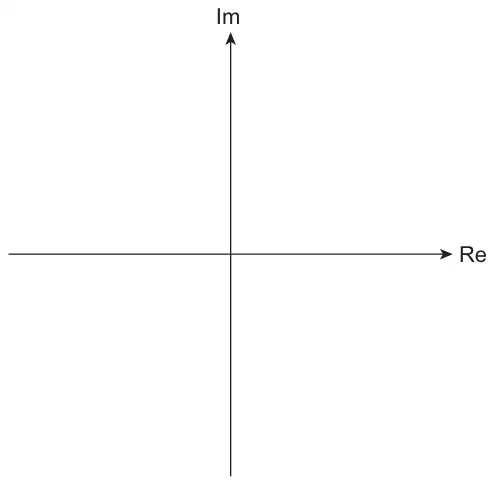
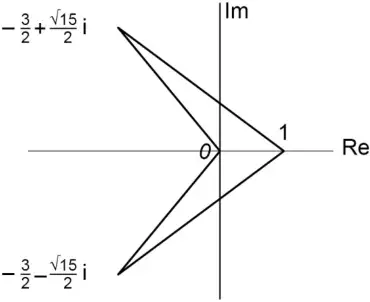
(i) Plot the four solutions to the equation in part (a) on the Argand diagram below and join them together to form a quadrilateral with one line of symmetry. [2 marks]
(ii) Show that the area of this quadrilateral is \(\dfrac{\sqrt{15}}{2}\) square units. [1 mark]
Mark scheme (a)
Scheme
Marks
AO
Defines \(z\) and \(z^*\) in terms of two variables for example \(x\) and \(y\)
M1
1.1a
Obtains correct expressions for \((2z - z^*)^*\) and \(z^2\)
A1
1.1b
Uses their expressions for \((2z - z^*)^*\) and \(z^2\) to form a pair of simultaneous equations
M1
3.1a
Deduces that the second equation implies the result “\(y = 0\) or \(x = -\dfrac{3}{2}\)”
A1
2.2a
Deduces that \(y = 0\) Implies the result “\(x = 0\) or 1” PI \(z = 0\) and \(z = 1\)
A1
2.2a
Obtains any two correct solutions in the form \(z = \cdots\)
A1
1.1b
Produces a clear argument to conclude that there are exactly four solutions stating them in the form \(z = \cdots\)
R1
2.1
(7)
Typical solution
Let \(z = x + \mathrm{i}y\) then \(z^* = x - \mathrm{i}y\)