
A2 June 2022 Paper 2 Q13
13
Show that \(\mathbf{A} = \left(\dfrac{1}{m^2 + 1}\right)\begin{bmatrix} 1 - m^2 & 2m \\ 2m & m^2 - 1 \end{bmatrix}\)
You may use the result in the formulae booklet. [5 marks]
Show that \((\mathbf{BA})^2 = k\mathbf{I}\)
where \(\mathbf{I}\) is the \(2 \times 2\) identity matrix and \(k\) is an integer. [3 marks]
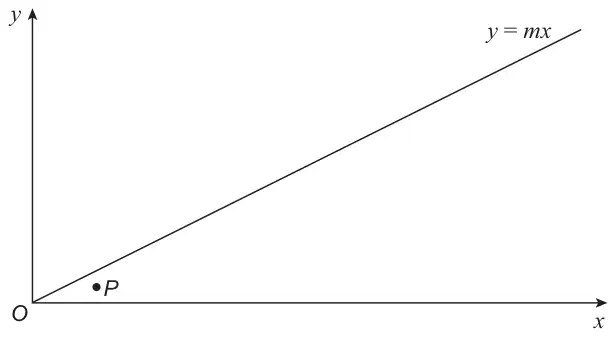
Draw four lines on the diagram to demonstrate the result proved in part (b).
Label as \(P^{\prime}\) the image of \(P\) under the transformation represented by \((\mathbf{BA})^2\) [2 marks]
Find the value of \(m\) such that \(\mathbf{C} = \mathbf{BA}\)
Fully justify your answer. [4 marks]
| Scheme | Marks | AO |
|---|---|---|
| States that \(m = \tan\theta\) and \(\mathbf{A} = \begin{bmatrix} \cos 2\theta & \sin 2\theta \\ \sin 2\theta & -\cos 2\theta \end{bmatrix}\) Condone omission of A= | B1 | 1.2 |
| Replaces \(\sin 2\theta\) and \(\cos 2\theta\) in the matrix with expressions in terms of trigonometric ratios of \(\theta\) or in terms of \(m\) | M1 | 3.1a |
| Deduces that one element of the matrix can be expressed as \(\cos^2\theta(1 - \tan^2\theta)\) or \(\cos^2\theta(1 - m^2)\) or \(2\tan\theta(\cos^2\theta)\) or \(2m\cos^2\theta\) or uses \(\cos 2\theta = \dfrac{1 - m^2}{1 + m^2}\) or \(\sin 2\theta = \dfrac{2m}{1 + m^2}\) | M1 | 2.2a |
| Uses \(\cos^2\theta = \dfrac{1}{m^2 + 1}\) | M1 | 1.1a |
| Completes a reasoned argument to obtain the required result Must include A=… | R1 | 2.1 |
| (5) |
Typical solution
\[\mathbf{A} = \begin{bmatrix} \cos 2\theta & \sin 2\theta \\ \sin 2\theta & -\cos 2\theta \end{bmatrix} \quad \text{where } \tan\theta = m\]\[\begin{aligned}\mathbf{A} &= \begin{bmatrix} \cos^2\theta - \sin^2\theta & 2\sin\theta\cos\theta \\ 2\sin\theta\cos\theta & \sin^2\theta - \cos^2\theta \end{bmatrix} \\ &= \cos^2\theta\begin{bmatrix} 1 - \tan^2\theta & 2\tan\theta \\ 2\tan\theta & \tan^2\theta - 1 \end{bmatrix} \\ &= \frac{1}{\sec^2\theta}\begin{bmatrix} 1 - m^2 & 2m \\ 2m & m^2 - 1 \end{bmatrix} \\ &= \frac{1}{\tan^2\theta + 1}\begin{bmatrix} 1 - m^2 & 2m \\ 2m & m^2 - 1 \end{bmatrix} \\ &= \left(\dfrac{1}{m^2 + 1}\right)\begin{bmatrix} 1 - m^2 & 2m \\ 2m & m^2 - 1 \end{bmatrix}\end{aligned}\]| Scheme | Marks | AO |
|---|---|---|
| Obtains BA (condone AB) or Uses the fact that B = 3I | M1 | 1.1a |
| Squares their BA or AB or 3IA and simplifies | M1 | 1.1a |
| Completes a reasoned argument to show the required result, using BA not AB or Uses and states the fact that \(\mathbf{A}^2 = \mathbf{I}\) because it is a reflection Condone missing \((\mathbf{BA})^2 =\) | R1 | 2.1 |
| (3) |
Typical solution
\[\begin{aligned}\mathbf{BA} &= \left(\dfrac{1}{m^2 + 1}\right)\begin{bmatrix} 3 & 0 \\ 0 & 3 \end{bmatrix}\begin{bmatrix} 1 - m^2 & 2m \\ 2m & m^2 - 1 \end{bmatrix} \\ &= \left(\dfrac{1}{m^2 + 1}\right)\begin{bmatrix} 3(1 - m^2) & 6m \\ 6m & 3(m^2 - 1) \end{bmatrix}\end{aligned}\]\[\begin{aligned}(\mathbf{BA})^2 &= \left(\dfrac{1}{m^2 + 1}\right)^2\begin{bmatrix} 3(1 - m^2) & 6m \\ 6m & 3(m^2 - 1) \end{bmatrix}\begin{bmatrix} 3(1 - m^2) & 6m \\ 6m & 3(m^2 - 1) \end{bmatrix} \\ &= \left(\dfrac{1}{m^2 + 1}\right)^2\begin{bmatrix} 9(1 - m^2)^2 + 36m^2 & 0 \\ 0 & 36m^2 + 9(m^2 - 1)^2 \end{bmatrix} \\ &= \left(\dfrac{1}{m^2 + 1}\right)^2\begin{bmatrix} 9 + 18m^2 + 9m^4 & 0 \\ 0 & 9 + 18m^2 + 9m^4 \end{bmatrix} \\ &= \begin{bmatrix} 9 & 0 \\ 0 & 9 \end{bmatrix} \\ &= 9\mathbf{I}\end{aligned}\]| Scheme | Marks | AO |
|---|---|---|
| (i) Uses the fact that B represents an enlargement, scale factor 3 or that A represents a reflection in \(y = mx\) | M1 | 1.2 |
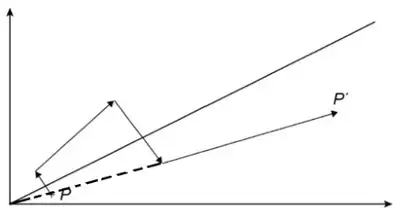
| Draws four correct lines on the diagram (the arrows and the dashed line are not needed), and labels \(P^{\prime}\) Condone A and B reversed | A1 | 1.1b |
| (2) | ||
| (ii) Explains how at least one of their lines represents a relevant transformation. | E1 | 2.4 |
| Explains how their lines represent the result of the transformations. | E1 | 2.4 |
| (2) |
Typical solution
(i)
(ii)
The lines on the diagram show the effect of A, then B, then A again, then B again, on the point \(P\).
The end point is the result of transforming \(P\) by an enlargement of scale factor 9.
Centre of enlargement \(O\)
| Scheme | Marks | AO |
|---|---|---|
| Expresses BA correctly in terms of \(m\) or calculates \(\mathbf{B}^{-1}\mathbf{C}\) correctly | B1 | 1.1b |
| Sets up an equation in \(m\) | M1 | 3.1a |
| Finds a correct solution of their correct equation in \(m\) (condone other solution(s) not rejected) | A1 | 1.1b |
| Uses a rigorous argument to obtain the required result, including clear reason for choosing \(m = \dfrac{1}{3}\) | R1 | 2.1 |
| (4) | ||
| (16 marks) |
Typical solution
\(\mathbf{C} = \mathbf{BA}\)
\[\begin{bmatrix} \dfrac{12}{5} & \dfrac{9}{5} \\[6pt] \dfrac{9}{5} & -\dfrac{12}{5} \end{bmatrix} = \left(\dfrac{1}{m^2 + 1}\right)\begin{bmatrix} 3(1 - m^2) & 6m \\ 6m & 3(m^2 - 1) \end{bmatrix}\]\[\frac{9}{5} = \frac{6m}{m^2 + 1}\]\[3m^2 - 10m + 3 = 0\]\[m = 3 \text{ or } m = \frac{1}{3}\]\(m = 3\) gives \(\dfrac{3(1 - m^2)}{m^2 + 1} = -\dfrac{12}{5} \neq \dfrac{12}{5}\)
so discard \(m = 3\)
Correct value is \(m = \dfrac{1}{3}\)