
A2 June 2022 Paper 2 Q12
12 The shaded region shown in the diagram below is bounded by the \(x\)-axis, the curve \(y = \mathrm{f}(x)\), and the lines \(x = a\) and \(x = b\)
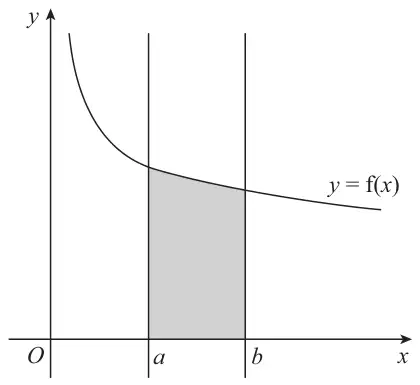
The shaded region is rotated through \(2\pi\) radians about the \(x\)-axis to form a solid.
(a) Show that the volume of this solid is\[\pi\int_a^b (\mathrm{f}(x))^2\,\mathrm{d}x\] [4 marks]
(b) In the case where \(a = 1\), \(b = 2\) and\[\mathrm{f}(x) = \frac{x + 3}{(x + 1)\sqrt{x}}\]
show that the volume of the solid is
\[\pi\left(\ln\left(\frac{2^m}{3^n}\right) - \frac{2}{3}\right)\]where \(m\) and \(n\) are integers. [7 marks]
| Scheme | Marks | AO |
|---|---|---|
| Draws or describes thin strip(s) under graph – may fit curve exactly or may be rectangular | B1 | 3.1a |
| Obtains expression for (approximate) volume of a thin disc. Condone expression for volume of a cylinder of radius \(y\) or \(\mathrm{f}(x)\) and of any height | M1 | 2.4 |
| Obtains expression for (approximate) total volume of discs | A1 | 2.4 |
| Completes a correct argument to show the required result, including taking the limit as \(\delta x \to 0\) | R1 | 2.1 |
| (4) |
Typical solution
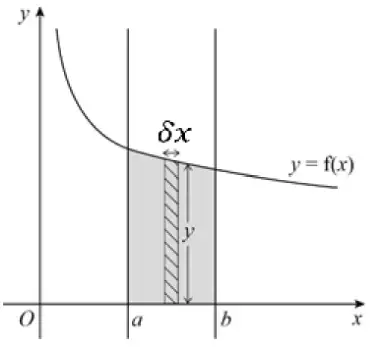
When a strip is rotated it forms a disc which is approximately cylindrical.
If thickness of disc is \(\delta x\) then volume of the disc is (approximately)
\[\pi y^2\delta x\]Total volume of discs is
\[\sum_{x=a}^{b} \pi y^2\delta x\]Volume of solid
\[\begin{aligned}&= \lim_{\delta x \to 0}\left(\sum_{x=a}^{b} \pi y^2\delta x\right) \\ &= \pi\int_a^b y^2\,\mathrm{d}x \\ &= \pi\int_a^b (\mathrm{f}(x))^2\,\mathrm{d}x\end{aligned}\]| Scheme | Marks | AO |
|---|---|---|
| Obtains \(\dfrac{(x + 3)^2}{x(x + 1)^2}\) | B1 | 1.1b |
| Expresses \((\mathrm{f}(x))^2\) as partial fractions in correct format | M1 | 3.1a |
| Obtains correct expression in partial fractions | A1 | 1.1b |
| Integrates expression to obtain two logarithmic terms and one algebraic fraction. Condone missing \(\pi\) | M1 | 1.1a |
| Obtains correct result of integration. Follow through their numerators Condone missing \(\pi\) | A1F | 1.1b |
| Substitutes limits into their three-term integrated expression for the volume. Must include \(\pi\) | M1 | 1.1a |
| Completes a reasoned argument to show the required result, including correct re-arrangement of log terms | R1 | 2.1 |
| (7) | ||
| (11 marks) |
Typical solution
\[(\mathrm{f}(x))^2 = \frac{(x + 3)^2}{x(x + 1)^2}\]\[\frac{(x + 3)^2}{x(x + 1)^2} \equiv \frac{A}{x} + \frac{B}{x + 1} + \frac{C}{(x + 1)^2}\]\[x^2 + 6x + 9 = A(x + 1)^2 + Bx(x + 1) + Cx\]\[x = 0 \Rightarrow A = 9\]\[x = -1 \Rightarrow C = -4\]Compare \(x^2\)-coeff: \(B = -8\)
\[\frac{(x + 3)^2}{x(x + 1)^2} \equiv \frac{9}{x} - \frac{8}{x + 1} - \frac{4}{(x + 1)^2}\]\[V = \pi\int_1^2 \frac{(x + 3)^2}{x(x + 1)^2}\,\mathrm{d}x\]\[\begin{aligned}V &= \pi\int_1^2 \left(\frac{9}{x} - \frac{8}{x + 1} - \frac{4}{(x + 1)^2}\right)\mathrm{d}x \\ &= \pi\left[9\ln x - 8\ln(x + 1) + \frac{4}{x + 1}\right]_1^2 \\ &= \pi\left\{\left(9\ln 2 - 8\ln 3 + \frac{4}{3}\right) - \left(9\ln 1 - 8\ln 2 + \frac{4}{2}\right)\right\} \\ &= \pi\left(17\ln 2 - 8\ln 3 - \frac{2}{3}\right) \\ &= \pi\left(\ln\left(\frac{2^{17}}{3^8}\right) - \frac{2}{3}\right)\end{aligned}\]