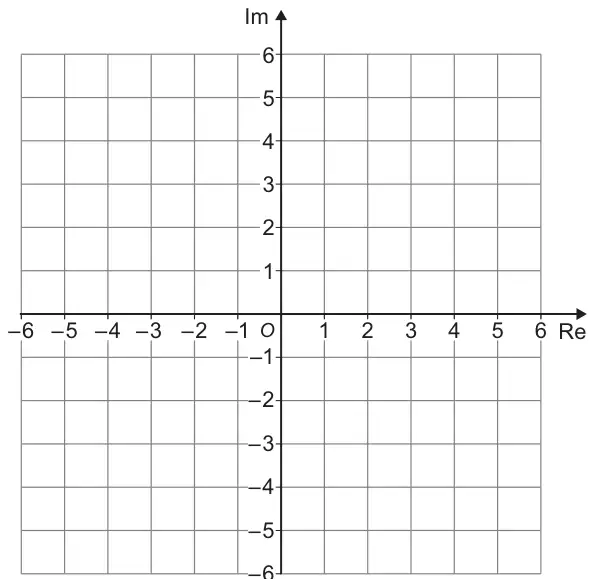
Sketch the region \(R\) on the Argand diagram below. [4 marks]
(c) \(z_1\) is the point in \(R\) at which \(|z|\) is minimum.
(i) Calculate the exact value of \(|z_1|\) [3 marks]
(ii) Express \(z_1\) in the form \(a + \mathrm{i}b\), where \(a\) and \(b\) are real. [2 marks]
Mark scheme (a)
Scheme
Marks
AO
Deduces correct gradient or intercept PI
M1
2.2a
Obtains correct equation with \(y\) as the subject
A1
1.1b
(2)
Typical solution
Gradient = \(\dfrac{1}{2}\)
Line passes through \((0, -2)\)
\[y = \frac{1}{2}x - 2\]
Mark scheme (b)
Scheme
Marks
AO
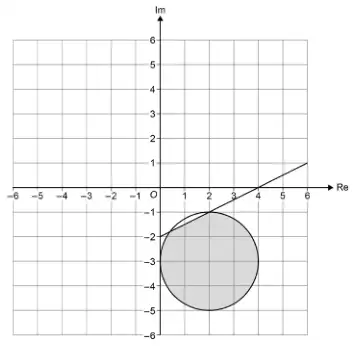
Draws a half line from \(-2\mathrm{i}\) passing through 4. Condone full line ft their linear equation in part (a)
B1F
1.1b
Draws circle or arc of a circle, with centre at \(2 - 3\mathrm{i}\) or radius 2
M1
2.2a
Draws circle or arc of a circle, centre at \(2 - 3\mathrm{i}\) and radius 2
A1
1.1b
Correct region indicated
A1
2.2a
(4)
Typical solution
Mark scheme (c)
Scheme
Marks
AO
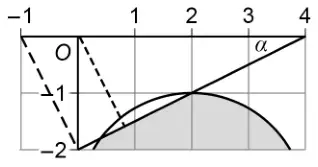
(i) Identifies the point in their region nearest to the origin. For example draws the perpendicular from the half-line to the origin or Finds \(y = -2x\)
B1F
3.1a
Finds the distance between their valid point and the origin For example uses \(\sin\left(\tan^{-1}\frac{1}{2}\right)\) or Finds the distance between the origin and the point of intersection of the lines \(y = \frac{1}{2}x - 2\) and \(y = -2x\)
M1
3.1a
Obtains correct exact value of \(|z_1|\)
A1
1.1b
(3)
(ii) Uses their values from part (c)(i) to obtain value of \(a\) or \(b\)