
A2 June 2020 Paper 2 Q14
14 The diagram shows the polar curve \(C_1\) with equation \(r = 2\sin\theta\)
The diagram also shows part of the polar curve \(C_2\) with equation \(r = 1 + \cos 2\theta\)
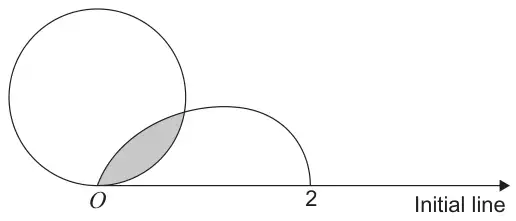
(a) On the diagram above, complete the sketch of \(C_2\) [2 marks]
(b) Show that the area of the region shaded in the diagram is equal to\[k\pi + m\alpha - \sin 2\alpha + q\sin 4\alpha\]
where \(\alpha = \sin^{-1}\left(\dfrac{\sqrt{5} - 1}{2}\right)\), and \(k\), \(m\) and \(q\) are rational numbers. [9 marks]
| Scheme | Marks | AO |
|---|---|---|
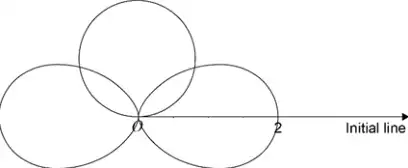
| Draws another quarter of the curve in the correct location. | M1 | 1.1a |
| Draws the complete curve. | A1 | 1.1b |
Typical solution
| Scheme | Marks | AO |
|---|---|---|
| Selects a method to find the area of the shaded region by splitting it into two regions with a line from the pole to the point of intersection of \(C_1\) and \(C_2\) PI by correct limits | B1 | 3.1a |
| Forms an equation for the intersection of \(C_1\) and \(C_2\) | M1 | 1.1a |
| Solves the equation to find the value of \(\sin\theta = \dfrac{-1 + \sqrt{5}}{2}\) at the point of intersection. | A1 | 2.2a |
| Uses an integral of the form \(\dfrac{1}{2}\displaystyle\int r^2\,\mathrm{d}\theta\) to find an area enclosed by a polar curve. | B1 | 3.1a |
| Selects a method to integrate \(\sin^2\theta\) or \(\cos^2 2\theta\) by using a double angle formula | M1 | 3.1a |
| Correctly integrates \(\displaystyle\int(2\sin\theta)^2\,\mathrm{d}\theta\) | A1 | 1.1b |
| Correctly integrates \(\displaystyle\int(1 + \cos 2\theta)^2\,\mathrm{d}\theta\) | A1 | 1.1b |
| Substitutes limits into one of their integrals to determine an area. | M1 | 1.1a |
| Completes a rigorous argument to show that the area of the shaded region is \(\dfrac{3}{8}\pi + \dfrac{1}{4}\alpha - \sin 2\alpha - \dfrac{1}{16}\sin 4\alpha\) | R1 | 2.1 |
| (11 marks) |
Typical solution
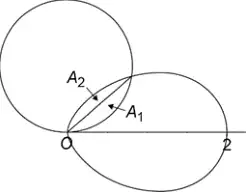
Point of intersection:
\[\begin{aligned} 1 + \cos 2\theta &= 2\sin\theta \\ 2\cos^2\theta &= 2\sin\theta \\ 2 - 2\sin^2\theta &= 2\sin\theta \\ \sin^2\theta + \sin\theta - 1 &= 0 \end{aligned}\]\[\sin\theta = \frac{-1 \pm \sqrt{5}}{2}\]\(\theta\) is acute so \(\quad \theta = \sin^{-1}\left(\dfrac{\sqrt{5} - 1}{2}\right) = \alpha\) as defined in the question.
\[A_1 = \frac{1}{2}\int_0^{\alpha}(2\sin\theta)^2\,\mathrm{d}\theta\]\[A_1 = \int_0^{\alpha}(1 - \cos 2\theta)\,\mathrm{d}\theta\]\[A_1 = \left[\theta - \frac{1}{2}\sin 2\theta\right]_0^{\alpha}\]\[A_1 = \alpha - \frac{1}{2}\sin 2\alpha\]\[A_2 = \frac{1}{2}\int_{\alpha}^{\frac{\pi}{2}}(1 + \cos 2\theta)^2\,\mathrm{d}\theta\]\[A_2 = \frac{1}{2}\int_{\alpha}^{\frac{\pi}{2}}(1 + 2\cos 2\theta + \cos^2 2\theta)\,\mathrm{d}\theta\]\[A_2 = \frac{1}{2}\int_{\alpha}^{\frac{\pi}{2}}\left(1 + 2\cos 2\theta + \frac{1}{2}(1 + \cos 4\theta)\right)\mathrm{d}\theta\]\[A_2 = \left[\frac{3}{4}\theta + \frac{1}{2}\sin 2\theta + \frac{1}{16}\sin 4\theta\right]_{\alpha}^{\frac{\pi}{2}}\]\[A_2 = \frac{3\pi}{8} - \left(\frac{3}{4}\alpha + \frac{1}{2}\sin 2\alpha + \frac{1}{16}\sin 4\alpha\right)\]Area enclosed \(= A_1 + A_2\)
\[= \frac{3\pi}{8} + \frac{1}{4}\alpha - \sin 2\alpha - \frac{1}{16}\sin 4\alpha\]