
A2 June 2021 Paper 2 Q7
7
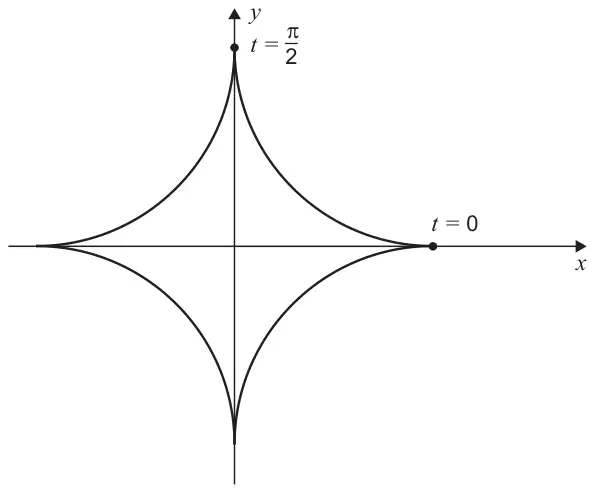
The diagram shows a curve known as an astroid.
The curve has parametric equations
\[\begin{gathered} x = 4\cos^3 t \\ y = 4\sin^3 t \\ (0 \leqslant t \lt 2\pi) \end{gathered}\]The section of the curve from \(t = 0\) to \(t = \dfrac{\pi}{2}\) is rotated through \(2\pi\) radians about the \(x\)-axis.
Show that the curved surface area of the shape formed is equal to \(\dfrac{b\pi}{c}\), where \(b\) and \(c\) are integers. [7 marks]
| Scheme | Marks | AO |
|---|---|---|
| Obtains derivatives of \(x\) and \(y\) | M1 | 1.1a |
| Obtains correct expression for \(\dot{x}^2 + \dot{y}^2\) | A1 | 1.1b |
| Uses trig identity to simplify their expression for \(\dot{x}^2 + \dot{y}^2\) | B1 | 2.2a |
| Substitutes their expression for \(\dot{x}^2 + \dot{y}^2\) into the formula for surface area Condone missing limits of integration and missing “\(2\pi\)” | M1 | 1.1a |
| Obtains correct expression for the surface area including correct limits of integration | A1 | 1.1b |
| Obtains \(k\sin^5 t\) by integration Condone missing limits of integration | A1 | 1.1b |
| Completes a rigorous argument to show the required result | R1 | 2.1 |
| (7 marks) |