
A2 June 2019 Q7
7. A shop sells two types of watch, analogue watches and digital watches.
The shop manager knows that, each month, she should order at least 60 watches in total. In addition, at most 80% of the watches she orders must be digital.
Let \(x\) be the number of analogue watches ordered and let \(y\) be the number of digital watches ordered.
Two further constraints are
\[\begin{gathered} y + 3x \geqslant 140 \\ 4y + x \geqslant 80 \end{gathered}\]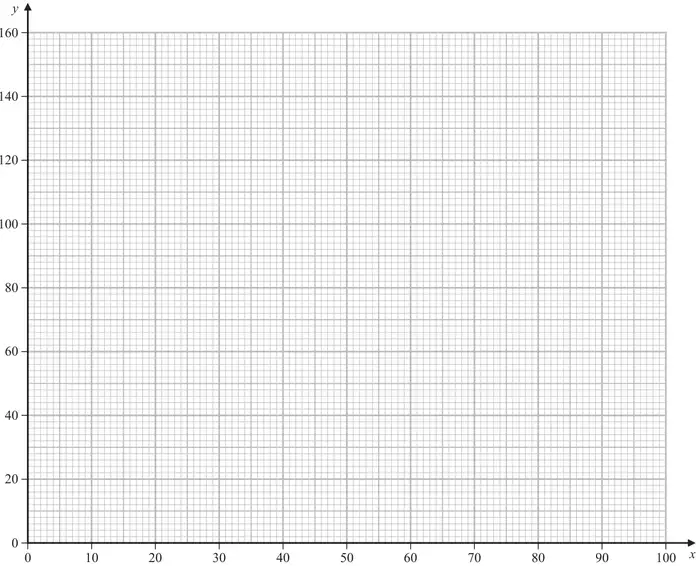
The cost to the shop of ordering an analogue watch is five times the cost of ordering a digital watch. The shop manager wishes to minimise the total cost.
Given that the minimum total cost of ordering the watches is £4455
| Scheme | Marks | AO |
|---|---|---|
| \(x + y \geqslant 60\) | B1 | 3.3 |
| \(y \leqslant \tfrac{4}{5}(x + y)\) | B1 | 3.3 |
| (2) |
Notes
(a) B1: CAO – allow any equivalent form of \(x + y \geqslant 60\) - do not condone strict inequality
B1: CAO – allow any equivalent form of \(y \leqslant \tfrac{4}{5}(x + y)\) (but not \(y \leqslant 80\%(x + y)\) only) and need not be simplified - do not condone strict inequality – isw if correct answer is incorrectly simplified
| Scheme | Marks | AO |
|---|---|---|
 | B1 B1 B1 B1 | 1.1b 1.1b 1.1b 2.2a |
| (4) |
Notes
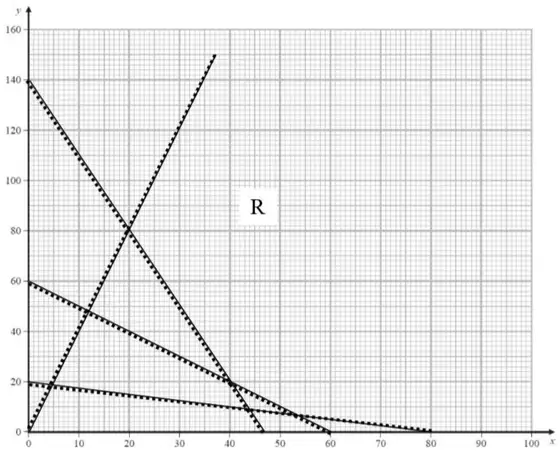
In (b), lines must be long enough to define the correct feasible region and would pass if extended through one small square of the points stated:
\(x + y = 60\) must pass within one small square of its intersection with the axes – (0, 60) and (60, 0)
\(y + 3x = 140\) must pass within one small square of its intersection with the axes – (0, 140) and \(\left(\frac{140}{3}, 0\right)\) (so at 46.666…, 0)
\(4y + x = 80\) must pass within one small square of its intersection with the axes – (0, 20) and (80, 0)
\(y = 4x\) must pass within one small square of (0, 0) and (25, 100)
In (b) condone for full marks lines which are drawn as dashed rather than solid
(b) B1: 2 lines drawn correctly
B1: 3 lines drawn correctly
B1: 4 lines drawn correctly
B1: Region, \(R\), correctly labelled – not just implied by shading – dependent on scoring the first three marks in this part
| Scheme | Marks | AO |
|---|---|---|
| objective line drawn or point-testing | M1 A1 | 3.1a 1.1b |
| (20, 80) so 20 analogue watches and 80 digital watches | A1 | 3.2a |
| (3) |
Notes
(c) M1: Drawing the correct objective line (with gradient – 5) or its reciprocal (with gradient \(-\frac{1}{5}\)). Line must be correct to within one small square if extended from axis to axis. If lines shorter than (5, 0) to (0, 25) or (0, 5) to (25, 0) then M0. Or point testing at least two exact coordinates of their \(R\) using their objective function which must be of the form \(k(5x + y)\) or \(k(x + 5y)\) for some positive real value \(k\)
A1: Correct objective line – condone lack of labelling of the objective line. Or point testing at least two of the correct exact coordinates which are (20, 80), (40, 20), (80, 0) and \(\left(\frac{160}{3}, \frac{20}{3}\right)\) using a correct objective function of the form \(k(5x + y)\)
A1: Correct number of watches – must be in context (and not just in terms of \(x\) and \(y\)) – dependent on a correct feasible region in (b) (so must have scored the first three marks in (b) but may not have labelled the FR as \(R\))
| Scheme | Marks | AO |
|---|---|---|
| \(20a + 80d = 4\,455\) | B1ft | 3.1b |
| \(a = 5d\) | B1 | 2.1 |
| Leading to \(a = 123.75\) and \(d = 24.75\) so an analogue watch costs £123.75 and a digital watch costs £24.75 | dB1 | 2.2a |
| (3) | ||
| (12 marks) |
Notes
Condone use of \(\boldsymbol{x}\) for \(\boldsymbol{a}\) and \(\boldsymbol{y}\) for \(\boldsymbol{d}\) in part (d)
(d) B1ft: A ‘correct’ equation (e.g. \(20a + 80d = 4\,455\)) involving their optimal point from (c) (accept any values even if non-integer) and 4455 –- note that for those who have done point testing in (c) the calculation 4455 / (their value for \(P\)) where \(P = 5x + y\) or \(x + 5y\) using their optimal point implies this mark
B1: CAO on the relationship between the costs of the two types of watches (\(a = 5d\)) – this mark may be implied e.g. \(20(5d) + 80d = 4455\) would score the first two marks in this part – note that for those who have done point testing in (c) the calculation 4455 / (their value for \(P\)) where \(P = 5x + y\) using their optimal point implies this mark e.g. just seeing 4455 / 180 is the first two marks in this part
dB1: CAO (dependent on first two B marks) – this mark is dependent on having the correct optimal point (20, 80) and is dependent on a correct feasible region in (b) (so must have scored at least the first three marks in (b)) – allow for \(a = 123.75\) and \(d = 24.75\) (so does not need to be in context or units) – the correct answers with no working scores no marks in this part (however, note that 4455 / 180 is the minimum amount of working that is acceptable)