
A2 October 2021 Q1
1.
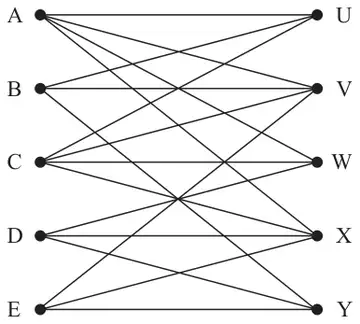
A Hamiltonian cycle for the graph in Figure 1 begins C, V, E, X, A, W, ….
| Scheme | Marks | AO |
|---|---|---|
| …, D, Y, B, U, C | B1 | 1.1b |
| (1) |
Notes
(a) B1: CAO (CVEXAWDYBUC) – must return to C
| Scheme | Marks | AO |
|---|---|---|
 | M1 | 2.1 |
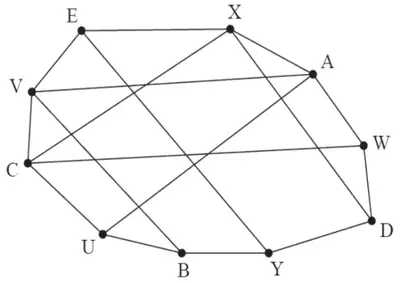
| e.g., select (and label) AU (as I) and the arcs that intersect AU are BV, EY, CW and DX (so label them O so AU(I), AV, BV(O), CW(O), CX, DX(O), EY(O)) | A1 | 1.1b |
| Edges BV and CW intersect and so the graph is not planar (oe) | A1 | 2.2a |
| (3) | ||
| (4 marks) |
Notes
(b) M1: Either draws their Hamiltonian cycle from part (a) as the edges of a polygon and shows the remaining arcs intersecting inside OR lists the arcs that are not part of the Hamiltonian cycle
A1: Selects any arc (that is not part of the Hamiltonian cycle) and lists/references the correct arcs that intersect with this selected arc – dependent on any correct Hamiltonian cycle and correct arcs that are not part of this cycle
A1: cao – based on their initial arc selection, states the two arcs that are unlabelled (or that are labelled with the same label) which intersect each other (e.g., if CX chosen as the initial selection then this arc intersects with BV, EY and AV but EY and AV intersect) and concludes that the graph is not planar. This mark is dependent on the correct Hamiltonian cycle stated in either (a) or (b)