
AS June 2018 Paper 1 Q9
9.
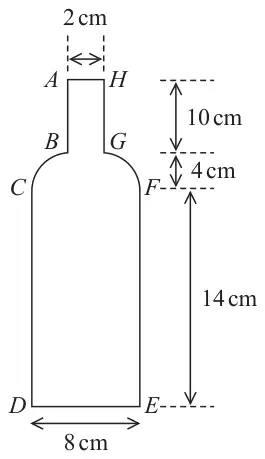
A mathematics student is modelling the profile of a glass bottle of water. Figure 1 shows a sketch of a central vertical cross-section \(ABCDEFGHA\) of the bottle with the measurements taken by the student.
The horizontal cross-section between \(CF\) and \(DE\) is a circle of diameter 8 cm and the horizontal cross-section between \(BG\) and \(AH\) is a circle of diameter 2 cm.
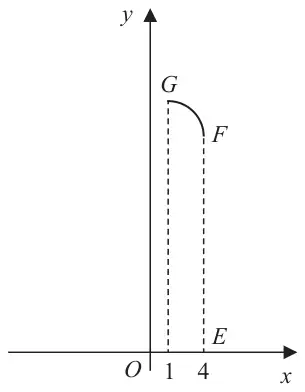
The student thinks that the curve \(GF\) could be modelled as a curve with equation
\[y = ax^2 + b \qquad 1 \leqslant x \leqslant 4\]where \(a\) and \(b\) are constants and \(O\) is the fixed origin, as shown in Figure 2.
The label on the bottle states that the bottle holds approximately 750 cm3 of water.
| Scheme | Marks | AO |
|---|---|---|
| \((4, 14),\ (1, 18) \Rightarrow 14 = a(4)^2 + b,\ 18 = a(1)^2 + b \Rightarrow a = \ldots, b = \ldots\) | M1 | 3.3 |
| \(a = -\dfrac{4}{15},\ b = \dfrac{274}{15}\) | A1 | 1.1b |
| (2) |
Notes
M1: Chooses (4, 14) and (1, 18) and substitutes into the equation modelling the curve to obtain at least one correct equation and attempts to find the values of \(a\) and \(b\).
A1: Infers from the data in the model, the values of \(a\) and \(b\)
| Scheme | Marks | AO |
|---|---|---|
| \(\pi \times 4^2 \times 14\) and \(\pi \times 1^2 \times 10\) | B1 | 1.1b |
| \(\pi\displaystyle\int x^2\,\mathrm{d}y = \frac{\pi}{4}\int(274 - 15y)\,\mathrm{d}y\) | B1ft | 1.1a |
| \(= \dfrac{\pi}{4}\displaystyle\int_{14}^{18}(274 - 15y)\,\mathrm{d}y\) | M1 | 3.3 |
| \(= \dfrac{\pi}{4}\left[274y - \dfrac{15y^2}{2}\right]_{14}^{18}\) | M1 A1 | 1.1b 1.1b |
| \(V = 234\pi + \dfrac{\pi}{4}\left[274(18) - \dfrac{15(18)^2}{2} - \left(274(14) - \dfrac{15(14)^2}{2}\right)\right]\) | ddM1 | 3.4 |
| \(V = 268\pi \approx 842\text{ cm}^3\) | A1 | 2.2b |
| (7) |
Notes
B1: Correct expressions for the 2 cylindrical parts. May be seen as a sum or as separate cylinders.
B1ft: Uses the model to obtain \(\pi\displaystyle\int\left(\frac{y - \text{their } b}{\text{their } a}\right)\mathrm{d}y\) (Note that the \(\pi\) may be recovered later)
M1: Chooses limits appropriate to the model i.e. 14 and 18
M1: Integrates to obtain an expression of the form \(\alpha y + \beta y^2\)
A1: Uses their model correctly to give \(274y - \dfrac{15y^2}{2}\)
ddM1: Uses the model to find the sum of their cylinders + their integrated volume. Must be a fully correct method here and is dependent on both previous method marks. So must have attempted the volumes of the cylinders “AHBG” and “CFED” and adds these to the magnitude of their integrated volume.
A1: \(268\pi\) or awrt 842
| Scheme | Marks | AO |
|---|---|---|
| Any one of e.g. The measurements may not be accurate The equation of the curve may not be a suitable model The bottom of the bottle may not be flat The thickness of the glass may not have been considered The glass may not be smooth This part asks for a limitation of the model so their answer must refer to e.g. :
| B1 | 3.5b |
| (1) |
Notes
B1: States an acceptable limitation of the model with no contradictory statements. (This is independent of part (b))
| Scheme | Marks | AO |
|---|---|---|
There are 2 criteria for this mark:
If they reach an answer that is greater than 750 then look for a sensible comment that is consistent with their value | B1ft | 3.5a |
| (1) | ||
| (11 marks) |
Notes
B1ft: Compares the actual volume to their answer to part (b) and makes an assessment of the model with a reason with no contradictory statements.