
AS October 2020 Paper 1 Q3
3.
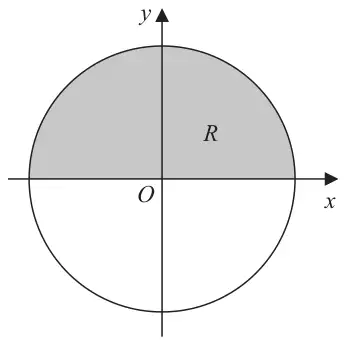
Figure 1 shows a circle with radius \(r\) and centre at the origin.
The region \(R\), shown shaded in Figure 1, is bounded by the \(x\)-axis and the part of the circle for which \(y > 0\)
The region \(R\) is rotated through 360° about the \(x\)-axis to create a sphere with volume \(V\)
Use integration to show that \(V = \dfrac{4}{3}\pi r^3\) (5)
| Scheme | Marks | AO |
|---|---|---|
| \(x^2 + y^2 = r^2\) | B1 | 1.2 |
| \(\{V\} = \pi\displaystyle\int_{-r}^{r} r^2 - x^2\ \mathrm{d}x\) or \(\{V\} = 2\pi\displaystyle\int_{0}^{r} r^2 - x^2\ \mathrm{d}x\) | B1 | 2.1 |
| Integrates to the form \(\alpha x \pm \beta x^3\) [note: the correct integration gives \(r^2x - \dfrac{1}{3}x^3\)] | M1 | 1.1b |
| Substitutes limits of \(-r\) and \(r\) and subtracts the correct way round\[\left(r^2(r) - \frac{1}{3}(r)^3\right) - \left(r^2(-r) - \frac{1}{3}(-r)^3\right)\]or Substitutes limits of 0 and \(r\) and subtracts the correct way round with twice the volume. Note the limit of 0 can be implied if gives and answer of 0\[\left(r^2(r) - \frac{1}{3}(r)^3\right) - (0)\] | dM1 | 1.1b |
| \(V = \dfrac{4}{3}\pi r^3\) * cso | A1* | 1.1b |
| (5) | ||
| (5 marks) |
Notes
B1: Correct equation of the circle, may be implied by correct integral
B1: Correct expression for the volume, including limits, d\(x\) may be implied and if using limits \(r\) and 0 the 2 could appear later with reasoning
M1: Integrates to the form \(\alpha x \pm \beta x^3\). Do not award if \(r^2 \to \lambda r^3\)
dM1: Dependent on previous method mark. Correct use of limits \(-r\) and \(r\) or limits of 0 and \(r\) with twice the volume.
A1*: \(V = \dfrac{4}{3}\pi r^3\) * cso
Note: rotation about the \(y\)-axis all marks are available, however for the final accuracy mark must refer to symmetry