
AS October 2020 Q1
1.
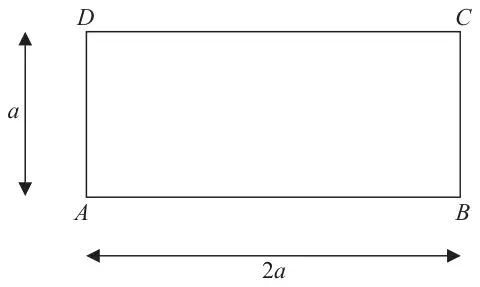
Figure 1 shows a uniform rectangular lamina \(ABCD\) with \(AB = 2a\) and \(AD = a\)
The mass of the lamina is \(6m\).
A particle of mass \(2m\) is attached to the lamina at \(A\), a particle of mass \(m\) is attached to the lamina at \(B\) and a particle of mass \(3m\) is attached to the lamina at \(D\), to form a loaded lamina \(L\) of total mass \(12m\).
A particle of mass \(km\) is now also attached to \(L\) at \(D\) to form a new loaded lamina \(N\).
When \(N\) is freely suspended from \(A\) and is hanging in equilibrium, the side \(AB\) makes an angle \(\alpha\) with the vertical, where \(\tan\alpha = \dfrac{3}{2}\)
| Scheme | Marks | AO |
|---|---|---|
| \(\dfrac{1}{2}a\) | B1 | 1.1b |
| Loaded lamina has a mass distribution which is symmetrical about the perpendicular bisector of \(AD\) | B1 | 2.4 |
| (2) |
Notes
B1: cao
B1: clear explanation
| Scheme | Marks | AO |
|---|---|---|
| Moments about \(AD\) | M1 | 3.1a |
| \(6ma + m.2a = 12m\bar{x}\) | A1 | 1.1b |
| \(\bar{x} = \dfrac{2a}{3}\) * | A1* | 2.2a |
| (3) |
Notes
M1: Correct no. of terms and dimensionally correct (allow cancelled \(m\)’s)
A1: A correct equation
A1*: Correctly obtained printed answer
| Scheme | Marks | AO |
|---|---|---|
| Moments about \(AB\) | M1 | 3.1a |
| \(kma + 12m.\dfrac{1}{2}a = (k+12)m\bar{y}\) | A1 A1 | 1.1.b 1.1b |
| \(\bar{y} = \dfrac{(k+6)a}{(k+12)}\) * | A1* | 2.2a |
| (4) |
Notes
M1: Correct no. of terms and dimensionally correct (allow cancelled \(m\)’s)
A1: Correct equation with one error
A1: Correct equation
A1*: Correctly obtained printed answer
| Scheme | Marks | AO |
|---|---|---|
| Moments about \(AD\) | M1 | 3.1a |
| \(\bar{x}_1 = \dfrac{8a}{(k+12)}\) | A1 | 1.1b |
| Use of \(\tan\alpha = \dfrac{\bar{y}}{\bar{x}_1}\) | M1 | 1.1b |
| \(\dfrac{3}{2} = \dfrac{\dfrac{(k+6)a}{(k+12)}}{\dfrac{8a}{(k+12)}}\) | A1 | 1.1b |
| Solve for \(k\) | M1 | 1.1b |
| \(k = 6\) | A1 | 1.1b |
| SC: For use of \((\tan\alpha =)\dfrac{\text{their } \bar{y}}{\text{their } \bar{x}} = \dfrac{3}{2}\), M1A1M0A0M0A0 | ||
| (6) | ||
| (15 marks) |
Notes
M1: Correct no. of terms and dimensionally correct (allow cancelled \(m\)’s)
A1: Correct distance
M1: Correct use of tan but allow reciprocal
A1: Correct equation
M1: Solve for \(k\)
A1: cao