
A2 October 2020 Q2
2.
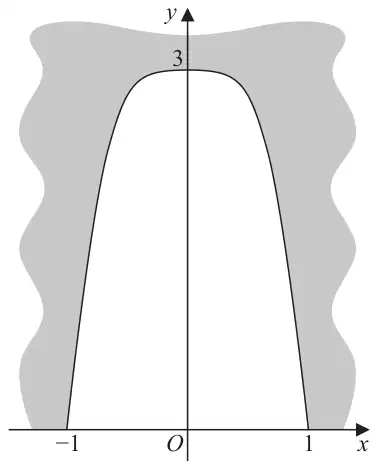
Figure 1 shows a sketch of the vertical cross-section of the entrance to a tunnel. The width at the base of the tunnel entrance is 2 metres and its maximum height is 3 metres.
The shape of the cross-section can be modelled by the curve with equation \(y = \mathrm{f}(x)\) where
\[\mathrm{f}(x) = 3\cos\left(\frac{\pi}{2}x^2\right) \qquad x \in [-1, 1]\]A wooden door of uniform thickness 85 mm is to be made to seal the tunnel entrance.
Use Simpson’s rule with 6 intervals to estimate the volume of wood required for this door, giving your answer in m3 to 4 significant figures.
(6)
| Scheme | Marks | AO | ||||||||||||||||||||||||
|---|---|---|---|---|---|---|---|---|---|---|---|---|---|---|---|---|---|---|---|---|---|---|---|---|---|---|
| Step \(\dfrac{1}{3}\) | B1 | 1.1b | ||||||||||||||||||||||||
| M1 | 3.4 | ||||||||||||||||||||||||
| \(y_0 + 4y_1 + 2y_2 + 4y_3 + 2y_4 + 4y_5 + y_6\) \(= \text{“}42.203\text{”}\) \(\{0 + 4(2.2981 + 3 + 2.2981) + 2(2.9544 + 2.9544) + 0\}\) | M1 | 1.1b | ||||||||||||||||||||||||
| \(= 42.203\left(= 24\cos\left(\dfrac{2\pi}{9}\right) + 12\cos\left(\dfrac{\pi}{18}\right) + 12\right)\) | A1 | 1.1b | ||||||||||||||||||||||||
| So volume required is approx. \(\dfrac{85}{1000} \times \dfrac{\frac{1}{3}}{3} \times \text{“}42.203\text{”}\) | M1 | 3.1a | ||||||||||||||||||||||||
| \(=\) awrt \(0.3986\,\mathrm{m}^3\) | A1 | 3.2a | ||||||||||||||||||||||||
| (6) | ||||||||||||||||||||||||||
| (6 marks) |
Notes
B1: Correct strip width for the method chosen \(\dfrac{1}{3}\) for the interval \([-1, 1]\)
M1: Uses the model to find the appropriate values for the method. May use that the function is even to only work out half of them, so may be implied by use in the formula. At least two correct values to 4 s.f. needed for the method.
M1: Applies the “bracket” of Simpson’s rule, “\(y_0 + 4y_1 + 2y_2 + 4y_3 + 2y_4 + 4y_5 + y_6\)”. Coefficients must be correct.
A1: Correct value for the “bracket”. If not explicitly seen, may be implied by awrt 4.689 as a value for the cross section area following correct values.
M1: Correct full method to find the volume. E.g. multiplies their bracket by their \(\dfrac{h}{3}\) and by 0.085.
Accept an attempt in any consistent units, so e.g. in mm3 ie \(85 \times \dfrac{\frac{1}{3}}{3} \times \text{“}42.203\text{”} \times 1000^2\)
A1: Correct answer in m3.
Alternative interval [0,1]
| Scheme | Marks | AO | ||||||||||||||||||||||||
|---|---|---|---|---|---|---|---|---|---|---|---|---|---|---|---|---|---|---|---|---|---|---|---|---|---|---|
| step \(\dfrac{1}{6}\) and the answer is doubled later | B1 | 1.1b | ||||||||||||||||||||||||
| M1 | 3.4 | ||||||||||||||||||||||||
| \(y_0 + 4y_1 + 2y_2 + 4y_3 + 2y_4 + 4y_5 + y_6\) \(= \text{“}42.1206\text{”}\) \(\{3 + 4(2.9971 + 2.7716 + 1.3852) + 2(2.9544 + 2.2981) + 0\}\) | M1 | 1.1b | ||||||||||||||||||||||||
| Awrt 42.121 | A1 | 1.1b | ||||||||||||||||||||||||
| So volume required is approx. \(\dfrac{85}{1000} \times \dfrac{\frac{1}{6}}{3} \times \text{“}42.1206\text{”} \times 2\) | M1 | 3.1a | ||||||||||||||||||||||||
| \(=\) awrt \(0.3978\,\mathrm{m}^3\) | A1 | 3.2a | ||||||||||||||||||||||||
| (6) |
B1: Correct strip width for the method chosen \(\dfrac{1}{6}\) for the interval \([0, 1]\) and later doubled.
M1: Uses the model to find the appropriate values for the method. May use that the function is even to only work out half of them, so may be implied by use in the formula. At least two correct values to 4 s.f. needed for the method.
M1: Applies the “bracket” of Simpson’s rule, “\(y_0 + 4y_1 + 2y_2 + 4y_3 + 2y_4 + 4y_5 + y_6\)”. Coefficients must be correct.
A1: Correct value for the “bracket”. If not explicitly seen, may be implied by awrt 4.680 as a value for the cross section area following correct values.
M1: Correct full method to find the volume. E.g. multiplies their bracket by their \(\dfrac{h}{3}\) and by 0.085.
Accept an attempt in any consistent units, so e.g. in mm3 ie \(85 \times \dfrac{\frac{1}{6}}{3} \times \text{“}42.1206\text{”} \times 1000^2 \times 2\) (corrected from the printed mark scheme, which has “42.203” here)
A1: Correct answer in m3.
Using 6 ordinates
Max score B0 M1 M0 A0 M0 A0
| \(y_0\) | \(y_1\) | \(y_2\) | \(y_3\) | \(y_4\) | \(y_5\) | |
|---|---|---|---|---|---|---|
| \(x\) | -1 | -0.6 | -0.2 | 0.2 | 0.6 | 1 |
| \(y\) | 0 | 2.53298 | 2.9941 | 2.9941 | 2.53298 | 0 |
B0: Incorrect strip width
M1: Uses the model to find the appropriate values for the method. At least two correct values to 4 s.f. needed for the method.