
A2 October 2020 Paper 2 Q7
7.
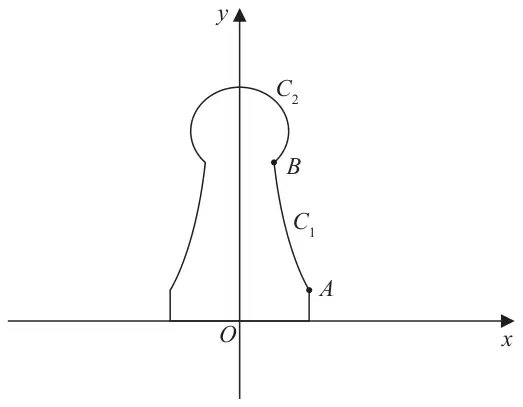
A student wants to make plastic chess pieces using a 3D printer. Figure 1 shows the central vertical cross-section of the student’s design for one chess piece. The plastic chess piece is formed by rotating the region bounded by the \(y\)-axis, the \(x\)-axis, the line with equation \(x = 1\), the curve \(C_1\) and the curve \(C_2\) through \(360^\circ\) about the \(y\)-axis.
The point \(A\) has coordinates \((1, 0.5)\) and the point \(B\) has coordinates \((0.5, 2.5)\) where the units are centimetres.
The curve \(C_1\) is modelled by the equation
\[x = \frac{a}{y + b} \qquad 0.5 \leqslant y \leqslant 2.5\]The curve \(C_2\) is modelled to be an arc of the circle with centre \((0, 3)\).
| Scheme | Marks | AO |
|---|---|---|
| \(1 = \dfrac{a}{0.5 + b},\ 0.5 = \dfrac{a}{2.5 + b} \Rightarrow a = \ldots,\ b = \ldots\) | M1 | 3.3 |
| \(a = 2,\ b = 1.5\) | A1 | 1.1b |
| (2) |
Notes
(a)
M1: Uses the given coordinates correctly in the equation modelling the curve to obtain at least one correct equation and attempts to find the values of \(a\) and \(b\)
A1: Correct values
| Scheme | Marks | AO |
|---|---|---|
| \(\displaystyle V_1 = \pi\int x^2\,\mathrm{d}y = \pi\int \left(\frac{\text{"}2\text{"}}{y + \text{"}1.5\text{"}}\right)^2\mathrm{d}y\) | B1ft | 3.4 |
| \(\displaystyle\pi\int_{0.5}^{2.5} \left(\frac{\text{"}2\text{"}}{y + \text{"}1.5\text{"}}\right)^2\mathrm{d}y\) | M1 | 1.1a |
| \(= \{4\pi\}\left[-(y + 1.5)^{-1}\right]_{0.5}^{2.5}\ (= \pi)\) | M1 | 1.1b |
| \(x^2 + (y - 3)^2 = 0.5\) | B1 | 2.2a |
| \(\displaystyle V_2 = \pi\int x^2\,\mathrm{d}y = \pi\int \left(0.5 - (y - 3)^2\right)\mathrm{d}y\) or \(\displaystyle\pi\int \left(-y^2 + 6y - 8.5\right)\mathrm{d}y\) | M1 | 1.1b |
| \(\displaystyle = \pi\int_{2.5}^{3 + \frac{1}{\sqrt{2}}} \left(0.5 - (y - 3)^2\right)\mathrm{d}y\) or \(\displaystyle = \pi\int_{2.5}^{3 + \frac{1}{\sqrt{2}}} \left(-y^2 + 6y - 8.5\right)\mathrm{d}y\) | M1 | 3.3 |
| \(= \{\pi\}\left[0.5y - \dfrac{1}{3}(y - 3)^3\right]_{2.5}^{3 + \frac{1}{\sqrt{2}}}\) or \(= \{\pi\}\left[-\dfrac{1}{3}y^3 + 3y^2 - 8.5y\right]_{2.5}^{3 + \frac{1}{\sqrt{2}}}\) | A1 | 1.1b |
| \(V_1 + V_2 + \text{cylinder} = \pi + \pi\left(\dfrac{5}{24} + \dfrac{\sqrt{2}}{6}\right) + \dfrac{1}{2}\pi\) | dM1 | 3.4 |
| \(= \pi\left(\dfrac{41}{24} + \dfrac{\sqrt{2}}{6}\right) \approx 6.11\,\text{cm}^3\) | A1 | 2.2b |
| (9) | ||
| (11 marks) |
Notes
(b)
B1ft: Uses the model to obtain \(\displaystyle\pi\int \left(\frac{\text{their } a}{y + \text{their } b}\right)^2\mathrm{d}y\). Note the \(\pi\) can be recovered if appears later.
M1: Chooses limits appropriate to the model i.e. 0.5 and 2.5
M1: Integrates to obtain an expression of the form \(k(y + \text{“}1.5\text{”})^{-1}\)
B1: Deduces the correct equation for the circle
M1: Uses their circle equation and \(\displaystyle\pi\int x^2\,\mathrm{d}y\) to attempt the top volume. Note the \(\pi\) can be recovered if appears later.
M1: Identifies limits appropriate to the model i.e. 2.5 and 3 + their radius
A1: Correct integration
dM1: Uses the model to find the volume of the chess piece including the cylindrical base (dependent on all previous method marks)
A1: Correct volume