
A2 October 2020 Paper 1 Q3
3.
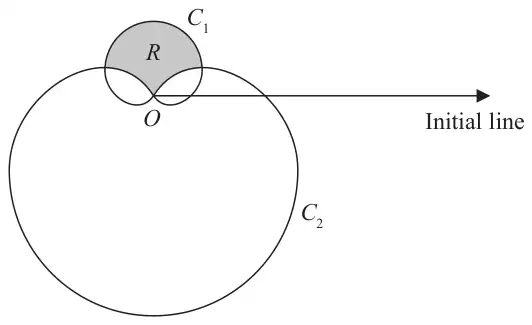
Figure 1 shows a sketch of two curves \(C_1\) and \(C_2\) with polar equations
\[C_1\colon r = (1 + \sin\theta) \qquad 0 \leqslant \theta \lt 2\pi\]\[C_2\colon r = 3(1 - \sin\theta) \qquad 0 \leqslant \theta \lt 2\pi\]The region \(R\) lies inside \(C_1\) and outside \(C_2\) and is shown shaded in Figure 1.
Show that the area of \(R\) is
\[p\sqrt{3} - q\pi\]where \(p\) and \(q\) are integers to be determined.
(9)
| Scheme | Marks | AO |
|---|---|---|
| \(3(1 - \sin\theta) = 1 + \sin\theta \Rightarrow \sin\theta = \dfrac{1}{2} \Rightarrow \theta = \ldots\) | M1 | 3.1a |
| \(\theta = \dfrac{\pi}{6}\ \left(\text{or } \dfrac{5\pi}{6}\right)\) | A1 | 1.1b |
| Use of \(\displaystyle\frac{1}{2}\int (1 + \sin\theta)^2\,\mathrm{d}\theta\) or \(\displaystyle\frac{1}{2}\int \left\{3(1 - \sin\theta)\right\}^2\,\mathrm{d}\theta\) | M1 | 1.1a |
| \(\displaystyle\left(\frac{1}{2}\right)\int \left[(1 + \sin\theta)^2 - 9(1 - \sin\theta)^2\right]\mathrm{d}\theta\) \(\displaystyle = \left(\frac{1}{2}\right)\int \left[1 + 2\sin\theta + \sin^2\theta - 9 + 18\sin\theta - 9\sin^2\theta\right]\mathrm{d}\theta\) or \(\displaystyle\int (1 + \sin\theta)^2\,\mathrm{d}\theta = \int \left(1 + 2\sin\theta + \sin^2\theta\right)\mathrm{d}\theta\) and \(\displaystyle\int 9(1 - \sin\theta)^2\,\mathrm{d}\theta = 9\int \left(1 - 2\sin\theta + \sin^2\theta\right)\mathrm{d}\theta\) | M1 A1 | 2.1 1.1b |
| \(\displaystyle\int \sin^2\theta\,\mathrm{d}\theta = \frac{1}{2}\int (1 - \cos 2\theta)\,\mathrm{d}\theta \Rightarrow\) \(\displaystyle\int \left[(1 + \sin\theta)^2 - 9(1 - \sin\theta)^2\right]\mathrm{d}\theta = 2\sin 2\theta - 12\theta - 20\cos\theta\) | M1 A1 | 3.1a 1.1b |
| \(\displaystyle A = \frac{1}{2}\int_{\frac{\pi}{6}}^{\frac{5\pi}{6}} \left[(1 + \sin\theta)^2 - 9(1 - \sin\theta)^2\right]\mathrm{d}\theta\) or \(\displaystyle A = 2 \times \frac{1}{2}\int_{\frac{\pi}{6}}^{\frac{\pi}{2}} \left[(1 + \sin\theta)^2 - 9(1 - \sin\theta)^2\right]\mathrm{d}\theta\) \(= \dfrac{1}{2}\left\{\left(-\sqrt{3} - 10\pi + 10\sqrt{3}\right) - \left(\sqrt{3} - 2\pi - 10\sqrt{3}\right)\right\} = \ldots\) | DM1 | 3.1a |
| \(= 9\sqrt{3} - 4\pi\) | A1 | 1.1b |
| (9) | ||
| (9 marks) |
Notes
M1: Realises that the angles at the intersection are required and solves \(C_1 = C_2\) to obtain a value for \(\theta\)
A1: Correct value for \(\theta\). Must be in radians – if given in degrees you may need to check later to see if they convert to radians before substitution.
M1: Evidence selecting the correct polar area formula on either curve
M1: Fully expands both expressions for \(r^2\) either as parts of separate integrals or as one complete integral. (Can be scored from incorrect polar area formula, e.g. missing the ½)
A1: Correct expansions for both curves (may be unsimplified)
M1: Selects the correct strategy by applying the correct double angle identity in order to reach an integrable form and attempting the integration of at least one of the curves.
A1: Correct integration (of both integrals if done separately),
FYI: If done separately the correct integrals are
\(\displaystyle\int (1 + \sin\theta)^2\,\mathrm{d}\theta = \theta - 2\cos\theta + \frac{1}{2}\left(\theta - \frac{1}{2}\sin 2\theta\right) = \frac{3}{2}\theta - 2\cos\theta - \frac{1}{4}\sin 2\theta\) and
\(\displaystyle\int 9(1 - \sin\theta)^2\,\mathrm{d}\theta = 9\theta + 18\cos\theta + \frac{9}{2}\left(\theta - \frac{1}{2}\sin 2\theta\right) = \frac{27}{2}\theta + 18\cos\theta - \frac{9}{4}\sin 2\theta\)
DM1: Depends on all previous M’s. For a fully correct strategy with appropriate limits correctly applied to their integral or integrals and terms combined if necessary. Make sure that if limits of \(\dfrac{\pi}{6}\) and \(\dfrac{\pi}{2}\) are used that the area is doubled as part of the strategy.
A1: Correct area