
AS June 2018 Q2
2.
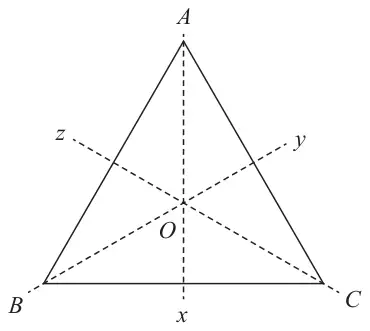
Figure 1 shows an equilateral triangle \(ABC\). The lines \(x\), \(y\) and \(z\) and their point of intersection, \(O\), are fixed in the plane. The triangle \(ABC\) is transformed about these fixed lines and the fixed point \(O\). The lines \(x\), \(y\) and \(z\) each pass through a vertex of the triangle and the midpoint of the opposite side.
The transformations \(I\), \(X\), \(Y\), \(Z\), \(R_1\) and \(R_2\) of the plane containing triangle \(ABC\) are defined as follows:
- \(I\): Do nothing
- \(X\): Reflect in the line \(x\)
- \(Y\): Reflect in the line \(y\)
- \(Z\): Reflect in the line \(z\)
- \(R_1\): Rotate \(120^\circ\) anticlockwise about \(O\)
- \(R_2\): Rotate \(240^\circ\) anticlockwise about \(O\)
The operation \(*\) is defined as ‘followed by’ on the set \(T = \{I, X, Y, Z, R_1, R_2\}\).
For example, \(X * Y\) means a reflection in the line \(x\) followed by a reflection in the line \(y\).
| Second transformation | |||||||
|---|---|---|---|---|---|---|---|
| \(*\) | \(I\) | \(X\) | \(Y\) | \(Z\) | \(R_1\) | \(R_2\) | |
| First Transformation | \(I\) | ||||||
| \(X\) | \(I\) | \(Z\) | |||||
| \(Y\) | |||||||
| \(Z\) | |||||||
| \(R_1\) | \(Y\) | ||||||
| \(R_2\) | |||||||
Given that the associative law is satisfied,
| Scheme | Marks | AO | |||||||||||||||||||||||||||||||||||||||||||||||||
|---|---|---|---|---|---|---|---|---|---|---|---|---|---|---|---|---|---|---|---|---|---|---|---|---|---|---|---|---|---|---|---|---|---|---|---|---|---|---|---|---|---|---|---|---|---|---|---|---|---|---|---|
(a)(i)
| B1 | 1.1b | |||||||||||||||||||||||||||||||||||||||||||||||||
| B1 B1 | 1.1b 1.1b | |||||||||||||||||||||||||||||||||||||||||||||||||
(ii) \(I\) is the identity and closure is shown (by the Cayley table) | M1 | 2.1 | |||||||||||||||||||||||||||||||||||||||||||||||||
| \(X\), \(Y\) and \(Z\) are self-inverse, \(R_1\) and \(R_2\) are inverses, (\(I\) is the identity so is self-inverse) | M1 | 2.5 | |||||||||||||||||||||||||||||||||||||||||||||||||
| (Associative law may be assumed) so \(T\) forms a group | A1 | 1.1b | |||||||||||||||||||||||||||||||||||||||||||||||||
| (6) |
Notes
(a)(i)
B1: Begins completing the table by having at least the first row and first column correct
B1: Mostly correct – three rows or three columns correct (so demonstrates an understanding of using \(*\))
B1: Fully correct table
(a)(ii)
M1: States closure and identifies the identity as \(I\)
M1: States the inverse of each element (reference to the Identity not required here)
A1: Concludes that \(T\) is a group (must see a conclusion)
Special case: If the inverses are not stated explicitly but a statement such as “all elements have an inverse” is seen, score M1M1A0
| Scheme | Marks | AO |
|---|---|---|
| \(R_2 * R_2 * R_2 = (R_2 * R_2) * R_2\) or \(R_2 * (R_2 * R_2) = R_1 * R_2\) or \(R_2 * R_1\) | M1 | 2.1 |
| \(= I\) (the identity) so \(R_2\) has order 3 | A1 | 2.2a |
| (2) |
Notes
M1: Clearly begins process to find \(R_2 * R_2 * R_2\) reaching \(R_1 * R_2\) or \(R_2 * R_1\)
A1: Gives answer as \(I\) states identity and deduces that the order is 3 or e.g. \((R_2)^3 = I\)
| Scheme | Marks | AO |
|---|---|---|
| \(R_1\) (and \(R_2\)) have order 3, \(X\), \(Y\) and \(Z\) have order 2 so: There is no element of \(T\) that generates the group or There is no element of order 6 | B1 | 2.4 |
| (1) |
Notes
B1: Demonstrates an understanding of the term cyclic by referring to the order of \(R_1\), \(X\), \(Y\) and \(Z\) and makes a suitable conclusion
| Scheme | Marks | AO |
|---|---|---|
| \(\{I, R_1, R_2\}\) | B1 | 1.1b |
| (1) | ||
| (10 marks) |
Notes
B1: Indicates the set \(\{I, R_1, R_2\}\) (Brackets not required)