
AS October 2020 Q5
5.
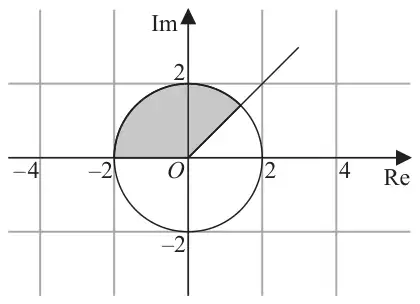
Figure 1 shows an Argand diagram.
The set of points, \(A\), that lies within the shaded region, including its boundaries, is defined by
where \(p\), \(q\) and \(r\) are positive constants.
Given that \(w = -2\sqrt{3} + 2\mathrm{i}\) and \(z \in A\),
| Scheme | Marks | AO |
|---|---|---|
| \(p = \dfrac{\pi}{4}\) and \(q = \pi\) or \(\dfrac{\pi}{4} \leqslant \arg z \leqslant \pi\) | B1 | 1.1b |
| \(r = 2\) or \(|z| \leqslant 2\) | B1 | 1.1b |
| (2) |
Notes
B1: Correct values or correct loci
B1: Correct value or correct loci
| Scheme | Marks | AO |
|---|---|---|
| Position for \(z\) is at intersection in quadrant 1 | B1 | 3.1a |
| Angle between \(y = x\) and “\(OW\)” is \(\dfrac{\pi}{3} + \dfrac{\pi}{4}\) | B1 | 2.2a |
| \(d^2 = 4^2 + 2^2 - 2 \times 4 \times 2\cos\left(\dfrac{\pi}{3} + \dfrac{\pi}{4}\right)\) | M1 | 1.1b |
| \(= 20 - 4\sqrt{2} + 4\sqrt{6}\) | A1 | 2.2a |
| (4) | ||
| (6 marks) |
Notes
B1: Realises that the position for \(z\) is at the intersection in quadrant 1 and makes progress in finding the distance
B1: Deduces from the information given that the angle between \(y = x\) and “\(OW\)” is \(\pi/4 + \pi/3\)
M1: Correct use of the cosine rule in order to find the required length2
A1: Deduces the required value in a simplified and exact form
Alternative for (b)
| Scheme | Marks | AO |
|---|---|---|
| Position for \(z\) is at intersection in quadrant 1 | B1 | 3.1a |
| \(y = x\) intersects \(x^2 + y^2 = 4\) at \((\sqrt{2}, \sqrt{2})\) | B1 | 2.2a |
| \(d^2 = \left(\text{“}\sqrt{2}\text{”} + 2\sqrt{3}\right)^2 + \left(\text{“}\sqrt{2}\text{”} - 2\right)^2\) | M1 | 1.1b |
| \(= 20 - 4\sqrt{2} + 4\sqrt{6}\) | A1 | 2.2a |
| (4) |
B1: Realises that the position for \(z\) is at the intersection in quadrant 1 and makes progress in finding the distance
B1: Deduces from the information given the correct coordinates for \(z\)
M1: Correct use of Pythagoras in order to find the required length2
A1: Deduces the required value in a simplified and exact form