
A2 June 2019 Paper 2 Q8
8.
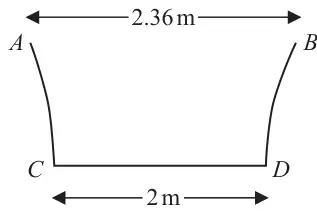
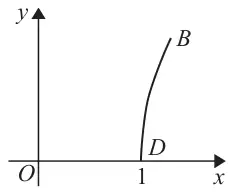
Figure 1 shows the central vertical cross section \(ABCD\) of a paddling pool that has a circular horizontal cross section. Measurements of the diameters of the top and bottom of the paddling pool have been taken in order to estimate the volume of water that the paddling pool can contain.
Using these measurements, the curve \(BD\) is modelled by the equation
\[y = \ln(3.6x - k) \qquad 1 \leqslant x \leqslant 1.18\]as shown in Figure 2.
The pool is being filled with water from a tap.
Given that the pool is being filled at a constant rate of 15 litres every minute,
| Scheme | Marks | AO |
|---|---|---|
| \(k = 2.6\) | B1 | 3.4 |
| (1) |
Notes
B1: Uses the model to obtain a correct value for \(k\). Must be 2.6 not -2.6
| Scheme | Marks | AO |
|---|---|---|
| \(x = 1.18 \Rightarrow \ln(3.6 \times 1.18 - \text{"}2.6\text{"}) = \ldots\) | M1 | 1.1b |
| \(h = 0.4995\ldots\) m | A1 | 2.2b |
| (2) |
Notes
M1: Substitutes their value of \(k\) and \(x = 1.18\) into the given model to find a value for \(y\)
A1: Infers that the depth of the pool could be awrt 0.5 m
| Scheme | Marks | AO |
|---|---|---|
| \(y = \ln(3.6x - 2.6) \Rightarrow x = \dfrac{\mathrm{e}^y + 2.6}{3.6}\) or \(\dfrac{5\mathrm{e}^y + 13}{18}\) | B1ft | 1.1a |
| \(\displaystyle V = \pi\int \left(\frac{\mathrm{e}^y + 2.6}{3.6}\right)^2 \mathrm{d}y = \frac{\pi}{3.6^2}\int \left(\mathrm{e}^{2y} + 5.2\mathrm{e}^y + 6.76\right)\mathrm{d}y\) \(\displaystyle\text{or } \frac{\pi}{324}\int \left(25\mathrm{e}^{2y} + 130\mathrm{e}^y + 169\right)\mathrm{d}y\) | M1 | 3.3 |
| \(= \dfrac{\pi}{3.6^2}\left[\dfrac{1}{2}\mathrm{e}^{2y} + 5.2\mathrm{e}^y + 6.76y\right]\ \left(\text{or } \dfrac{\pi}{324}\left[\dfrac{25}{2}\mathrm{e}^{2y} + 130\mathrm{e}^y + 169y\right]\right)\) | A1 | 1.1b |
| \(= \dfrac{\pi}{3.6^2}\left\{\left(\dfrac{1}{2}\mathrm{e}^{2h} + 5.2\mathrm{e}^h + 6.76h\right) - \left(\dfrac{1}{2}\mathrm{e}^0 + 5.2\mathrm{e}^0 + 6.76(0)\right)\right\}\) or e.g. \(= \dfrac{\pi}{324}\left\{\left(\dfrac{25}{2}\mathrm{e}^{2h} + 130\mathrm{e}^h + 169h\right) - \left(\dfrac{25}{2}\mathrm{e}^0 + 130\mathrm{e}^0 + 6.76(0)\right)\right\}\) | M1 | 2.1 |
| \(= \dfrac{\pi}{3.6^2}\left(\dfrac{1}{2}\mathrm{e}^{2h} + 5.2\mathrm{e}^h + 6.76h - 5.7\right)\) | A1 | 1.1b |
| (5) |
Notes
B1ft: Uses the model to obtain \(x\) correctly in terms of \(y\) (follow through their \(k\))
M1: Uses the model to obtain an expression for the volume of the pool using \(\displaystyle\pi\int (\mathit{their}\ f(y))^2\,\mathrm{d}y\) – must expand in order to reach an integrable form (allow poor squaring e.g. \((a + b)^2 = a^2 + b^2\). Note that the \(\pi\) may be recovered later.
A1: Correct integration
M1: Selects limits appropriate to the model (\(h\) and 0) substitutes and clearly shows the use of both limits (i.e. including zero)
A1: Correct expression (allow unsimplified and isw if necessary)
Way 1
| Scheme | Marks | AO |
|---|---|---|
| \(\dfrac{\mathrm{d}V}{\mathrm{d}h} = \dfrac{\pi}{3.6^2}\left(\mathrm{e}^{2h} + 5.2\mathrm{e}^h + 6.76\right) = \dfrac{\pi}{3.6^2}\left(\mathrm{e}^{0.4} + 5.2\mathrm{e}^{0.2} + 6.76\right)\) | M1 | 3.1a |
| \(\dfrac{\mathrm{d}h}{\mathrm{d}t} = \dfrac{\mathrm{d}h}{\mathrm{d}V}\dfrac{\mathrm{d}V}{\mathrm{d}t} = \dfrac{1}{3.539\ldots} \times 0.015 \times 60\) | M1 | 1.1b |
| \(\dfrac{\mathrm{d}h}{\mathrm{d}t} = 25.4\ \text{cm h}^{-1}\) | A1 | 3.2a |
| (3) | ||
| (11 marks) |
Notes
Way 1
M1: Recognises that \(\dfrac{\mathrm{d}V}{\mathrm{d}h}\) is required and attempts to find \(\dfrac{\mathrm{d}V}{\mathrm{d}h}\) or \(\dfrac{\mathrm{d}h}{\mathrm{d}V}\) from their integration or using the earlier result (before integrating). Must clearly be identified as \(\dfrac{\mathrm{d}V}{\mathrm{d}h}\) or \(\dfrac{\mathrm{d}h}{\mathrm{d}V}\) unless this implied by subsequent work.
M1: Evidence of the correct use of the chain rule (ignore any confusion with units). Look for an attempt to divide 15 or their converted 15 by their \(\dfrac{\mathrm{d}V}{\mathrm{d}h}\) or to multiply 15 or their converted 15 by \(\dfrac{\mathrm{d}h}{\mathrm{d}V}\) but must reach a value for \(\dfrac{\mathrm{d}h}{\mathrm{d}t}\) but you do not need to check their value.
A1: Interprets their solution correctly to obtain the correct answer (awrt 25.4) with the correct units
Alternative: Way 2
| Scheme | Marks | AO |
|---|---|---|
| \(y = 0.2 \Rightarrow x = \dfrac{2.6 + \mathrm{e}^{0.2}}{3.6} \Rightarrow A = \pi\left(\dfrac{2.6 + \mathrm{e}^{0.2}}{3.6}\right)^2\ (= 3.54)\) | M1 | 3.1a |
| \(\dfrac{\mathrm{d}h}{\mathrm{d}t} = \dfrac{0.015 \times 60}{3.54}\) | M1 | 1.1b |
| \(\dfrac{\mathrm{d}h}{\mathrm{d}t} = 25.4\ \text{cm h}^{-1}\) | A1 | 3.2a |
M1: Uses \(y = 0.2\) to find \(x\) and the surface area of the water at that instant
M1: Attempts to divide the rate by their area (ignore any confusion with units)
A1: Interprets their solution correctly to obtain the correct answer (awrt 25.4) with the correct units