
A2 June 2019 Paper 1 Q3
3.
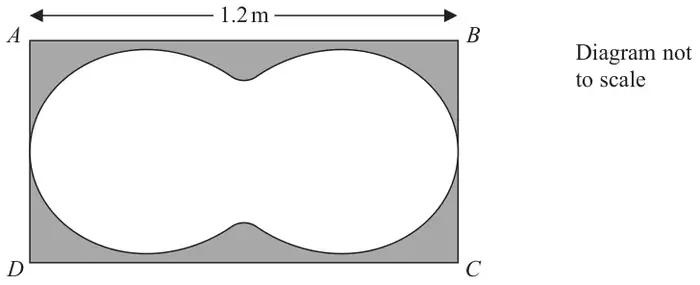
Figure 1 shows the design for a table top in the shape of a rectangle \(ABCD\). The length of the table, \(AB\), is 1.2 m. The area inside the closed curve is made of glass and the surrounding area, shown shaded in Figure 1, is made of wood.
The perimeter of the glass is modelled by the curve with polar equation
\[r = 0.4 + a\cos 2\theta \qquad 0 \leqslant \theta \lt 2\pi\]where \(a\) is a constant.
Hence, given that \(AD = 60\) cm,
| Scheme | Marks | AO |
|---|---|---|
| \(2(0.4 + a) = 1.2\) or \(0.4 + a = 0.6\) or \(0.4 + a\cos 0 = 0.6\) \(\Rightarrow a = \ldots\) | M1 | 3.4 |
| \(a = 0.2\) * cso | A1* | 1.1b |
| (2) |
Notes
M1: Interprets the information from the model and realises that the maximum value of \(r\) gives half the length of the table top (or equivalent) and solves to find a value for \(a\). Use \(\theta = 0\) and \(r = 0.6\) or \(\theta = \pi\) and \(r = -0.6\) to find a value for \(a\).
Using \(\theta = 2\pi\) is M0
A1*: Correct value for \(a\).
Alternative
M1: Uses \(a = 0.2\) and \(\theta = 0\) to find a value for \(r\)
A1: Finds \(r = 0.6\) and concludes that \(a = 0.2\)
| Scheme | Marks | AO |
|---|---|---|
| Area of rectangle is \(1.2 \times 0.6\ (= 0.72)\) | B1 | 1.1b |
| Area enclosed by curve \(= \dfrac{1}{2}\displaystyle\int (0.4 + 0.2\cos 2\theta)^2\,(\mathrm{d}\theta)\) | M1 | 3.1a |
| \((0.4 + 0.2\cos 2\theta)^2 = 0.16 + 0.16\cos 2\theta + 0.04\cos^2 2\theta\) \(= 0.16 + 0.16\cos 2\theta + 0.04\left(\dfrac{\cos 4\theta + 1}{2}\right)\) | M1 | 2.1 |
| \(\dfrac{1}{2}\displaystyle\int (0.4 + 0.2\cos 2\theta)^2\,\mathrm{d}\theta = \frac{1}{2}\left[0.18\theta + 0.08\sin 2\theta + 0.005\sin 4\theta\,(+c)\right]\) \(= 0.09\theta + 0.04\sin 2\theta + 0.0025\sin 4\theta\,(+c)\) o.e. | A1ft | 1.1b |
| Area enclosed by curve \(= \left[0.09\theta + 0.04\sin 2\theta + 0.0025\sin 4\theta\right]_0^{2\pi}\) or Area enclosed by curve \(= 2\left[0.09\theta + 0.04\sin 2\theta + 0.0025\sin 4\theta\right]_0^{\pi}\) or Area enclosed by curve \(= 4\left[0.09\theta + 0.04\sin 2\theta + 0.0025\sin 4\theta\right]_0^{\pi/2}\) | dM1 | 3.1a |
| \(= \dfrac{9}{50}\pi\) or \(0.18\pi\ (= 0.5654\ldots)\) | A1 | 1.1b |
| Area of wood \(= 1.2 \times 0.6 - 0.18\pi\) | M1 | 1.1b |
| \(=\) awrt 0.155 (m2) | A1 | 1.1b |
| (8) | ||
| (10 marks) |
Notes
B1: \(1.2 \times 0.6\) or 0.72
M1: A correct strategy identified for finding an area enclosed by the polar curve using a correct formula with \(r\) substituted. Attempt at area \(= \dfrac{1}{2}\displaystyle\int (0.4 + 0.2\cos 2\theta)^2\,\mathrm{d}\theta = \ldots\)
Look for \(= \lambda \times \dfrac{1}{2}\displaystyle\int (0.4 + 0.2\cos 2\theta)^2\,\mathrm{d}\theta = \ldots\)
If the \(\dfrac{1}{2}\) is not explicitly seen then look at the limits and it must be either
\[= \int_0^{\pi} (0.4 + 0.2\cos 2\theta)^2\,\mathrm{d}\theta = \ldots \text{ or } = 2\int_0^{\frac{\pi}{2}} (0.4 + 0.2\cos 2\theta)^2\,\mathrm{d}\theta = \ldots\]Condone missing \(\mathrm{d}\theta\)
M1: Squares to achieve three terms and uses \(\cos^2 2\theta = \dfrac{\pm 1 \pm \cos 4\theta}{2}\) to obtain an expression in an integrable form.
A1ft: Correct follow through integration as long as the previous two method marks have been awarded.
dM1: Dependent of first method mark. Finds the required area enclosed by the curve using the correct limits.
There are only three cases either \(\dfrac{1}{2}\displaystyle\int_0^{2\pi} (0.4 + 0.2\cos 2\theta)^2\,\mathrm{d}\theta\) or \(\displaystyle\int_0^{\pi} (0.4 + 0.2\cos 2\theta)^2\,\mathrm{d}\theta\) or \(2\displaystyle\int_0^{\frac{\pi}{2}} (0.4 + 0.2\cos 2\theta)^2\,\mathrm{d}\theta\)
The use of the limit 0 can be implied if it gives 0 but the use of 0 must been seen or implied if it does not result in 0 (just writing 0 is insufficient)
A1: Correct area of the glass following fully correct working. Do not award for the correct answer following incorrect working.
M1: Subtracts their area of the glass from their area of the rectangle, as long as it does not give a negative area
A1: awrt 0.155 or awrt 0.155 m2 (If the units are stated they must be correct)
Note: Using a calculator to find the area scores a maximum of B1M0M0A0M0A0M1A1