
AS June 2024 Q2
2.
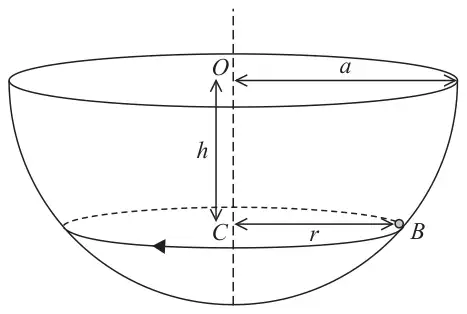
A thin hollow hemisphere, with centre \(O\) and radius \(a\), is fixed with its axis vertical, as shown in Figure 2.
A small ball \(B\) of mass \(m\) moves in a horizontal circle on the inner surface of the hemisphere. The circle has centre \(C\) and radius \(r\). The point \(C\) is vertically below \(O\) such that \(OC = h\).
The ball moves with constant angular speed \(\omega\)
The inner surface of the hemisphere is modelled as being smooth and \(B\) is modelled as a particle. Air resistance is modelled as being negligible.
Given that the magnitude of the normal reaction between \(B\) and the surface of the hemisphere is \(3mg\)
| Scheme | Marks | AO |
|---|---|---|
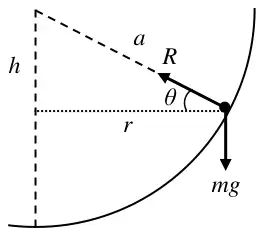 | ||
| Resolve horizontally | M1 | 3.1b |
| \(mr\omega^2 = R\cos\theta\) | A1 | 1.1b |
| Resolve vertically | M1 | 3.1b |
| \(mg = R\sin\theta\) | A1 | 1.1b |
| \(\dfrac{g}{r\omega^2} = \tan\theta = \dfrac{h}{r}\) | DM1 | 1.1b |
| \(\Rightarrow \omega^2 = \dfrac{g}{h}\) * | A1* | 2.2a |
| (6) |
Notes
M1: Dimensionally correct. Condone sine/cosine confusion
A1: Or equivalent correct unsimplified equation
M1: Dimensionally correct. Condone consistent sine/cosine confusion
A1: Or equivalent correct unsimplified equation
NB: can score the first 4 marks by resolving tangentially: \(mg\cos\theta = mr\omega^2\sin\theta\)
DM1: Eliminate \(R\), \(\theta\) to obtain equation in \(\omega^2\)
Dependent on both previous M marks
A1*: Obtain given answer from full and correct working
| Scheme | Marks | AO |
|---|---|---|
| Resolve horizontally or vertically | M1 | 2.1 |
| \(ma\cos\theta\,\omega^2 = 3mg\cos\theta \Rightarrow a\omega^2 = 3g\) or \(mg = 3mg\sin\theta \Rightarrow g = 3g \times \dfrac{g}{a\omega^2}\) | A1 | 1.1b |
| \(\omega = \sqrt{\dfrac{3g}{a}}\) | A1 | 1.1b |
| (3) |
Notes
M1: Resolve and substitute for \(R\) and \(r\). Dimensionally correct. Condone sine/cosine confusion
A1: Correct equation in \(a\), \(g\) and \(\omega\)
A1: Correct only
| Scheme | Marks | AO |
|---|---|---|
| Have ignored the dimensions of \(B\) | B1 | 3.5b |
| (1) | ||
| (10 marks) |
Notes
B1: Or equivalent or acceptable alternatives e.g. have ignored spin of \(B\)
B0 for weight acts through a point
B0 if any incorrect extras