
AS June 2025 Q4
4. A car is travelling round a circular track. The car moves with constant speed in a horizontal circle of radius \(r\).
In an initial model,
- the car and driver are modelled as a single particle
- the track is modelled as being rough, so that there is sideways friction between the tyres of the car and the track with coefficient of friction \(\mu\)
- the track is modelled as being horizontal
Using this model, the maximum speed at which the car can move round the circle of radius \(r\) without slipping sideways is \(\dfrac{1}{2}\sqrt{gr}\).
In a refined model,
- the car and driver are modelled as a single particle
- the track is modelled as being rough, so that there is sideways friction between the tyres of the car and the track with coefficient of friction \(\dfrac{1}{4}\)
- the track is modelled as being banked at an angle \(\theta\) to the horizontal
Using this model, the minimum speed at which the car can move round the circle of radius \(r\) without slipping sideways is \(\sqrt{\dfrac{4rg}{35}}\)
| Scheme | Marks | AO |
|---|---|---|
| \(R = mg\) | B1 | 1.1b |
| Equation of motion horizontally | M1 | 3.4 |
| \(F = m\dfrac{\left(\frac{gr}{4}\right)}{r}\ \left(= \dfrac{1}{4}mg\right)\) | A1 | 1.1b |
| Use \(F = \mu R\) | M1 | 1.2 |
| \(\mu = \dfrac{1}{4}\) * | A1* | 2.2a |
| (5) |
Notes
B1: cao
M1: Correct no. of terms and use of given velocity seen
A1: Correct equation
M1: Use of \(F = \mu R\)
A1*: Correct answer correctly obtained
| Scheme | Marks | AO |
|---|---|---|
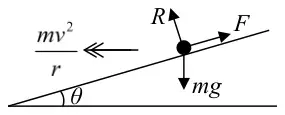 | ||
| Resolve vertically or perpendicular to slope | M1 | 3.4 |
| \(R\cos\theta + F\sin\theta = mg\) or \(R - mg\cos\theta = \dfrac{mv^2}{r}\sin\theta\) | A1 | 1.1b |
| Equation of motion horizontally or parallel to slope | M1 | 3.4 |
| \(R\sin\theta - F\cos\theta = m\dfrac{\left(\frac{4gr}{35}\right)}{r}\) or \(mg\sin\theta - F = \dfrac{mv^2}{r}\cos\theta\) | A1 | 1.1b |
| Use of \(F = \dfrac{1}{4}R\) | M1 | 1.2 |
| Eliminate \(F\) and \(R\) and obtain equation in \(\tan\theta\): \(\dfrac{\tan\theta - \frac{1}{4}}{1 + \frac{1}{4}\tan\theta} = \dfrac{4}{35}\) | M1 | 3.1b |
| \(\tan\theta = \dfrac{3}{8}\) \(\left(= \dfrac{51}{136} = 0.375\right)\) | A1 | 1.1b |
| (7) | ||
| (12 marks) |
Notes
M1: Correct no. of terms, condone sin/cos confusion and sign errors
A1: Correct equation
M1: Correct no. of terms, condone sin/cos confusion and sign errors
A1: Correct equation
M1: Use of \(F = \dfrac{1}{4}R\) (where \(R \neq mg\) or \(mg\cos\theta\))
M1: Produce equation in \(\tan\theta\) only
A1: cao. Condone 0.38 or better