
AS June 2025 Q3
3. [In this question you may quote, without proof, the formula for the distance of the centre of mass of a circular arc from its centre.]
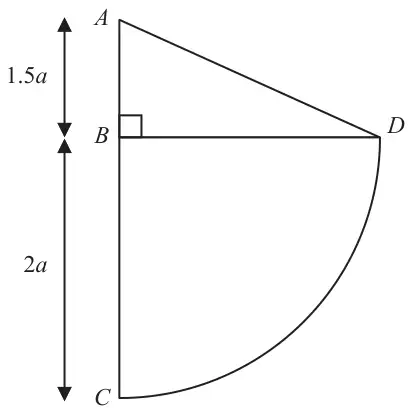
Uniform wire is used to form the rigid framework shown in Figure 2.
The framework consists of four straight pieces of wire, \(AB\), \(BC\), \(BD\) and \(AD\) and one piece in the shape of an arc of a circle, \(CD\).
In the framework
- \(AB = 1.5a\) and \(BC = BD = 2a\)
- \(CD\) is an arc of a circle of radius \(2a\) and centre \(B\)
- \(ABC\) is a straight line and \(ABD\) is a right angle
- \(A, B, C\) and \(D\) all lie in the same plane
The framework is freely pivoted at \(A\).
The framework is held in equilibrium, with \(BD\) horizontal, by an upward vertical force that is applied to the framework at \(D\).
The mass of the framework is \(M\).
The magnitude of the force exerted on the framework by the pivot at \(A\) is \(kMg\).
| Scheme | Marks | AO |
|---|---|---|
| \(\dfrac{2a\sin\frac{\pi}{4}}{\frac{\pi}{4}}\cos\dfrac{\pi}{4}\) | M1 | 2.1 |
| \(\dfrac{4a}{\pi}\) * | A1* | 1.1b |
| (2) |
Notes
M1: Correct expression using either trigonometry or Pythagoras’:
\(\sqrt{2 \times \text{“distance”}^2} = \dfrac{2a\sin\frac{\pi}{4}}{\frac{\pi}{4}}\) leading to “distance” = …
A1*: Correct given answer correctly obtained. Condone \(\dfrac{4}{\pi}a\).
| Scheme | Marks | AO |
|---|---|---|
| \(AD\) \(BD\) Arc \(CD\) framework | ||
| \(2.5a\) \(2a\) \(\pi a\) \(8a + \pi a\) | B1 | 1.2 |
| Moments about \(AC\) | M1 | 3.1a |
| \(2.5a \times a + 2a \times a + \pi a \times \dfrac{4a}{\pi} = (8a + \pi a)\bar{x}\) | A1 | 1.1b |
| \(\bar{x} = \dfrac{17a}{2(8+\pi)}\) * | A1* | 2.2a |
| (4) |
Notes
B1: Any equivalent ratios
M1: Or moments about a parallel axis (distances consistent with framework not lamina). Allow consistently cancelled \(a\). Must have the correct number of terms.
A1: Correct unsimplified equation for their axis
A1*: Correct given answer correctly obtained. Condone \(\dfrac{17a}{2(\pi+8)}\)
| Scheme | Marks | AO |
|---|---|---|
| Moments about \(D\) or any other complete method | M1 | 3.1a |
| \(kMg \times 2a = Mg\left(2a - \dfrac{17a}{2(8+\pi)}\right)\) | A1 | 1.1b |
| \(k = \dfrac{15 + 4\pi}{4(8+\pi)}\) | A1 | 1.1b |
| (3) | ||
| (9 marks) |
Notes
M1: Correct no. of terms, dim correct or e.g. M(\(A\)) and vertical resolution.
A1: Correct unsimplified equation in \(k\), \(Mg\), \(a\) and \(\pi\) only. Condone correctly cancelled terms.
A1: cao (denominator does not need to be factorised)