
AS October 2020 Paper 1 Q2
2 Fig. 2 shows two complex numbers \(z_1\) and \(z_2\) represented on an Argand diagram.
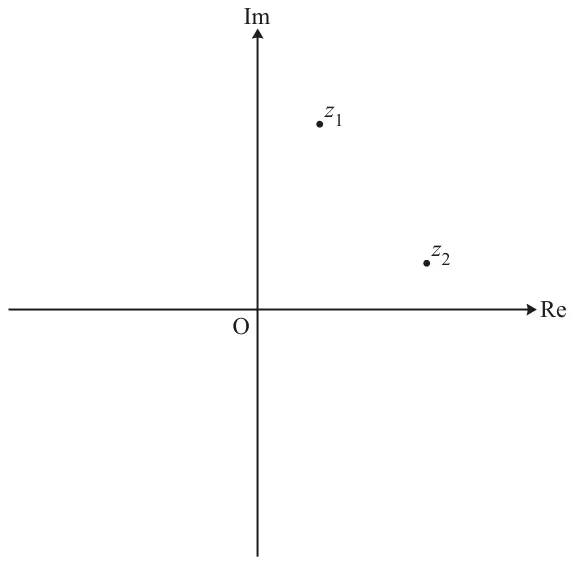
(a) On a copy of Fig. 2, mark points representing each of the following complex numbers.
- \(z_1^*\)
- \(z_2 - z_1\) [2]
(b) In this question you must show detailed reasoning.
In the case where \(z_1 = 1 + 2\mathrm{i}\) and \(z_2 = 3 + \mathrm{i}\), find \(\dfrac{z_2 - z_1}{z_1^*}\) in the form \(a + \mathrm{i}b\), where \(a\) and \(b\) are real numbers. [2]
In the case where \(z_1 = 1 + 2\mathrm{i}\) and \(z_2 = 3 + \mathrm{i}\), find \(\dfrac{z_2 - z_1}{z_1^*}\) in the form \(a + \mathrm{i}b\), where \(a\) and \(b\) are real numbers. [2]
| Scheme | Marks | AO |
|---|---|---|
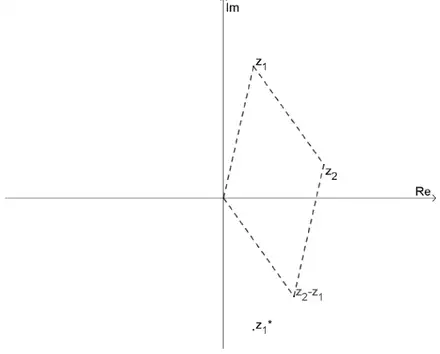 | B1 B1 | 1.1 1.1 |
| [2] |
Notes
B1: (1st) \(z_1^*\) reflection in Re axis
B1: (2nd) \(z_2 - z_1\) forming parallelogram
| Scheme | Marks | AO |
|---|---|---|
| DR \(\dfrac{z_2 - z_1}{z_1^*} = \dfrac{2 - \mathrm{i}}{1 - 2\mathrm{i}} = \dfrac{(2 - \mathrm{i})(1 + 2\mathrm{i})}{(1 - 2\mathrm{i})(1 + 2\mathrm{i})}\) | M1 | 1.1 |
| \(= \dfrac{4}{5} + \dfrac{3}{5}\mathrm{i}\) | A1 | 1.1 |
| [2] |
Notes
M1: \(\times\) top and bottom by \(1 + 2\mathrm{i}\)
A1: condone \(\dfrac{4 + 3\mathrm{i}}{5}\)