10 The region \(R\) on an Argand diagram satisfies both \(|z + 2\mathrm{i}| \leqslant 3\) and \(-\dfrac{\pi}{6} \leqslant \arg(z) \leqslant \dfrac{\pi}{2}\)
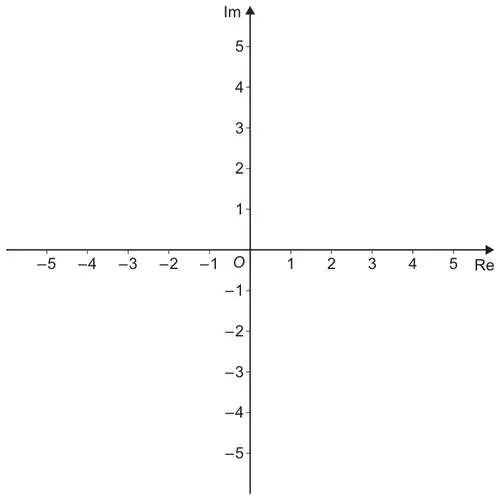
(a) Sketch \(R\) on the Argand diagram below. [3 marks]
(b) Find the maximum value of \(|z|\) in the region \(R\), giving your answer in exact form. [5 marks]
Mark scheme (a)
Scheme
Marks
AO
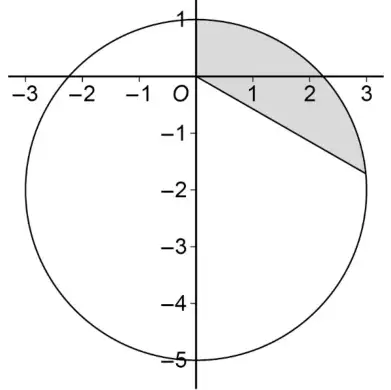
Draws correct arc or circle, intersecting the imaginary axis at 1.
B1
1.1b
Draws correct half-line or line at an angle between \(-\dfrac{\pi}{4}\) and 0.
B1
1.1b
Shades or clearly labels correct region.
B1
1.1b
(3)
Typical solution
Mark scheme (b)
Scheme
Marks
AO
Deduces that the maximum value occurs where the half-line \(\arg z = -\dfrac{\pi}{6}\) and the circle intersect. PI
M1
2.2a
Selects a method to form a quadratic equation in \(x\), \(y\) or \(|z|\)
M1
3.1a
Forms a correct quadratic in \(x\), \(y\) or \(|z|\)
A1
2.2a
Obtains an expression for the maximum value of \(|z|\)
M1
1.1a
Obtains the correct exact value for the maximum value of \(|z|\) ACF e.g. \(\sqrt{7 + 2\sqrt{6}}\)
A1
1.1b
(5)
(8 marks)
Typical solution
Maximum value of \(|z|\) occurs where circle and half-line intersect.