
AS June 2018 Paper 1 Q13
13 The graph of the rational function \(y = \mathrm{f}(x)\) intersects the \(x\)-axis exactly once at \((-3, 0)\)
The graph has exactly two asymptotes, \(y = 2\) and \(x = -1\)
(a) Find \(\mathrm{f}(x)\) [2 marks]
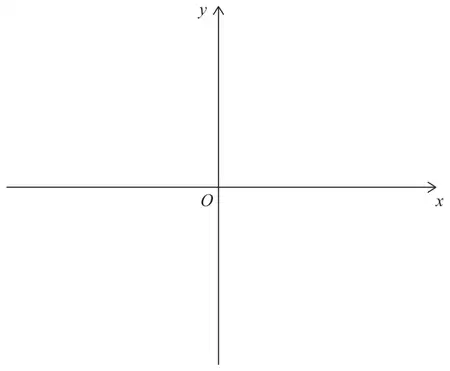
(b) Sketch the graph of the function. [3 marks]
(c) Find the range of values of \(x\) for which \(\mathrm{f}(x) \leqslant 5\) [4 marks]
| Scheme | Marks | AO |
|---|---|---|
| Writes any rational function with a horizontal asymptote of \(y = 2\) or one vertical asymptote of \(x = -1\), e.g. \(y = \frac{ax + b}{x + 1}\) or \(y = \frac{2x + b}{x + c}\) or \(y = \frac{ax^n + bx^{n-1} + cx^{n-2} + \ldots\ldots}{dx^n + ex^{n-1} + fx^{n-2} + \ldots\ldots}\) where \(\frac{a}{d} = 2\) Accept any correct rearrangement of \(y = \mathrm{f}(x)\), where \(\mathrm{f}(x)\) is a function as described above. | M1 | 3.1a |
| Obtains a fully correct answer. | A1 | 1.1b |
Typical solution
\[y = \frac{2x + c}{x + 1}\]but \(x = -3\) when \(y = 0\)
\[\therefore 0 = \frac{2 \times -3 + c}{-3 + 1}\]\[-6 + c = 0\]\[c = 6\]\[\therefore y = \frac{2x + 6}{x + 1}\](Corrected from the printed mark scheme: its first line is printed as \(y = \frac{2x + m}{x + 1}\), but the working that follows uses \(c\).)
Alternative
\[(x + 1)(y - 2) = n\]but \(x = -3\) when \(y = 0\)
\[\therefore (-3 + 1)(0 - 2) = n\]\[4 = n\]\[\therefore (x + 1)(y - 2) = 4\]\[y - 2 = \frac{4}{x + 1}\]\[y = 2 + \frac{4}{x + 1}\]| Scheme | Marks | AO |
|---|---|---|
| Sketches any rectangular hyperbola, or rational function, tending to the correct vertical and horizontal asymptotes included or implied. | M1 | 1.1a |
| Sketches a correct graph, including the asymptotes. Accept the graph of their function if M1A1 scored in part (a). Accept un-ruled asymptotes – mark intention. | A1 | 1.1b |
| Indicates correct axis-intercepts. Follow through their equation if their \(y\)-intercept matches their graph. | A1F | 1.1b |
Typical solution
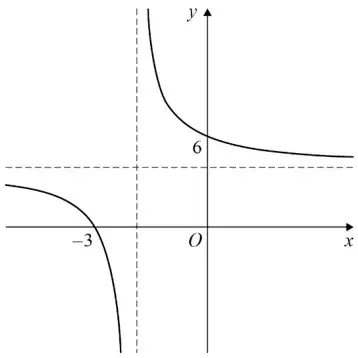
| Scheme | Marks | AO |
|---|---|---|
| Forms an equation or inequality with \(y = 5\) and their rational function. | M1 | 1.1a |
| Obtains correct \(x\)-intercept with \(y = 5\) Follow through their rational function from part (a) | A1F | 1.1b |
| Deduces one correct region \(x \geqslant \frac{1}{3}\) or \(x \lt -1\) Condone \(x \leqslant -1\) for this mark. Follow through their \(\frac{1}{3}\) if greater than \(-1\) | A1F | 2.2a |
| Deduces correct regions. Accept correct regions for their function if M1A1 scored in part (a). | A1 | 2.2a |
| (9 marks) |
Typical solution
\[5 = \frac{2x + 6}{x + 1}\]\[5(x + 1) = 2x + 6\]\[5x + 5 = 2x + 6\]\[3x = 1\]\[x = \frac{1}{3}\]\[x \lt -1, \quad x \geqslant \frac{1}{3}\]Alternative
\[\frac{2x + 6}{x + 1} \leqslant 5\]\[(2x + 6)(x + 1) \leqslant 5(x + 1)^2\]\[0 \leqslant (x + 1)\left(5(x + 1) - (2x + 6)\right)\]\[0 \leqslant (x + 1)(3x - 1)\]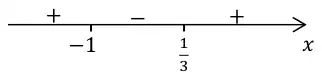
Alternative
\[\frac{2x + 6}{x + 1} \leqslant 5\]\[\frac{2x + 6}{x + 1} - \frac{5(x + 1)}{x + 1} \leqslant 0\]\[\frac{-3x + 1}{x + 1} \leqslant 0\]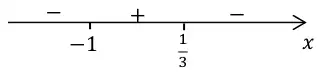
Alternative
For \(x \gt -1\):
\[2x + 6 \leqslant 5(x + 1)\]\[1 \leqslant 3x\]\[x \geqslant \frac{1}{3}\]For \(x \lt -1\):
\[2x + 6 \geqslant 5(x + 1)\]\[1 \geqslant 3x\]\[x \lt -1, \quad x \geqslant \frac{1}{3}\]