
AS June 2018 Q2
2.
Two teams, A and B, are to face each other as part of a quiz.
There will be several rounds to the quiz with 10 points available in each round.
For each round, the two teams will each choose a team member and these two people will compete against each other until all 10 points have been awarded. The number of points that Team A can expect to gain in each round is shown in the table below.
| Team B | ||||
|---|---|---|---|---|
| Paul | Qaasim | Rashid | ||
| Team A | Mischa | 5 | 6 | 3 |
| Noel | 4 | 1 | 7 | |
| Olive | 4 | 5 | 8 | |
The teams are each trying to maximise their number of points.
At the last minute, Olive becomes unavailable for selection by Team A.
Team A decides to choose its player for each round so that the probability of choosing Mischa is \(p\) and the probability of choosing Noel is \(1 - p\).
For this value of \(p\),
| Scheme | Marks | AO |
|---|---|---|
| The gains (or losses) made by one player are exactly balanced by the losses (or gains) made by the other player. | B1 | 1.2 |
| (1) |
Notes
B1: cao - indication that either the losses of one (player) are balanced by the gains of the other (player) or that the total points scored by both (players) is zero
| Scheme | Marks | AO |
|---|---|---|
| 3 | B1 | 1.1b |
| (1) |
Notes
B1: cao (3)
| Scheme | Marks | AO |
|---|---|---|
| e.g. if a member of team \(A\) gains \(x\) points then a member of team \(B\) gains \(10 - x\) points. Subtracting 5 from both gives \(A\): \(x - 5\) and \((10 - x) - 5 = 5 - x\). The sum is \((x - 5) + (5 - x) = 0\) | B1 | 2.4 |
| (1) |
Notes
B1: correct explanation – could explain their reasoning using a numerical example
| Scheme | Marks | AO |
|---|---|---|
| (i) Row minima: \(-2, -4, -1\) max is \(-1\) Column maxima: \(0, 1, 3\) min is \(0\) Play safe for Team \(A\) is Olive and for Team \(B\) is Paul | M1 A1 A1 | 1.1b 1.1b 1.1b |
| (ii) Row maximin (\(-1\)) \(\neq\) Col minimax (0) so not stable | B1 | 2.4 |
| (4) |
Notes
(i) M1: finding row minimums and column maximums – condone one error
A1: max (row minima) and min (column maxima) correct – dependent on all correct values of row minimums and column maximums
A1: correct play safes for both teams (Olive (O) and Paul (P))
(ii) B1: row maximin (\(-1\)) \(\neq\) col minimax (0) (so not stable)
SC for (d) and (e) for those candidates who do not consider the zero-sum game
For (d) M1 only for finding row minimums (3, 1, 4) and column maximums (5, 6, 8) – condone one error. Then allow possibility of full marks in (e) – expressions should be \(p + 4\), \(5p + 1\) and \(-4p + 7\) and the graph should lead to \(5p + 1 = -4p + 7\)
| Scheme | Marks | AO |
|---|---|---|
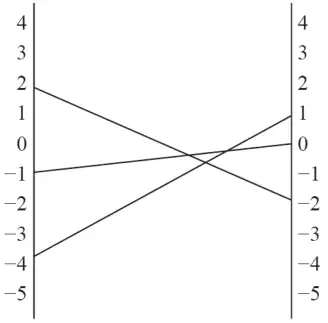
| If \(B\) plays strategy 1, \(A\)’s gains are \(-1(1 - p) = p - 1\) If \(B\) plays strategy 2, \(A\)’s gains are \(p + -4(1 - p) = 5p - 4\) If \(B\) plays strategy 3, \(A\)’s gains are \(-2p + 2(1 - p) = 2 - 4p\) | M1 A1 | 1.1b 1.1b |
 | M1 A1 | 1.1b 1.1b |
| \(2 - 4p = 5p - 4 \Rightarrow p = 2/3\) | A1 | 1.1b |
| Team A should play Mischa with probability 2/3 and Noel with probability 1/3 | A1ft | 3.2a |
| (6) |
Notes
M1: setting up three expressions in terms of \(p\) with at least one correct
A1: all three expressions correct
M1: axes correct, at least one line correctly drawn for their expressions
A1: correct graph with consistent scaling (lines must not extend past \(p \lt 0\) and \(p \gt 1\))
A1: correct probability expressions leading to correct value of \(p\)
A1ft: interpret their value of \(p\) in the context of the question – must refer to play and the team members
SC for (d) and (e) for those candidates who do not consider the zero-sum game
For (d) M1 only for finding row minimums (3, 1, 4) and column maximums (5, 6, 8) – condone one error. Then allow possibility of full marks in (e) – expressions should be \(p + 4\), \(5p + 1\) and \(-4p + 7\) and the graph should lead to \(5p + 1 = -4p + 7\)
| Scheme | Marks | AO |
|---|---|---|
| (i) 13/3 | B1 | 1.1b |
| (ii) 17/3 | B1ft | 2.2a |
| (2) | ||
| (15 marks) |
Notes
(i) B1: cao
(ii) B1ft: 10 – their answer to (f)(i)