
AS June 2019 Q4
4. The table below gives the pay-off matrix for a zero-sum game between two players, Aljaz and Brendan. The values in the table show the pay-offs for Aljaz.
| Brendan | ||||
|---|---|---|---|---|
| Option X | Option Y | Option Z | ||
| Aljaz | Option P | \(-6\) | \(-1\) | \(2\) |
| Option Q | \(5\) | \(4\) | \(-7\) | |
| Option R | \(5\) | \(6\) | \(3\) | |
Option R is removed from Aljaz’s choices and the reduced game, with option R removed, is no longer stable.
Let Brendan play option X with probability \(q\)
| Scheme | Marks | AO |
|---|---|---|
| (i) Row minima: \(-6, -7, 3\) max is \(3\) Column maxima: \(5, 6, 3\) min is \(3\) | M1 | 1.1b |
| Row(maximin) = Col(minimax) therefore game is stable | A1 | 2.4 |
| (ii) value of the game to B is \(-3\) | B1 | 2.2a |
| (3) |
Notes
M1: finding row minimums and column maximums – condone one error
A1: row maximin (3) = col minimax (3) so stable (dependent on correct row minimums and col maximums) - as a minimum accept ‘3 = 3 so stable’
B1: CAO (\(-3\))
| Scheme | Marks | AO |
|---|---|---|
| Let A play option P with probability \(p\) and option Q with probability \(1 - p\) | B1 | 3.3 |
| If \(B\) plays option X, \(A\)’s gains are \(-6p + 5(1 - p) = 5 - 11p\) If \(B\) plays option Y, \(A\)’s gains are \(-p + 4(1 - p) = 4 - 5p\) If \(B\) plays option Z, \(A\)’s gains are \(2p + (-7)(1 - p) = -7 + 9p\) | M1 A1 | 1.1b 1.1b |
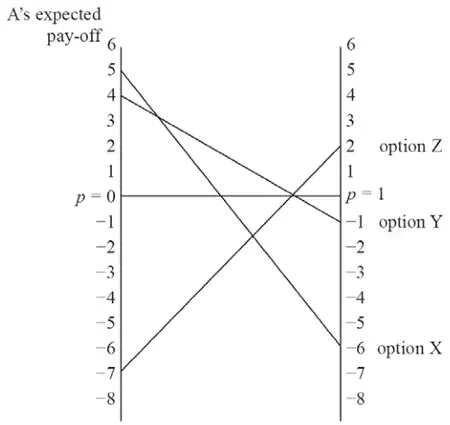 | M1dep A1 | 1.1b 1.1b |
| \(5 - 11p = -7 + 9p \Rightarrow p = 3/5\) | A1 | 1.1b |
| A should play option P with probability 0.6 and option Q with probability 0.4 | A1ft | 3.2a |
| (7) |
Notes
B1: defining variable \(p\) (must mention ‘probability’ – as a minimum accept ‘P with probability \(p\) and Q with probability \(1 - p\)’)
M1: setting up three expressions in terms of \(p\) (need not be simplified)
A1: all three expressions correctly simplified
M1dep: axes correct, at least one line correctly drawn from their expressions – dependent on previous M mark in (b)
A1: correct graph – if no scaling on vertical axis assume 1 line = 1 unit (A0 if graph extends for \(p \lt 0\) and/or \(p \gt 1\))
A1: using the graph to obtain the correct probability expressions leading to the correct value of \(p\)
A1ft: interpret their value of \(p\) in the context of the question – must refer to ‘play’ and the associated probabilities (need not say ‘probability’ again) – this mark is dependent on both previous M marks in this part
| Scheme | Marks | AO |
|---|---|---|
| As indicated by the graph Brendan can, for all values of \(p\), gain more by playing either options X or Z e.g. for \(0 \leqslant p \leqslant \frac{3}{5}\) Brendan would be better off playing Z and for \(\frac{3}{5} \lt p \leqslant 1\) Brendan would be better off playing X than playing Y | B1 | 3.2a |
| (1) |
Notes
B1: correct explanation in context (of playing only X and Z for all \(p\)) with specific reference to the modelling of the problem by the graph
| Scheme | Marks | AO |
|---|---|---|
| (i) If A plays option P then B can expect to gain \(-\left(-6q + 2(1 - q)\right)\) as the values in the table are the pay-offs for A | B1 | 2.2a |
| The value of the game to B is \(-\left(5 - 11(0.6)\right) = 1.6\) (or equivalent calculation e.g. \(-\left(-7 + 9(0.6)\right)\)) | B1 | 2.1 |
| (ii) \(6q - 2(1 - q) = 1.6 \Rightarrow q = 0.45\) | B1 | 1.1b |
| B should play option X with probability 0.45 and option Z with probability 0.55 | B1 | 3.2a |
| (4) | ||
| (15 marks) |
Notes
(i) B1: correctly deducing the lhs of the given equation (with clear reasoning for the change in sign) – only allow stating \(6q - 2(1 - q)\) (without seeing the change of sign) if the game is restated for player B
B1: correctly deriving the rhs of the given equation (must indicate that this is the value of the game to B although as a minimum accept V(B)) – stating \(\pm 1.6\) without any working is B0 - note that for either mark in (d)(i) candidates must explain where the two parts of the given equation came from
Note that candidates may explain the formulation of the given equation by considering \(-6q + 2(1 - q) = -1.6\) (which is what player B can expect to lose if player A plays option P which is equal to the value of the game to player A)
(ii) B1: CAO for the value of \(q\) (must come from solving \(6q - 2(1 - q) = 1.6\))
B1: CAO in context and must refer to ‘play’