
AS June 2019 Q4
4.
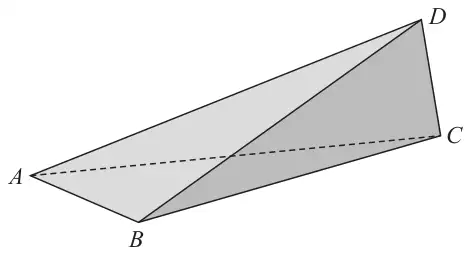
Figure 1 shows a sketch of a solid doorstop made of wood. The doorstop is modelled as a tetrahedron.
Relative to a fixed origin \(O\), the vertices of the tetrahedron are \(A\ (2, 1, 4)\), \(B\ (6, 1, 2)\), \(C\ (4, 10, 3)\) and \(D\ (5, 8, d)\), where \(d\) is a positive constant and the units are in centimetres.
Given that the volume of the doorstop is \(21\ \text{cm}^3\)
| Scheme | Marks | AO |
|---|---|---|
| \(A(2, 1, 4),\ B(6, 1, 2),\ C(4, 10, 3),\ D(5, 8, d)\) | ||
| Way 1 Uses appropriate vectors in a correct method to make a complete attempt to find the area of triangle \(ABC\). | M1 | 3.1b |
| \(\overrightarrow{AB} = \begin{pmatrix}4\\ 0\\ -2\end{pmatrix},\ \overrightarrow{AC} = \begin{pmatrix}2\\ 9\\ -1\end{pmatrix},\ \left\{\overrightarrow{BC} = \begin{pmatrix}-2\\ 9\\ 1\end{pmatrix}\right\}\) | M1 | 1.1b |
| e.g. \(\begin{vmatrix}\mathbf{i} & \mathbf{j} & \mathbf{k}\\ 4 & 0 & -2\\ 2 & 9 & -1\end{vmatrix} = \ldots\) or \(\begin{pmatrix}4\\ 0\\ -2\end{pmatrix} \times \begin{pmatrix}2\\ 9\\ -1\end{pmatrix} = \ldots\) | M1 | 1.1b |
| \(= 18\mathbf{i} + 0\mathbf{j} + 36\mathbf{k}\) | ||
| Area \(ABC = \dfrac{1}{2}\sqrt{(18)^2 + (0)^2 + (36)^2}\) | ||
| \(\{= 20.1246\ldots\} = 9\sqrt{5}\ (\text{cm}^2)\) or awrt \(20.1\ (\text{cm}^2)\) | A1 | 2.2a |
| (4) |
Notes
Way 1
M1: Complete correct process of taking the vector product between 2 edges of triangle \(ABC\), applying Pythagoras and multiplying the result by 0.5
M1: Uses a correct method to find any 2 edges of triangle \(ABC\)
M1: Attempts to take the vector cross product between 2 edges of triangle \(ABC\)
A1: Deduces the correct area of either \(9\sqrt{5}\ (\text{cm}^2)\) or awrt \(20.1\ (\text{cm}^2)\)
Note: For Way 1 and Way 2, using any of \(\overrightarrow{OA}\), \(\overrightarrow{OB}\) or \(\overrightarrow{OC}\) in their vector product is M0 M0 A0 A0
(a) Way 2
| Scheme | Marks | AO |
|---|---|---|
| Uses appropriate vectors to find an angle or perpendicular height in triangle \(ABC\) and uses a correct method to make a complete attempt to find the area of triangle \(ABC\). | M1 | 3.1b |
| \(\overrightarrow{AB} = \begin{pmatrix}4\\ 0\\ -2\end{pmatrix},\ \overrightarrow{AC} = \begin{pmatrix}2\\ 9\\ -1\end{pmatrix},\ \left\{\overrightarrow{BC} = \begin{pmatrix}-2\\ 9\\ 1\end{pmatrix}\right\}\) | M1 | 1.1b |
| Uses a correct method to find an angle or perpendicular height in triangle \(ABC\) | M1 | 1.1b |
| Note: \(B\hat{A}C = 76.047\ldots,\ A\hat{B}C = 76.047\ldots,\ B\hat{C}A = 27.905\ldots\) or perpendicular height \(= 9\) | ||
| Area \(ABC = \dfrac{1}{2}\sqrt{86}\sqrt{20}\sin 76.047\ldots\) or \(\dfrac{1}{2}\sqrt{86}\sqrt{86}\sin 27.905\ldots\) or \(\dfrac{1}{2}\sqrt{20}(9)\) | ||
| \(\{= 20.1246\ldots\} = 9\sqrt{5}\ (\text{cm}^2)\) or awrt \(20.1\ (\text{cm}^2)\) | A1 | 2.2a |
| (4) |
M1: See scheme
M1: Uses a correct method to find any 2 edges of triangle \(ABC\)
M1: Either
- finds an angle in \(ABC\) by using a correct scalar product method
- finds an angle in \(ABC\) by using the cosine rule in the correct direction
- realises triangle \(ABC\) is isosceles and applies Pythagoras in the correct direction to find the perpendicular height
A1: Deduces the correct area as either \(9\sqrt{5}\ (\text{cm}^2)\) or awrt \(20.1\ (\text{cm}^2)\)
(Corrected from the printed mark scheme: the Note in Way 2 is printed as \(B\hat{A}C = 27.905\ldots,\ A\hat{B}C = 76.047\ldots,\ B\hat{C}A = 76.047\ldots\); since \(AC = BC = \sqrt{86}\), the angles at \(A\) and \(B\) are equal, and the angle at \(C\) is \(27.905\ldots\).)
(a) Way 3
| Scheme | Marks | AO |
|---|---|---|
| Complete attempt to find the area of triangle \(ABC\) by applying \(\dfrac{1}{2}\left|\overrightarrow{OA} \times \overrightarrow{OB} + \overrightarrow{OB} \times \overrightarrow{OC} + \overrightarrow{OC} \times \overrightarrow{OA}\right|\) or equivalent | M1 | 3.1b |
| \(\overrightarrow{OA} \times \overrightarrow{OB} = \begin{vmatrix}\mathbf{i} & \mathbf{j} & \mathbf{k}\\ 2 & 1 & 4\\ 6 & 1 & 2\end{vmatrix} = \ldots\) and \(\overrightarrow{OB} \times \overrightarrow{OC} = \begin{vmatrix}\mathbf{i} & \mathbf{j} & \mathbf{k}\\ 6 & 1 & 2\\ 4 & 10 & 3\end{vmatrix} = \ldots\), and \(\overrightarrow{OC} \times \overrightarrow{OA} = \begin{vmatrix}\mathbf{i} & \mathbf{j} & \mathbf{k}\\ 4 & 10 & 3\\ 2 & 1 & 4\end{vmatrix} = \ldots\) | M1 | 1.1b |
| \(\{\overrightarrow{OA} \times \overrightarrow{OB} + \overrightarrow{OB} \times \overrightarrow{OC} + \overrightarrow{OC} \times \overrightarrow{OA}\} = \begin{pmatrix}-2\\ 20\\ -4\end{pmatrix} + \begin{pmatrix}-17\\ -10\\ 56\end{pmatrix} + \begin{pmatrix}37\\ -10\\ -16\end{pmatrix}\) | M1 | 1.1b |
| Area \(ABC = \dfrac{1}{2}\sqrt{(18)^2 + (0)^2 + (36)^2}\) | ||
| \(\{= 20.1246\ldots\} = 9\sqrt{5}\ (\text{cm}^2)\) or awrt \(20.1\ (\text{cm}^2)\) | A1 | 2.2a |
| (4) |
M1: See scheme
M1: Attempts to apply \(\overrightarrow{OA} \times \overrightarrow{OB}\), \(\overrightarrow{OB} \times \overrightarrow{OC}\) and \(\overrightarrow{OC} \times \overrightarrow{OA}\)
A1: Attempts to add (as vectors) the results of applying \(\overrightarrow{OA} \times \overrightarrow{OB}\), \(\overrightarrow{OB} \times \overrightarrow{OC}\) and \(\overrightarrow{OC} \times \overrightarrow{OA}\)
A1: Deduces the correct area as either \(9\sqrt{5}\ (\text{cm}^2)\) or awrt \(20.1\ (\text{cm}^2)\)
| Scheme | Marks | AO |
|---|---|---|
| Finds appropriate vectors to form the equation volume tetrahedron \(ABCD = 21\) to give a linear equation in \(d\) Note: The volume must include \(\dfrac{1}{6}\) | M1 | 3.1a |
| e.g. \(\left|\begin{pmatrix}3\\ 7\\ d - 4\end{pmatrix} \bullet \begin{pmatrix}18\\ 0\\ 36\end{pmatrix}\right| = \ldots\) or \(\begin{vmatrix}4 & 0 & -2\\ 2 & 9 & -1\\ 3 & 7 & d - 4\end{vmatrix} = \ldots\) | M1 | 1.1b |
| \(= |54 + 36d - 144|\) or \(|4(9d - 36 + 7) - 2(14 - 27)|\ \{= |36d - 90|\}\) | A1 | 1.1b |
| \(\left\{\dfrac{1}{6}|36d - 90| = 21 \Rightarrow |36d - 90| = 126 \Rightarrow\right\}\ d = 6\) | A1 | 1.1b |
| (4) | ||
| (8 marks) |
Notes
M1: See scheme
M1: Uses appropriate vectors in an attempt at the scalar triple product
A1: Correct applied expression for the scalar triple product (allow \(\pm\) and ignore modulus sign)
A1: Correct solution leading to \(d = 6\)
Note: Using any of \(\overrightarrow{OA}\), \(\overrightarrow{OB}\), \(\overrightarrow{OC}\) or \(\overrightarrow{OD}\) in their scalar triple product is M0 M0 A0 A0
Note: Some vector product calculations for reference:
\[\left|\overrightarrow{AD}.\left(\overrightarrow{AB} \times \overrightarrow{AC}\right)\right| = \begin{vmatrix}3 & 7 & d - 4\\ 4 & 0 & -2\\ 2 & 9 & -1\end{vmatrix} = \left|\begin{pmatrix}3\\ 7\\ d - 4\end{pmatrix} \bullet \begin{pmatrix}18\\ 0\\ 36\end{pmatrix}\right| = |54 + 36d - 144| = |36d - 90|\]\[\left|\overrightarrow{AB}.\left(\overrightarrow{AC} \times \overrightarrow{AD}\right)\right| = \begin{vmatrix}4 & 0 & -2\\ 2 & 9 & -1\\ 3 & 7 & d - 4\end{vmatrix} = \left|\begin{pmatrix}4\\ 0\\ -2\end{pmatrix} \bullet \begin{pmatrix}9d - 29\\ 5 - 2d\\ -13\end{pmatrix}\right| = |36d - 116 + 26| = |36d - 90|\]\[\left|\overrightarrow{AC}.\left(\overrightarrow{AB} \times \overrightarrow{AD}\right)\right| = \begin{vmatrix}2 & 9 & -1\\ 4 & 0 & -2\\ 3 & 7 & d - 4\end{vmatrix} = \left|\begin{pmatrix}2\\ 9\\ -1\end{pmatrix} \bullet \begin{pmatrix}14\\ 10 - 4d\\ 28\end{pmatrix}\right| = |28 + 90 - 36d - 28| = |90 - 36d|\]