
AS June 2024 Q1
1.
In this question you must show all stages of your working.
Solutions relying entirely on calculator technology are not acceptable.
| Scheme | Marks | AO |
|---|---|---|
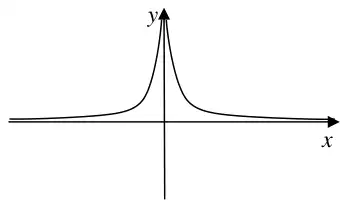 | M1 | 1.1b |
| See notes | A1 | 1.1b |
| (2) |
Notes
M1: For one branch with the correct shape in quadrant 1 or quadrant 2 (probably first quadrant)
Give tolerance on curves bending away from the axis where it is clear the correct shape is meant provided there is no clear intention to draw a minimum.
Ignore any dashed lines/scale and just look for the shape.
The branch must not clearly intentionally meet or cross either axis.
Condone gaps between the branches and the axes as long as the asymptotic behaviour is intended.
A1: Fully correct sketch. Branches should show asymptotic behaviour to the axes but condone gaps as above for this mark, clear bending away is A0.
Ignore dotted lines at or near either axis if they are clearly intended to indicate they are asymptotes.
| Scheme | Marks | AO |
|---|---|---|
| \(3 - 2x^2 = \dfrac{1}{x^2} \Rightarrow 2x^4 - 3x^2 + 1 = 0 \Rightarrow x^2 = \ldots\) or e.g. \(3 - 2x^2 = \dfrac{1}{x^2} \Rightarrow 3 - 2x^2 - \dfrac{1}{x^2} = 0 \Rightarrow \dfrac{3x^2 - 2x^4 - 1}{x^2} = 0 \Rightarrow x^2 = \ldots\) | M1 | 1.1b |
| \(x^2 = 1,\ \dfrac{1}{2}\) or e.g. \(2x^4 - 3x^2 + 1 = 0 \Rightarrow (2x^2 - 1)(x^2 - 1) = 0 \Rightarrow x^2 = 1,\ \dfrac{1}{2}\) or e.g. \(-2x^4 + 3x^2 - 1 = 0 \Rightarrow (-2x^2 + 1)(x^2 - 1) = 0 \Rightarrow (x - 1)(x + 1)(-\sqrt{2}x + 1)(\sqrt{2}x + 1) = 0\) \(\Rightarrow x = \pm 1,\ \pm\dfrac{1}{\sqrt{2}}\) | A1 | 1.1b |
| \(x = \pm 1, \pm\dfrac{\sqrt{2}}{2}\) | B1 | 1.1b |
| \(-1 \lt x \lt -\dfrac{\sqrt{2}}{2}, \qquad \dfrac{\sqrt{2}}{2} \lt x \lt 1\) | M1 A1 | 2.1 2.2a |
| (5) | ||
| (7 marks) |
Notes
The question says all working to be shown and solutions not entirely from a calculator.
M1: For an algebraic method to find the critical values so requires:
- e.g. multiplies both sides by \(x^2\) and collects terms to one side or collects terms to one side and puts over a common denominator
- solves the resulting 3 term equation for \(x^2\) (usually \(2x^4 - 3x^2 + 1 = 0\)). This can be by any method e.g. factors, formula, completing the square or calculator. The usual rules apply so if values are just written down, they must be correct for their equation.
A1: For \(x^2 = 1,\ \dfrac{1}{2}\) (ignore any reference to \(x = 0\)) or if using factors may proceed directly to \(x\)
B1 (A1 in Epen): For all four correct and exact cv’s and no others apart from \(x = 0\)
M1: Forms regions of the correct form using their four critical values.
Must have four non-zero cv’s \(a, b, c, d\) where \(a \lt b \lt c \lt d\) and form 2 “inside” inequalities with the cv’s in ascending order e.g. \(a \lt x \lt b,\ \ c \lt x \lt d\)
The directions must be correct but allow strict or non-strict inequalities or a mixture of both.
Accept alternative notation including set notation e.g.
\(\left\{x \in \mathbb{R} : -1 \lt x \lt -\frac{\sqrt{2}}{2}\right\}, \left\{x \in \mathbb{R} : \frac{\sqrt{2}}{2} \lt x \lt 1\right\}\) or e.g. \(\left(-1, -\dfrac{\sqrt{2}}{2}\right),\ \left(\dfrac{\sqrt{2}}{2}, 1\right)\)
There must be no other regions.
A1: Correct regions only. Accept with \(\dfrac{1}{\sqrt{2}}\) or e.g. \(\sqrt{\dfrac{1}{2}}\) (must be exact).
Accept equivalent correct notation but if using set notation do not condone \(\cap\)
Special case:
Candidates who solve the quartic inequality using a calculator e.g.
\(3 - 2x^2 \gt \dfrac{1}{x^2} \Rightarrow 2x^4 - 3x^2 + 1 \lt 0 \Rightarrow -1 \lt x \lt -\dfrac{\sqrt{2}}{2}, \quad \dfrac{\sqrt{2}}{2} \lt x \lt 1\)
Score a maximum of 1 mark – score as M0A0B0M1A0 in EPEN
(Corrected from the printed mark scheme: the special case prints \(2x^4 - 3x^2 + 1 \gt 0\); multiplying by \(x^2\) gives \(2x^4 - 3x^2 + 1 \lt 0\).)