
A2 June 2023 Q3
3.
In this question you must show all stages of your working.
Solutions relying entirely on calculator technology are not acceptable.
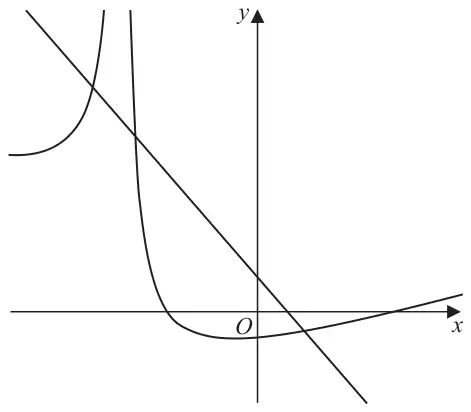
Figure 1 shows a sketch of the curve with equation \(y = \dfrac{x^2 - 2x - 24}{|x + 6|}\) and the line with equation \(y = 5 - 4x\)
Use algebra to determine the values of \(x\) for which
\[\frac{x^2 - 2x - 24}{|x + 6|} \lt 5 - 4x\](7)
| Scheme | Marks | AO |
|---|---|---|
| \(\dfrac{x^2 - 2x - 24}{|x + 6|} = 5 - 4x \Rightarrow x^2 - 2x - 24 = |x + 6|(5 - 4x)\) \(x \gt -6 \Rightarrow x^2 - 2x - 24 = (x + 6)(5 - 4x) \Rightarrow x = \ldots\) or \(x \lt -6 \Rightarrow x^2 - 2x - 24 = -(x + 6)(5 - 4x) \Rightarrow x = \ldots\) or \(\left(x^2 - 2x - 24\right)^2 = (x + 6)^2(5 - 4x)^2 \Rightarrow\) \(15x^4 + 156x^3 + 165x^2 - 1236x + 324 = 0 \Rightarrow x = \ldots\) | M1 | 1.1b |
| \(5x^2 + 17x - 54 = 0 \Rightarrow x = 2, -\dfrac{27}{5}\) or \(3x^2 + 21x - 6 = 0 \Rightarrow x = \dfrac{-7 \pm \sqrt{57}}{2}\ \left(\text{or just } \dfrac{-7 - \sqrt{57}}{2}\right)\) or any two correct roots | A1 | 1.1b |
| \(x^2 - 2x - 24 \lt (x + 6)(5 - 4x) \Rightarrow x = \ldots\) and \(x^2 - 2x - 24 \lt -(x + 6)(5 - 4x) \Rightarrow x = \ldots\) (or at least three roots from quartic) | M1 | 3.1a |
| \(x = 2, -\dfrac{27}{5}, \dfrac{-7 \pm \sqrt{57}}{2}\ \left(\text{or just } \dfrac{-7 - \sqrt{57}}{2}\right)\) | A1 | 1.1b |
| Forms \(x \lt \alpha\) and \(\beta \lt x \lt \gamma\) (see notes) | M1 | 3.1a |
| Either \(x \lt \dfrac{-7 - \sqrt{57}}{2}\) or \(-\dfrac{27}{5} \lt x \lt 2\) | A1ft | 2.2a |
| Both \(x \lt \dfrac{-7 - \sqrt{57}}{2}\) and \(-\dfrac{27}{5} \lt x \lt 2\) | A1 | 2.2a |
| (7) | ||
| (7 marks) |
Notes
M1: Multiplies through by \(|x + 6|\) or \((x + 6)\) and considers either \((x + 6)\) or \(-(x + 6)\) and attempts to solve the resulting 3TQ (do not be concerned about the method of solving), or squares both sides and simplifies to a quartic and attempts to solve. May use “=” or any inequality for this and the next 3 marks. Allow if an extra factor \((x + 6)\) is included (i.e. multiplies through by \((x + 6)^2\)).
A1: Correct roots for either equation, or any two correct roots from the (correct) quartic. Allow if \(-6\) is also included but do not count this as one of the roots.
M1: Recognises the requirement to consider both \((x + 6)\) and \(-(x + 6)\) and attempts to solve the resulting 3TQ’s (allow for any two values following the quadratic), or implied by an attempt to solve their quartic equation to find for 3 or 4 answers for their quartic, and allow for decimals, 0.2749…, −7.2749… for this mark. Again allow if extra factor \((x + 6)\) included. Allow if this is carried out but later rejected (e.g. crossed out) as they think the answers are inadmissible.
A1: All correct and exact critical values (and may include \(-6\) and \(\dfrac{-7 + \sqrt{57}}{2}\) at this stage) and no other incorrect values.
M1: Produces an answer with the correct form of the solution set from the graph, allowing for non-strict inequalities for this mark, using three distinct answer from their critical values, \(\alpha, \beta, \gamma\), with \(\alpha \leqslant -6 \leqslant \beta \lt 0 \lt \gamma\) and allow with either \(\alpha = -6\) or \(\beta = -6\) (but not both) for this mark. SC allow M1 if they list as 3 separate inequalities \(x \lt \dfrac{-7 - \sqrt{57}}{2},\ x \gt -\dfrac{27}{5},\ x \lt 2\) for this mark.
A1ft: Deduces one of the correct ranges, following through on appropriate critical values. If the two quadratics are solved independently then allow for either their \(\dfrac{-27}{5} \lt x \lt\) their 2 from the “\(x \gt -6\)” equation (one positive, one negative) or for \(x \lt\) their \(\dfrac{-7 - \sqrt{57}}{2}\) from the “\(x \lt -6\)” equation choosing a root less than \(-6\). If a quartic is solved then allow with any three of their CVs satisfying the M used to get one interval of correct form. (Answer may be inexact here - follow through decimal roots.)
A1: Fully correct solution set, in any suitable form. May give the two inequality statements, in which case accept with “or” or “and” between. Accept in interval notation. In formal set notation accept with union (\(\cup\)) but intersection (\(\cap\)) is A0. Do not accept \(x \gt -\dfrac{27}{5},\ x \lt 2\) for the second interval for this mark. Values must be exact.
(Corrected from the printed mark scheme: the second M1 note prints the decimal root as 0.2729…; the root \(\dfrac{-7 + \sqrt{57}}{2} = 0.2749\ldots\))