
AS June 2022 Paper 1 Q2
2.
| Scheme | Marks | AO |
|---|---|---|
| \(|w| = \sqrt{\left(4\sqrt{3}\right)^2 + (-4)^2} = 8\) | B1 | 1.1b |
| \(\arg w = \arctan\left(\dfrac{\pm 4}{4\sqrt{3}}\right) = \arctan\left(\pm\dfrac{1}{\sqrt{3}}\right)\) | M1 | 1.1b |
| \(= -\dfrac{\pi}{6}\) | A1 | 1.1b |
| So \((w =)\,8\left(\cos\left(-\dfrac{\pi}{6}\right) + \mathrm{i}\sin\left(-\dfrac{\pi}{6}\right)\right)\) | A1 | 1.1b |
| (4) |
Notes
B1: Correct modulus
M1: Attempts the argument. Allow for \(\arctan\left(\dfrac{\pm 4}{\pm 4\sqrt{3}}\right)\) or equivalents using the modulus (may be in wrong quadrant for this mark).
A1: Correct argument \(-\dfrac{\pi}{6}\) (must be in fourth quadrant but accept \(\dfrac{11\pi}{6}\) or other difference of \(2\pi\) for this mark).
A1: Correct expression found for \(w\), in the correct form, must have positive \(r = 8\) and \(\theta = -\dfrac{\pi}{6}\).
Note: using degrees B1 M1 A0 A0
| Scheme | Marks | AO |
|---|---|---|
 | B1 | 1.1b |
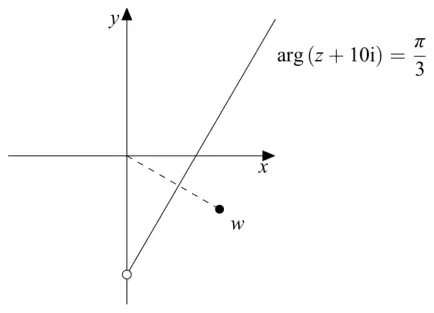
| (ii) half line with positive gradient emanating from imaginary axis. | M1 | 1.1b |
| The half line should pass between \(O\) and \(w\) starting from a point on the imaginary axis below \(w\) | A1 | 1.1b |
| (3) |
Notes
(b)(i)&(ii)
B1: \(w\) plotted in correct quadrant with either the correct coordinate clearly seen or above the line \(y = -x\)
M1: Half line drawn starting on the imaginary axis away from \(O\) with positive gradient (need not be labelled)
A1: Sketch on one diagram – both previous marks must have been scored and the half line should pass between \(O\) and \(w\) starting from a point on the imaginary axis below \(w\). (You may assume it starts at \(-10\mathrm{i}\) unless otherwise stated by the candidate)
Note: If candidates draw the loci on separate diagrams the maximum they can score is B1 M1 A0
| Scheme | Marks | AO |
|---|---|---|
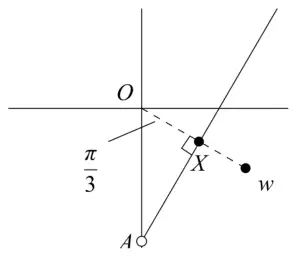 \(OX = 10\sin\dfrac{\pi}{6} = 5\) (oe) | M1 | 3.1a |
| So shortest distance is \(WX = OW - OX = \text{‘}8\text{’} - 5 = \ldots\) | M1 | 1.1b |
| So min distance is 3 | A1 | 1.1b |
Alternative 1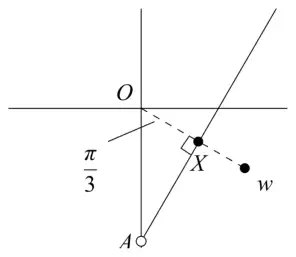 | ||
| A complete method to find the coordinates of \(X\). Finds the equation of the line from \(O\) to \(w\), \(y = -\dfrac{1}{\sqrt{3}}x\) and the equation of the half line \(y = \sqrt{3}x - 10\), solves to find the point of intersection \(X\left(\dfrac{5\sqrt{3}}{2}, -\dfrac{5}{2}\right)\) | M1 | 3.1a |
| Finds the length \(WX\)\[\sqrt{\left(4\sqrt{3} - \frac{5\sqrt{3}}{2}\right)^2 + \left(-4 - -\frac{5}{2}\right)^2}\] | M1 | 1.1b |
| So min distance is 3 | A1 | 1.1b |
| Alternative 2 Finds the length \(AW = \sqrt{\left(4\sqrt{3} - 0\right)^2 + (-4 - -10)^2} = \ldots\left\{\sqrt{84}\right\}\) Finds the angle between the horizontal and the line \(AW\) \(= \tan^{-1}\left(\dfrac{-4 - -10}{4\sqrt{3}}\right) = \ldots\{0.7137\ldots\text{radians or } 40.89\ldots^\circ\}\) | M1 | 3.1a |
| Finds the length of \(WX = \sqrt{84} \times \sin\left(\dfrac{\pi}{3} - 0.7137\right) = \ldots\) Or \(= \sqrt{84} \times \sin(60 - 40.89) = \ldots\) | M1 | 1.1b |
| So min distance is 3 | A1 | 1.1b |
| Alternative 3 Vector equation of the half line \(r = \begin{pmatrix}0\\ -10\end{pmatrix} + \lambda\begin{pmatrix}1\\ \sqrt{3}\end{pmatrix}\) \(XW = \begin{pmatrix}4\sqrt{3} - \lambda\\ -4 - \lambda\sqrt{3} - (-10)\end{pmatrix}\) Then either \(\begin{pmatrix}4\sqrt{3} - \lambda\\ 6 - \lambda\sqrt{3}\end{pmatrix}\bullet\begin{pmatrix}1\\ \sqrt{3}\end{pmatrix} = 4\sqrt{3} - \lambda + 6\sqrt{3} - 3\lambda = 0 \Rightarrow \lambda = \ldots\left\{\dfrac{5}{2}\sqrt{3}\right\}\) \(r = \begin{pmatrix}0\\ -10\end{pmatrix} + \dfrac{5}{2}\sqrt{3}\begin{pmatrix}1\\ \sqrt{3}\end{pmatrix} = \ldots\) Or \(XW^2 = \left(4\sqrt{3} - \lambda\right)^2 + \left(6 - \lambda\sqrt{3}\right)^2 = 48 - 8\lambda\sqrt{3} + \lambda^2 + 36 - 12\lambda\sqrt{3} + 3\lambda^2\) \(xw^2 = 84 - 20\lambda\sqrt{3} + 4\lambda^2\) leading to \(\dfrac{\mathrm{d}\left(XW^2\right)}{\mathrm{d}\lambda} = -20\sqrt{3} + 8\lambda = 0 \Rightarrow \lambda = \ldots\) | M1 | 3.1a |
| Finds the length \(WX\)\[\sqrt{\left(4\sqrt{3} - \frac{5\sqrt{3}}{2}\right)^2 + \left(-4 - -\frac{5}{2}\right)^2}\]Or\[XW = \sqrt{\left(4\sqrt{3} - \text{‘}\tfrac{5}{2}\sqrt{3}\text{’}\right)^2 + \left(6 - \text{‘}\tfrac{5}{2}\sqrt{3}\text{’}\sqrt{3}\right)^2}\] | M1 | 1.1b |
| So min distance is 3 | A1 | 1.1b |
| (3) | ||
| (10 marks) |
Notes
M1: Formulates a correct strategy to find the shortest distance, e.g. uses right angle \(OXA\) where \(X\) is where the lines meet and proceeds at least as far as \(OX\).
M1: Full method to achieve the shortest distance, e.g. for \(WX = OW - OX\).
A1: cao shortest distance is 3
Alternative 1:
M1: Uses a correct method to find the equation of the line from \(O\) to \(w\), \(y = -\dfrac{1}{\sqrt{3}}x\) and the equation of the half line \(y = \sqrt{3}x - 10\), solves to find the point of intersection \(X\left(\dfrac{5\sqrt{3}}{2}, -\dfrac{5}{2}\right)\)
If the incorrect gradient(s) is used with no valid method seen this is M0
M1: Finds the length \(WX = \sqrt{\left(\text{their }\dfrac{5\sqrt{3}}{2} - 4\sqrt{3}\right)^2 + \left(\text{their } -\dfrac{5}{2} - -4\right)^2} = \ldots\) condone a sign slip in the brackets.
A1: cao shortest distance is 3
Alternative 2:
M1: Uses a correct method to find the length \(AW\) and a correct method to find the angle between the horizontal and the line \(AW\)
M1: Finds the length of \(WX = \text{their }\sqrt{84} \times \sin\left(\dfrac{\pi}{3} - \text{their } 0.7137\right) = \ldots\)
A1: cao shortest distance is 3
Alternative 3
M1: Finds the vector equation of the half line, then \(XW\).
Then either: Sets dot product \(XW\) and the line = 0 and solves for \(\lambda\). Substitutes their \(\lambda\) into the equation of the half line to find the point of intersection.
Or finds the length of \(XW\) and differentiates, set = 0 and solve for \(\lambda\)
M1: Finds the length \(WX = \sqrt{\left(\text{their }\dfrac{5\sqrt{3}}{2} - 4\sqrt{3}\right)^2 + \left(\text{their } -\dfrac{5}{2} - -4\right)^2} = \ldots\) condone a sign slip in the brackets.
Or substitutes their value for \(\lambda\) into the length of (d)
A1: cao shortest distance is 3