
AS June 2023 Paper 1 Q10
10.
In this question you must show all stages of your working.
Solutions relying on calculator technology are not acceptable.
Without solving the equation, determine the quartic equation whose roots are
\[(3p - 1),\ (3q - 1),\ (3r - 1) \text{ and } (3s - 1)\]Give your answer in the form \(w^4 + aw^3 + bw^2 + cw + d = 0\), where \(a\), \(b\), \(c\) and \(d\) are integers to be found. (5)Determine
| Scheme | Marks | AO |
|---|---|---|
| \(w = 3z - 1 \Rightarrow z = \dfrac{w + 1}{3}\) | B1 | 3.1a |
| \(\left(\dfrac{w + 1}{3}\right)^4 + 5\left(\dfrac{w + 1}{3}\right)^2 - 30 = 0\) | M1 | 3.1a |
| \(\dfrac{1}{81}\left(w^4 + 4w^3 + 6w^2 + 4w + 1\right) + \dfrac{5}{9}\left(w^2 + 2w + 1\right) - 30 = 0\) leading to \(w^4 + aw^3 + bw^2 + cw + d\ \{= 0\}\) | M1 | 1.1b |
| \(w^4 + 4w^3 + 51w^2 + 94w - 2384 = 0\) | A1 A1 | 1.1b 1.1b |
| (5) |
Notes
B1: Selects the method of making a connection between \(z\) and \(w\) by writing \(z = \dfrac{w + 1}{3}\). Other variables may be used
M1: Applies the process of substituting their \(z = \dfrac{w + 1}{3}\) into \(z^4 + 5z^2 - 30 = 0\)
M1: Manipulates their equation into the form \(w^4 + aw^3 + bw^2 + cw + d = 0\) having substituted their \(z\) in terms of \(w\). Note that the “= 0” can be missing for this mark.
A1: At least two of \(a\), \(b\), \(c\), \(d\) correct. Note that the “= 0” can be missing for this mark.
A1: Fully correct equation including “= 0” Must be in terms of \(w\)
Alternative
| Scheme | Marks | AO |
|---|---|---|
| \(p + q + r + s = 0,\quad pq + pr + ps + qr + qs + rs = 5\) \(pqr + pqs + prs + qrs = 0,\quad pqrs = -30\) | B1 | 3.1a |
| New sum \(= 3(p + q + r + s) - 4 = \ldots\{-4\}\) New pair sum \(= 9(pq + pr + ps + qr + qs + rs) - 9(p + q + r + s) + 6 = \ldots\{51\}\) New triple sum \(= 27(pqr + pqs + prs + qrs) - 18(pq + pr + ps + qr + qs + rs)\) \(\quad + 9(p + q + r + s) - 4 = \ldots\{-94\}\) New product \(= 81(pqrs) - 27(pqr + pqs + prs + qrs)\) \(\quad + 9(pq + pr + ps + qr + qs + rs) - 3(p + q + r + s) + 1 = \ldots\{-2384\}\) | M1 | 3.1a |
| Applies \(w^4 - (\text{new sum})w^3 + (\text{new pair sum})w^2 - (\text{new triple sum})w + (\text{new product}) = 0\) | M1 | 1.1b |
| \(w^4 + 4w^3 + 51w^2 + 94w - 2384 = 0\) | A1 A1 | 1.1b 1.1b |
| (5) |
(Corrected from the printed mark scheme: the new triple sum is printed with \(+6(p + q + r + s)\); the correct coefficient is \(+9(p + q + r + s)\). The value −94 is unchanged because \(p + q + r + s = 0\).)
(i) Alternative
B1: Selects the method of giving four correct equations containing \(p\), \(q\), \(r\) and \(s\)
M1: Applies the process of finding at least three of the new sum, new pair sum, new triple sum and new product. Condone slips but the intention is clear and uses their values.
M1: Applies \(w^4 - (\text{new sum})w^3 + (\text{new pair sum})w^2 - (\text{new triple sum})w + (\text{new product}) = 0\).
Condone use of any variable for this mark.
Note that the “= 0” can be missing for this mark.
A1: At least two of \(a\), \(b\), \(c\), \(d\) correct. Note that the “= 0” can be missing for this mark.
A1: Fully correct equation including “= 0” Must be in terms of \(w\)
| Scheme | Marks | AO |
|---|---|---|
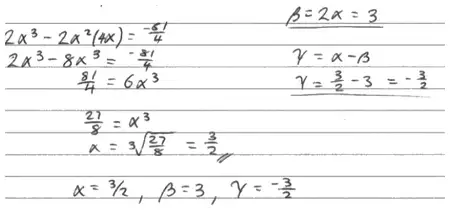
| \(\alpha + 2\alpha + \alpha - \beta = 0\) and \(\alpha \times 2\alpha \times (\alpha - \beta) = -\dfrac{81}{4}\) | M1 A1 | 3.1a 1.1b |
| Solves simultaneously e.g. \(4\alpha - \beta = 0 \Rightarrow \beta = 4\alpha\) \(2\alpha^2(\alpha - 4\alpha) = -\dfrac{81}{4} \Rightarrow \alpha^3 = \dfrac{27}{8} \Rightarrow \alpha = \ldots\) | M1 | 3.1a |
| Uses their values \(\alpha = \dfrac{3}{2}\) \(\beta = 6\) to find the roots \(\alpha,\ 2\alpha,\ \alpha - \beta\) | M1 | 1.1b |
| Roots 1.5, 3, − 4.5 | A1 | 1.1b |
| (5) |
Notes
M1: Uses the sum and product to form two equations in \(\alpha\) and \(\beta\). Condone product = \(\dfrac{81}{4}\) for this mark
Note: \(4\alpha - \beta = -\dfrac{n}{4}\) or \(4\alpha - \beta = 81\) is M0
A1: Correct equations need not be simplied
M1: Solves simultaneous equations to find a value for \(\alpha\) or \(\beta\)
M1: Uses their values for \(\alpha\) and \(\beta\) to find the roots using \(\alpha,\ 2\alpha,\ \alpha - \beta\). Condone third root as \(\beta\)
A1: Correct roots
Candidates may use their own notation for the roots
Condone confusion with \(\beta\) for M1 but A0
| Scheme | Marks | AO |
|---|---|---|
| \(n = \left[(1.5 \times 3) + (1.5 \times -4.5) + (3 \times -4.5)\right] \times 4\) Or Multiplies out \((x - 3)\left(x - \dfrac{3}{2}\right)\left(x + \dfrac{9}{2}\right)\) or \((x - 3)(2x - 3)(2x + 9)\) to achieve the form \(4x^3 + \ldots\) | M1 | 1.1b |
| \(n = -63\) cso (must have correct roots in (a) | A1 | 1.1b |
| (2) | ||
| (12 marks) |
Notes
M1: Finds the pair sum for their numerical roots and multiplies by 4
Alternative multiplies out three brackets \((x - \text{their } \alpha)(x - \text{their } 2\alpha)(x - (\alpha - \beta))\) to achieve the form \(4x^3 + \ldots\)
A1: Correct value from correct roots only