
A2 June 2022 Paper 2 Q4
4.
| Scheme | Marks | AO |
|---|---|---|
| \(z_1 = 6\left[\cos\left(\dfrac{\pi}{3}\right) + \mathrm{i}\sin\left(\dfrac{\pi}{3}\right)\right] = \ldots\left\{3 + 3\sqrt{3}\mathrm{i}\right\}\) \(z_2 = 6\sqrt{3}\left[\cos\left(\dfrac{5\pi}{6}\right) + \mathrm{i}\sin\left(\dfrac{5\pi}{6}\right)\right] = \ldots\left\{-9 + 3\sqrt{3}\mathrm{i}\right\}\) \(\{z_1 + z_2 =\}\left(3 + 3\sqrt{3}\mathrm{i}\right) + \left(-9 + 3\sqrt{3}\mathrm{i}\right) = \ldots\left\{-6 + 6\sqrt{3}\mathrm{i}\right\}\) Or \(\{z_1 + z_2 =\}\,6\left[\cos\left(\dfrac{\pi}{3}\right) + \mathrm{i}\sin\left(\dfrac{\pi}{3}\right)\right] + 6\sqrt{3}\left[\cos\left(\dfrac{5\pi}{6}\right) + \mathrm{i}\sin\left(\dfrac{5\pi}{6}\right)\right] = a + b\mathrm{i}\) where \(a\) and \(b\) are constants, the trig function must be evaluated | M1 | 3.1a |
| Clearly show the method to find modulus and argument for \(z_1 + z_2\) \(\arg(z_1 + z_2) = \pi - \tan^{-1}\left(\dfrac{6\sqrt{3}}{6}\right)\) or \(\tan^{-1}\left(\dfrac{6\sqrt{3}}{-6}\right) = \ldots\left\{\dfrac{2\pi}{3}\right\}\) and \(|z_1 + z_2| = \sqrt{6^2 + \left(6\sqrt{3}\right)^2} = \ldots\{12\}\) | dM1 | 2.1 |
| \(z_1 + z_2 = 12\mathrm{e}^{\frac{2\pi}{3}\mathrm{i}}\) * | A1* | 1.1b |
| (3) |
Notes
M1: A complete method to find both \(z_1\) and \(z_2\) in the form \(a + b\mathrm{i}\) and adds them together.
dM1: Dependent on previous method mark, finds the modulus and argument of \(z_1 + z_2\). They must show their method, just stating modulus = 12 and argument \(= \dfrac{2\pi}{3}\) is not sufficient as this is a show question.
Alternative 1: Factorises out 12 and find the argument
Alternative 2: uses \(12\mathrm{e}^{\frac{2\pi}{3}\mathrm{i}} = 12\left(\cos\dfrac{2\pi}{3} + \mathrm{i}\sin\dfrac{2\pi}{3}\right) = \ldots\)
A1*: Achieves the correct answer following no errors or omissions.
Alternatively shows that \(12\mathrm{e}^{\frac{2\pi}{3}\mathrm{i}} = -6 + 6\sqrt{3}\mathrm{i}\) and concludes therefore \(z_1 + z_2 = 12\mathrm{e}^{\frac{2\pi}{3}\mathrm{i}}\) *
Alternative 1 and Alternative 2 (for the dM1 and A1*)
| Scheme | Marks | AO |
|---|---|---|
| Alternative 1 \(-6 + 6\sqrt{3}\mathrm{i} = 12\left(-\dfrac{1}{2} + \dfrac{\sqrt{3}}{2}\mathrm{i}\right) = 12\left(\cos\left(\dfrac{2\pi}{3}\right) + \mathrm{i}\sin\left(\dfrac{2\pi}{3}\right)\right)\) Alternative 2 \(12\mathrm{e}^{\frac{2\pi}{3}\mathrm{i}} = 12\left(\cos\dfrac{2\pi}{3} + \mathrm{i}\sin\dfrac{2\pi}{3}\right) = \ldots\left\{-6 + 6\sqrt{3}\mathrm{i}\right\}\) | dM1 | 2.1 |
| \(12\mathrm{e}^{\frac{2\pi}{3}\mathrm{i}} = -6 + 6\sqrt{3}\mathrm{i}\) Therefore \(z_1 + z_2 = 12\mathrm{e}^{\frac{2\pi}{3}\mathrm{i}}\) * | A1* | 1.1b |
Alternative 3
| Scheme | Marks | AO |
|---|---|---|
| \(z_1 + z_2 = 6\mathrm{e}^{\frac{\pi}{3}\mathrm{i}} + 6\sqrt{3}\,\mathrm{e}^{\frac{5\pi}{6}\mathrm{i}}\) \(= 12\left[\dfrac{1}{2}\cos\left(\dfrac{\pi}{3}\right) + \dfrac{1}{2}\mathrm{i}\sin\left(\dfrac{\pi}{3}\right) + \dfrac{\sqrt{3}}{2}\cos\left(\dfrac{5\pi}{6}\right) + \dfrac{\sqrt{3}}{2}\mathrm{i}\sin\left(\dfrac{5\pi}{6}\right)\right]\) | M1 | 3.1a |
| \(12\left(-\dfrac{1}{2} + \dfrac{\sqrt{3}}{2}\mathrm{i}\right) = 12\left(\cos\left(\dfrac{2\pi}{3}\right) + \mathrm{i}\sin\left(\dfrac{2\pi}{3}\right)\right)\) | dM1 | 2.1 |
| \(z_1 + z_2 = 12\mathrm{e}^{\frac{2\pi}{3}\mathrm{i}}\) * | A1* | 1.1b |
| (3) |
M1: Factorises out 12 and writes in the form \(12\left[\ldots\cos\left(\dfrac{\pi}{3}\right) + \ldots\mathrm{i}\sin\left(\dfrac{\pi}{3}\right) + \ldots\cos\left(\dfrac{5\pi}{6}\right) + \ldots\mathrm{i}\sin\left(\dfrac{5\pi}{6}\right)\right]\)
dM1: Dependent on previous mark. Writes in the form \(12(a + b\mathrm{i})\) leading to the form \(12(\cos\theta + \mathrm{i}\sin\theta)\)
A1*: Achieves the correct answer following no errors or omissions.
Alternative 4
| Scheme | Marks | AO |
|---|---|---|
| \(z_1 + z_2 = 6\mathrm{e}^{\frac{\pi}{3}\mathrm{i}} + 6\sqrt{3}\,\mathrm{e}^{\frac{5\pi}{6}\mathrm{i}} = 6\mathrm{e}^{\frac{\pi}{3}\mathrm{i}}\left(1 + \sqrt{3}\,\mathrm{e}^{\frac{\pi}{2}\mathrm{i}}\right) = 6\mathrm{e}^{\frac{\pi}{3}\mathrm{i}}\left(1 + \sqrt{3}\mathrm{i}\right)\) | M1 | |
| Either \(r = \sqrt{1^2 + \left(\sqrt{3}\right)^2} = 2\) and \(\arg = \arctan\left(\dfrac{\sqrt{3}}{1}\right) = \dfrac{\pi}{3}\) Or \(6\mathrm{e}^{\frac{\pi}{3}\mathrm{i}}\left(1 + \sqrt{3}\mathrm{i}\right) = 12\mathrm{e}^{\frac{\pi}{3}\mathrm{i}}\left(\dfrac{1}{2} + \dfrac{\sqrt{3}}{2}\mathrm{i}\right) = 12\mathrm{e}^{\frac{\pi}{3}\mathrm{i}}\left(\cos\left(\dfrac{\pi}{3}\right) + \mathrm{i}\sin\left(\dfrac{\pi}{3}\right)\right)\) | dM1 | |
| \(z_1 + z_2 = 12\mathrm{e}^{\frac{\pi}{3}\mathrm{i}}\mathrm{e}^{\frac{\pi}{3}\mathrm{i}} = 12\mathrm{e}^{\frac{2\pi}{3}\mathrm{i}}\) * | A1* | |
| (3) |
M1: Factorises out 6 and writes in the form \(6\mathrm{e}^{\frac{\pi}{3}\mathrm{i}}\left(1 + \sqrt{3}\,\mathrm{e}^{\frac{\pi}{2}\mathrm{i}}\right) = 6\mathrm{e}^{\frac{\pi}{3}\mathrm{i}}(1 + a\mathrm{i})\)
dM1: Dependent on previous method mark, finds the modulus and argument of \((1 + a\mathrm{i})\) or \(12(a + b\mathrm{i})\) leading to the form \(12(\cos\theta + \mathrm{i}\sin\theta)\)
A1*: Achieves the correct answer following no errors or omissions.
Alternative 5
| Scheme | Marks | AO |
|---|---|---|
Uses geometry to show that \(z_1\), \(z_2\) and \(z_1 + z_2\) form a right-angled triangle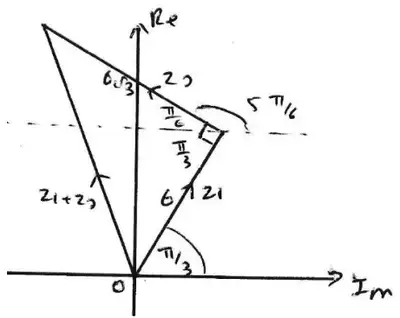 | M1 | 3.1a |
| \(\arg(z_1 + z_2) = \dfrac{\pi}{3} + \tan^{-1}\left(\dfrac{6\sqrt{3}}{6}\right) = \ldots\left\{\dfrac{2\pi}{3}\right\}\) \(|z_1 + z_2| = \sqrt{(6)^2 + \left(6\sqrt{3}\right)^2} = \ldots\{12\}\) | dM1 | 1.1b |
| \(z_1 + z_2 = 12\mathrm{e}^{\frac{2\pi}{3}\mathrm{i}}\) * | A1* | 1.1b |
| (3) |
(In the printed diagram the axis labels Re and Im are the wrong way round: the real axis is the horizontal one.)
M1: Draws a diagram to show that \(z_1\), \(z_2\) and \(z_1 + z_2\) form a right-angled triangle.
dM1: Dependent on previous method mark, finds the modulus and argument of \(z_1 + z_2\)
A1*: Achieves the correct answer following no errors or omissions.
Note: Writing \(\arg(z_1 + z_2) = \arctan\left(\dfrac{6\sqrt{3}}{-6}\right) = -\dfrac{\pi}{3}\) therefore \(\arg(z_1 + z_2) = \pi - \dfrac{\pi}{3} = \dfrac{2\pi}{3}\) with no diagram or finding \(z_1 + z_2\) is M0dM0A0
| Scheme | Marks | AO |
|---|---|---|
 | M1 | 3.1a |
| \(\sin\left(\dfrac{\pi}{3}\right) = \dfrac{|z|}{5} \Rightarrow |z| = \ldots\) | M1 | 1.1b |
| \(|z| = \dfrac{5\sqrt{3}}{2}\) | A1 | 1.1b |
| (3) | ||
| (6 marks) |
Notes
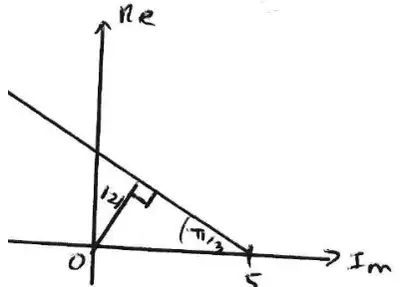
(In the printed diagram the axis labels Re and Im are the wrong way round: the real axis is the horizontal one.)
M1: Draws a diagram and recognises that the shortest distance will form a right-angled triangle.
M1: Uses trigonometry to find the shortest length.
A1: Correct exact value.
Alternative 1
| Scheme | Marks | AO |
|---|---|---|
| Gradient \(= -\tan\left(\dfrac{\pi}{3}\right)\) \(c = 5\tan\left(\dfrac{\pi}{3}\right)\) leading to \(y = -\sqrt{3}x + 5\sqrt{3}\) or \(\tan\left(\dfrac{\pi}{3}\right) = \dfrac{y}{5 - x}\) \(|z|^2 = x^2 + y^2 = x^2 + \left(-\sqrt{3}x + 5\sqrt{3}\right)^2 = 4x^2 - 30x + 75\) \(\dfrac{\mathrm{d}|z|^2}{\mathrm{d}x} = 8x - 30 = 0 \Rightarrow x = \ldots\{3.75\}\) or \(|z|^2 = 4(x - 3.75)^2 + 18.75 \Rightarrow x = \ldots\{3.75\}\) | M1 | 3.1a |
| \(|z| = \sqrt{4(\text{their } 3.75)^2 - 30(\text{their } 3.75) + 75}\) | M1 | 1.1b |
| \(|z| = \dfrac{5\sqrt{3}}{2}\) | A1 | 1.1b |
| (3) |
M1: Finds the equation of the half-line by attempting \(m = -\tan\left(\dfrac{\pi}{3}\right)\) \(c = 5\tan\left(\dfrac{\pi}{3}\right)\). Finds \(x^2 + y^2\) in terms of \(x\), differentiates, sets \(= 0\) and finds the value of \(x\).
M1: Uses their value of \(x\) to find the minimum value of \(\sqrt{x^2 + y^2}\)
A1: Correct exact value.
Alternative 2
| Scheme | Marks | AO |
|---|---|---|
| Gradient \(= -\tan\left(\dfrac{\pi}{3}\right)\) \(c = 5\tan\left(\dfrac{\pi}{3}\right)\) leading to \(y = -\sqrt{3}x + 5\sqrt{3}\) Perpendicular line through the origin \(y = \dfrac{1}{\sqrt{3}}x\) and find the point of intersection of the two lines \(\left(\dfrac{15}{4}, \dfrac{5\sqrt{3}}{4}\right)\) | M1 | 3.1a |
| Finds the distance from the origin to their point of intersection \(|z| = \sqrt{\left(\text{their } \dfrac{15}{4}\right)^2 + \left(\text{their } \dfrac{5\sqrt{3}}{4}\right)^2} = \ldots\) | M1 | 1.1b |
| \(|z| = \dfrac{5\sqrt{3}}{2}\) | A1 | 1.1b |
| (3) |
M1: Finds the equation of the half-line by attempting \(m = -\tan\left(\dfrac{\pi}{3}\right)\) \(c = 5\tan\left(\dfrac{\pi}{3}\right)\). Finds the equation of the line perpendicular which passes through the origin. Finds the point of intersection of the lines
M1: Finds the distance from the origin to their point of intersection
A1: Correct exact value.