
AS June 2023 Q3
3. A two-person zero-sum game is represented by the following pay-off matrix for player \(A\).
| \(B\) plays X | \(B\) plays Y | |
|---|---|---|
| \(A\) plays Q | \(2\) | \(-2\) |
| \(A\) plays R | \(-1\) | \(5\) |
| \(A\) plays S | \(3\) | \(4\) |
| \(A\) plays T | \(0\) | \(2\) |
Option S is removed from player \(A\)’s choices and the reduced game, with option S removed, is no longer stable.
Let \(B\) play option X with probability \(p\) and option Y with probability \(1 - p\).
| Scheme | Marks | AO |
|---|---|---|
| (i) Row minima: \(-2, -1, 3, 0\) max is 3 Column maxima: 3, 5 min is 3 | M1 | 1.1b |
| Row(maximin) \(=\) Col(minimax) which are both 3 therefore game is stable | A1 | 2.4 |
| (ii) Value of the game to player \(B\) is \(-3\) | A1 | 2.2a |
| (3) |
Notes
M1: finding row minimums and column maximums – condone one error
A1: row maximin 3 = col minimax 3 (so stable) – dependent on all 6 correct values – as a minimum must see the two 3’s explicitly being considered
A1: cao (\(-3\)) – ‘lose 3’ is A0
| Scheme | Marks | AO |
|---|---|---|
| \(\begin{pmatrix} -2 & 1 & 0 \\ 2 & -5 & -2 \end{pmatrix}\) | B1 | 1.1b |
| (1) |
Notes
B1: cao (must be the reduced game so with option S removed)
| Scheme | Marks | AO |
|---|---|---|
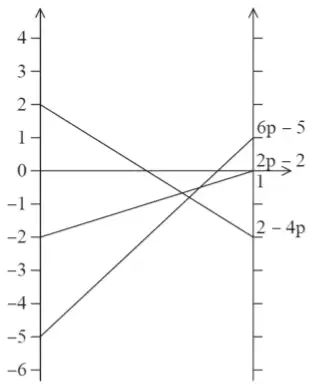
| If \(A\) plays option Q, \(B\)’s gains are \(-2p + 2(1-p) = 2 - 4p\) If \(A\) plays option R, \(B\)’s gains are \(p + (-5)(1-p) = -5 + 6p\) If \(A\) plays option T, \(B\)’s gains are \((-2)(1-p) = -2 + 2p\) | M1 A1 | 1.1b 1.1b |
 | M1 A1 | 1.1b 1.1b |
| \(2 - 4p = -5 + 6p \Rightarrow p = 7/10\) | A1 | 1.1b |
| \(B\) should play option X with probability 7/10 and option Y with probability 3/10 | A1ft | 3.2a |
| (6) |
Notes
In (c) if the candidate includes option S (and so has four expressions and lines) then this can score the first 3 marks only in this part
M1: setting up three expressions in terms of \(p\)
A1: all three expressions correctly simplified
M1: at least two lines correctly drawn for their expressions – if values on at least one vertical axis not given then lines must be in the right position relative to each other
A1: completely correct graph with clear indication of the correct intersection points at the ends where \(p = 0\) and \(p = 1\) (so if no scaling on the vertical axis assume that 1 line = 1 unit (unless other suitable scaling is clear), and lines must not extend past \(p \lt 0\) and/or \(p \gt 1\))
A1: using the graph (with 3 lines) to obtain the correct probability expressions leading to the correct value of \(p\)
A1ft: interpret their value of \(p\) in the context of the question – must refer to ‘play’ and the associated probabilities (but do not need to explicitly use the word ‘probability’)
| Scheme | Marks | AO |
|---|---|---|
| (i) \(6\left(\frac{7}{10}\right) - 5 = -4/5 \Rightarrow\) value of the game to player \(A\) is 4/5 | B1 | 3.1a |
| (ii) Player \(A\) should never play option T | B1 | 2.2a |
| (iii) If \(A\) plays their option Q with probability \(q\) and their option R with probability \(1 - q\) then \(2q + (-1)(1-q) = \dfrac{4}{5}\) | M1 | 3.1b |
| \(q = \dfrac{3}{5} \Rightarrow\) \(A\) should play option Q with probability 3/5 and option R with probability 2/5 (play S and T never) | A1 | 3.2a |
| (4) | ||
| (14 marks) |
Notes
(d)(i) B1: cao (\(\frac{4}{5}\) or 0.8)
(d)(ii) B1: cao (option T)
(d)(iii) M1: Setting up a linear equation with their V(\(A\)) from (d)(i) wither either of the two correct expressions \(2q + (-1)(1-q)\) or \(-2q + 5(1-q)\) or setting up the correct equation \(-2q + 5(1-q) = 2q + (-1)(1-q)\) (or \(2q - 5(1-q) = -2q + (1-q)\))
A1: interpret the correct value of \(q\) in the context of the question – must refer to ‘play’ and the associated probabilities (but do not need to explicitly use the word ‘probability’)
(corrected from the printed mark scheme: the printed line in (d)(i) reads “6 7/10 −5 = −4/5”, with the bracket/multiplication between 6 and 7/10 missing)