
AS June 2024 Q3
3. Haruki and Meera play a zero-sum game. The game is represented by the following pay-off matrix for Haruki.
| Meera | ||||
|---|---|---|---|---|
| Option X | Option Y | Option Z | ||
| Haruki | Option A | \(4\) | \(-2\) | \(-5\) |
| Option B | \(1\) | \(4\) | \(-3\) | |
| Option C | \(-1\) | \(6\) | \(1\) | |
| Option D | \(-4\) | \(5\) | \(3\) | |
Option Y for Meera is now removed.
The number of points scored by Haruki when he plays Option C and Meera plays Option X changes from \(-1\) to \(k\)
Given that the value of the game is now the same for both players,
| Scheme | Marks | AO |
|---|---|---|
| (i) Row minima: \(-5, -3, -1, -4\) max is \(-1\) Column maxima: \(4, 6, 3\) min is \(3\) Row(maximin) \(\neq\) Col(minimax) therefore game is not stable | M1 A1 | 1.1b 2.4 |
| (2) |
Notes
M1: finding row minimums and column maximums – condone one error
A1: row maximin \(\neq\) col minimax so not stable (dependent on correct row mins and col maxs)
| Scheme | Marks | AO | |||||||||||||||||||||||
|---|---|---|---|---|---|---|---|---|---|---|---|---|---|---|---|---|---|---|---|---|---|---|---|---|---|
| B1 | 1.1b | |||||||||||||||||||||||
| (1) | |||||||||||||||||||||||||
Notes
B1: Correct reduced table for Meera (2 rows only)
| Scheme | Marks | AO |
|---|---|---|
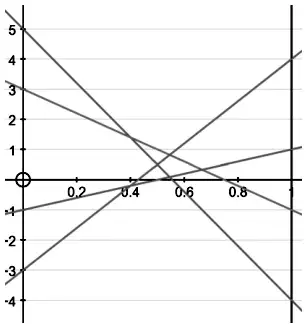
| (i) If \(H\) plays Option A, \(M\)’s gains are \(-4p + 5(1-p) = 5 - 9p\) If \(H\) plays Option B, \(M\)’s gains are \(-p + 3(1-p) = 3 - 4p\) If \(H\) plays Option C, \(M\)’s gains are \(p + (-1)(1-p) = -1 + 2p\) If \(H\) plays Option D, \(M\)’s gains are \(4p + (-3)(1-p) = -3 + 7p\) | M1 A1 | 1.1b 1.1b |
 | M1 A1 | 1.1b 1.1b |
| \(5 - 9p = -1 + 2p \Rightarrow p = 6/11\) Meera should play Option X with probability \(\frac{6}{11}\) and Option Z with probability \(\frac{5}{11}\) | A1 | 3.2a |
| (ii) Value to Meera \(= -1 + 2\times\frac{6}{11} = \frac{1}{11}\) Value to Haruki \(= \frac{-1}{11}\) | B1 ft | 3.4 |
| (iii) Haruki never plays B and D | B1 | 3.2a |
| (7) |
Notes
M1: setting up four expressions in terms of \(p\)
A1: all four expressions correct and fully simplified
M1: axes correct, at least one line correctly drawn for their expressions
A1: correct graph (all lines drawn with a ruler, scale clear with correct relative position of lines)
A1: using the graph to obtain the correct probability expressions leading to the correct value of \(p\) and interpret their value of \(p\) in the context of the question (dependent on previous A mark)
B1ft: correct value of game to Haruki (ft their \(p\))
B1: CAO – B and D
| Scheme | Marks | AO |
|---|---|---|
| Value of game = 0 | B1 | 3.1a |
| When \(H\) plays Option A, \(M\)’s gain \(5 - 9p = 0 \quad p = 5/9\) | M1 | 1.1b |
| When \(H\) plays Option C, \(M\)’s gain \(-5k/9 - 4/9 = 0\) | M1 | 3.4 |
| \(k = -4/5\) | A1 | 2.2a |
| (4) | ||
| (14 marks) |
Notes
B1: States value = 0 (may be implied by forming equation in \(p\) or \(q = 0\))
M1: considers Option A and obtains value for \(p\) (alt considers \(H\) and obtains value for \(q\))
M1: considers Option C and sets up equation in \(k\) (dependent on previous M mark)
A1: CAO (\(-4/5\) o.e.)
Alternative
Considers \(H\) playing A with probability \(q\) and C with probability \((1-q)\)
When \(M\) plays Z \(H\)’s gain \(1 - 6q = 0 \quad q = 1/6\)
When \(M\) plays X \(H\)’s gain \(4/6 + 5k/6 = 0\)
\(k = -4/5\)