
A2 June 2024 Q6
6. The precedence table below shows the 12 activities required to complete a project.
| Activity | Immediately preceding activities |
|---|---|
| A | – |
| B | – |
| C | – |
| D | A |
| E | A, B, C |
| F | A, B, C |
| G | C |
| H | D, E |
| I | D, E |
| J | D, E |
| K | F, G, J |
| L | F, G |
Your activity network must contain the minimum number of dummies only. (5)
Each of the activities shown in the precedence table requires one worker. The project is to be completed in the minimum possible time.

Figure 3 shows a schedule for the project using three workers.
Immediately after the start of the project, it is found that the duration of activity I, as shown in Figure 3, is incorrect. In fact, activity I will take 8 hours.
The durations of all the other activities remain as shown in Figure 3.
Your answer must make specific reference to workers, times and activities. (2)
| Scheme | Marks | AO |
|---|---|---|
e.g.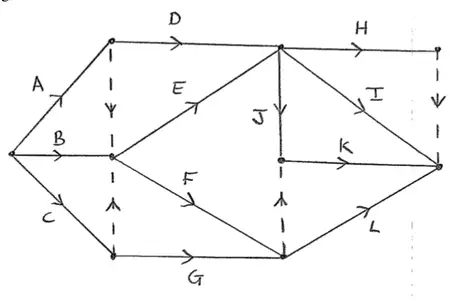 | M1 A1 A1 A1 A1 | 2.1 1.1b 1.1b 1.1b 1.1b |
| (5) |
Notes
Condone lack of, or incorrect, numbered events throughout. ‘Dealt with correctly’ means that the activity starts from the correct event but need not necessarily finishes at the correct event, e.g. ‘H dealt with correctly’ requires the correct precedences for this activity, i.e. D and E labelled correctly and leading into the same node and H starting from that node but do not consider the end event for H. Activity on node is M0
If an arc is not labelled, for example, if the arc for activity C is not labelled (but the arc is present) then this will lose the first A mark and the final (CSO) A mark – they can still earn the second A mark on the bod. If two or more arcs are not labelled then mark according to the scheme. Assume that a solid line is an activity which has not been labelled rather than a dummy (even if in the correct place for where a dummy should be)
Note: if they make multiple attempts which are not clearly replaced mark the one which is best for the candidate
Ignore incorrect or lack of arrows on the activities for the first four marks only
M1: At least nine activities (labelled on arc), one start, at least two dummies placed
A1: Activities A, B, C, D and G dealt with correctly
A1: Activities E, F, H, I and J and the first two dummies (+ arrows) at the ends of A and C dealt with correctly (note H and I are interchangeable)
A1: Activities K, L and dummy at the end of F/G (+ arrow) dealt with correctly
A1: CSO – Final dummy (+ arrow) for uniqueness of H/I, all arrows present for every activity with one finish and no additional dummies. (Note direction of arrow on dummy between H and I is interchangeable) (Note the dummy could also be drawn at the start of H and I)
Please check all arcs carefully for arrows – if there are no arrows on dummies then M1A1max
Note that additional (but unnecessary) ‘correct’ dummies that still maintain precedence for the network should only be penalised with the final A mark if earned
| Scheme | Marks | AO |
|---|---|---|
| (i) Critical path: C – E – J – K | B1 | 1.1b |
| (ii) Minimum completion time: 20 | B1 | 1.1b |
| (iii) Total float on activity B is 2 | B1 | 1.1b |
| (iv) Total float on activity G is 4 | B1 | 3.1b |
| (4) |
Notes
(i) B1: CAO (critical path CEJK – in this order)
(ii) B1: CAO (20)
(iii) B1: CAO (2 – total float on B)
(iv) B1: CAO (4 – total float on G)
| Scheme | Marks | AO |
|---|---|---|
| e.g. (One worker continues to do the critical activities (in time 20)) Second worker completes A, D, G and H as originally planned but now completes activity L in the interval 14 to 20 (but must have started L by time 17 at the latest due to its duration of 3) Third worker completes B and F as planned but now completes activity I exactly in the time interval 12 to 20 so yes, the project can be completed by 3 workers | B2, 1, 0 | 2.4 2.4 |
e.g.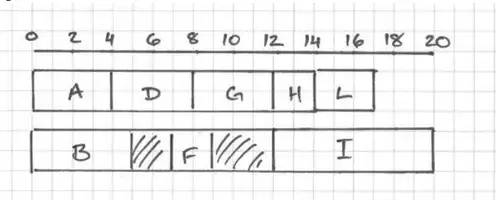 | ||
| (2) | ||
| (11 marks) |
Notes
B1: Award this mark with an indication that either
- activities I and L have swapped workers
- activity H has swapped worker and I now starts at 12
B1: dependent on first B mark – must have a time reference for both I and either L or H for this mark (L or H may be a range) completely correct reasoning including mention of workers, times and activities (for example, clear indication that (H and) L (in either order) must take place in the interval 12 to 20 and that I must now be done in the interval 12 to 20 or states starts at 12 but not just ends at 20) and either concludes yes or clearly implies that it can be completed on time
Note their explanation must not include an incorrect statement
Alternatively redraws the schedule for worker 2 and 3 with one completing H and L (in either order) in the time interval 12 – 20 and the other completing I and concludes that the project can be completed by 3 workers