
A2 June 2024 Q4
4.
A tree, T, has exactly six nodes. The degrees of the six nodes of T are
\(1 \qquad 2 \qquad (4 - x) \qquad (2x - 5) \qquad (4x - 11) \qquad (3x - 5)\)
where \(x\) is an integer.
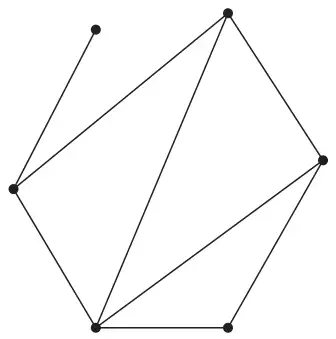
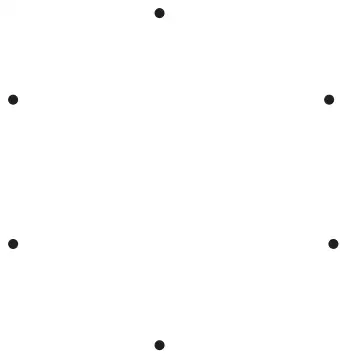
Figure 2 shows a graph, G, with six nodes with degrees 1, 2, 3, 3, 3 and 4
| Scheme | Marks | AO |
|---|---|---|
| e.g. A graph cannot contain an odd number of odd vertices e.g. \(\dfrac{1+2+3+4+5+6}{2} = 10.5\) which is not an integer and so therefore not possible to have a graph with the given vertex orders | B1 | 1.2 |
| (1) |
Notes
(a) In a and b condone poor language such as number of odd degrees instead of number of odd nodes
B1: CAO – common examples that score B1:
- Cannot have (a graph with an) odd number of odd vertices
- Cannot have a graph with three odd vertices
- The sum of the degrees/order (of the vertices) is 21 which is not even therefore not possible (but not just for obtaining 21 and saying ‘impossible’). The 21 must be linked either in words to the ‘sum of the degrees/order’ or explicitly showing 1+ 2 + 3 + 4 + 5 + 6 = 21 so just ’21 is not even’ scores B0
- The sum of the degrees/order (of the vertices) is 21 which is odd therefore not possible (with equivalent justification of the 21 as in the previous bullet-point)
- \(\dfrac{1+2+3+4+5+6}{2} = 10.5\) which is not an integer so therefore impossible. They do not have to explain that they are using the result that \(\sum \text{vertex degrees} = 2(\text{no of arcs})\) but they must explain why a value of 10.5 leads to the required graph not being possible. A value of 10.5 with no working (or explanation) scores B0
| Scheme | Marks | AO |
|---|---|---|
| e.g. T has at least one node of degree one or one node with odd degree | B1 | 2.4 |
| (1) |
Notes
(b) B1: CAO – correct reasoning that not all the vertices of T can have an even degree. Allow for this mark a general statement that no tree can be Eulerian as all trees contain at least two nodes of degree 1. Allow as a minimum statement that at least one of the nodes has a degree of 1 or at least one odd node (accept valency instead of degree or order)
| Scheme | Marks | AO |
|---|---|---|
| 6 nodes in T therefore the tree contains 5 arcs | B1 | 1.2 |
| \(1 + 2 + (4 - x) + (2x - 5) + (4x - 11) + (3x - 5) = 2(5)\) \((8x - 14 = 10)\) | M1 | 3.1a |
| \(x = 3\) | A1 | 1.1b |
| Alternatively \(\begin{array}{llll} 4 - x \gt 0 & \Rightarrow\ x \lt 4 \qquad & 4 - x \geqslant 1 & \Rightarrow\ x \leqslant 3 \\ 2x - 5 \gt 0 & \Rightarrow\ x \gt 2.5 & 4x - 11 \geqslant 1 & \Rightarrow\ x \geqslant 3 \\ 2.5 \lt x \lt 4 & \Rightarrow\ x = 3 & & \phantom{\Rightarrow\ } x = 3 \end{array}\) | ||
| Therefore, the degrees of the nodes are 1, 2, 1, 1, 1 and 4 | M1 | 2.1 |
| T is not semi-Eulerian as there are more than two nodes of odd degree | A1 | 2.2a |
| (5) |
Notes
B1: correctly using the fact that the number of arcs in T is 5 (possibly implied by later working – e.g. forming an equation for the sum of nodes = 2 x 5) An answer of \(x = 3\) from correct working implies this mark.
Alternative approach either \(4 - x \gt 0 \;\Rightarrow\; x \lt 4\) or \(2x - 5 \gt 0 \;\Rightarrow\; x \gt 2.5\)
May use \(4x - 11 \geqslant 1 \;\Rightarrow\; x \geqslant 3\)
M1: Forming an equation involving the degree of the six nodes and 2(5).
Alternative approach both inequalities stated and combined to obtain range of values for \(x\)
A1: CAO (\(x = 3\)) – must come from correct working
M1: Calculating the degree of the remaining vertices using their value of \(x\). As a minimum we must see correct values for at least two more odd nodes. Must have an integer value for \(x\) (this can be implied by sight of 1, 2, 1, 1, 1, 4) Alternatively may clearly use \(x = 3\) is odd and deduce that there are at least three odd nodes
A1: CAO (not Semi-Eulerian) – with correct reasoning
| Scheme | Marks | AO |
|---|---|---|
e.g.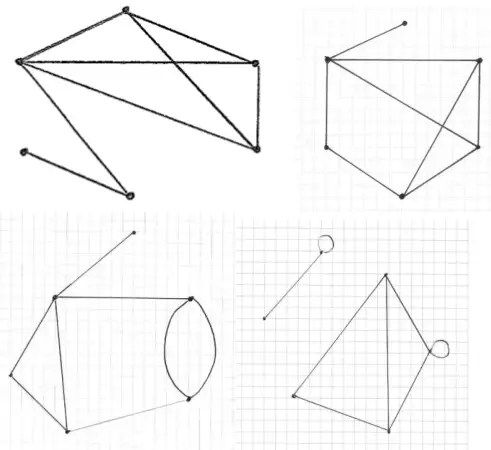 | B1 | 1.1b |
| (1) | ||
| (8 marks) |
Notes
B1: CAO (any graph that is not isomorphic to G – must contain exactly 8 arcs) If a simple, connected graph the vertex with degree 1 must connect to either the vertex of degree 2 or degree 4. Note this does not have to be a simple graph and may not be connected
(Degrees are 1, 2, 3, 3, 3, 4)