
AS June 2022 Paper 1 Q7
7 In this question you must show detailed reasoning.
Two loci, \(C_1\) and \(C_2\), are defined as follows.
\(C_1 = \left\{z : \arg(z + 2 - \mathrm{i}) = \dfrac{1}{4}\pi\right\}\) and \(C_2 = \left\{z : \arg(z - 2 - \sqrt{3} - 2\mathrm{i}) = \dfrac{2}{3}\pi\right\}\)
By considering the representations of \(C_1\) and \(C_2\) on an Argand diagram, determine the locus \(C_1 \cap C_2\). [7]
| Scheme | Marks | AO |
|---|---|---|
| DR \(m_1 = [\tan(\pi/4)] = 1\) and \(m_2 = [\tan(2\pi/3)] = -\sqrt{3}\) | B1 | 3.1a |
| \(C_1\): \(z + 2 - \mathrm{i} = z - (-2 + \mathrm{i})\) so equation of (half-)line is \(y - 1 = x - -2\) or \(y = x + 3\) | M1 | 3.1a |
| \(C_2\): \(z - 2 - \sqrt{3} - 2\mathrm{i} = z - (2 + \sqrt{3} + 2\mathrm{i})\) so equation is \(y - 2 = -\sqrt{3}(x - (2 + \sqrt{3}))\) or \(y = -\sqrt{3}x + 2\sqrt{3} + 5\) | M1 | 1.1 |
| \(x + 3 = -\sqrt{3}x + 2\sqrt{3} + 5\) \(\Rightarrow (1 + \sqrt{3})x = 2(1 + \sqrt{3}) \Rightarrow x = 2\) | M1 | 2.1 |
| \(\Rightarrow y = 2 + 3 = 5\) | A1 | 1.1 |
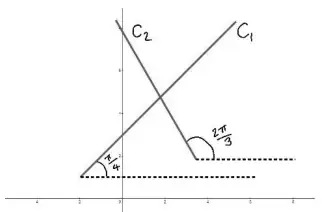 | B1 | 2.3 |
| \(C_1 \cap C_2 = \{2 + 5\mathrm{i}\}\) (or in words: “so the required locus contains only the number \(2 + 5\mathrm{i}\)”) | A1 | 3.2a |
| [7] |
Notes
B1: (1st) soi in solution
Must be connect to the gradients of the lines (soi)
M1: (1st) Identifying a point on the extended line (condone sign errors) and using it and their gradient to form the equation of a line
Don’t need to see equation in \(z\) first
Gradient must have come from considering angle of \((\pi/4)\)
M1: (2nd) Identifying a point on the extended line (condone sign errors) and using it and their gradient to form the equation of a line
Don’t need to see equation in \(z\) first
Gradient must have come from considering angle of \((2\pi/3)\) or \((\pi/3)\)
M1: (3rd) Eliminating one unknown and solving for the other
B1: (2nd) A sketch to show \(C_1\) and \(C_2\) as half lines with correct start points clearly indicated. PoI lies on both half lines in approximately the right positions. Angles should look approximately correct. Lines need to intersect.
Or : \(C_1\): Need \(x \gt -2\). \(C_2\): Need \(x \lt 2 + \sqrt{3}\), therefore solution with \(x = 2\) is valid
Or: \(C_1\): Need \(y \gt 1\). \(C_2\) Need \(y \gt 2\), so solution with \(y = 5\) is valid
A1: (2nd) A1 can be awarded if answer represented unambiguously on an Argand Diagram either as \(2 + 5\mathrm{i}\), or 2 and \(5\mathrm{i}\) marked on axes.
Not just \((2, 5)\) or \((2, 5\mathrm{i})\)
Needs to be an indication that the locus is a single point, expressed as a complex number. Cannot be expressed as coordinates.