
A2 June 2023 Paper 2 Q7
7.
In this question you must show all stages of your working.
Solutions relying entirely on calculator technology are not acceptable.
John picked 100 berries from a plant.
The largest berry picked was approximately 2.8 cm long.
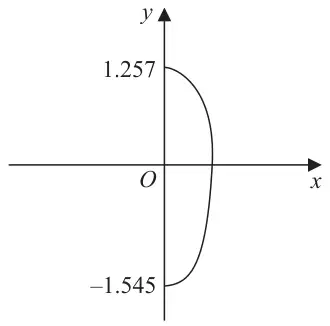
The shape of this berry is modelled by rotating the curve with equation
\[16x^2 + 3y^2 - y\cos\left(\frac{5}{2}y\right) = 6 \qquad x \geqslant 0\]shown in Figure 2, about the \(y\)-axis through \(2\pi\) radians, where the units are cm.
Given that the \(y\) intercepts of the curve are \(-1.545\) and \(1.257\) to four significant figures,
Given that the 100 berries John picked were then squeezed for juice,
| Scheme | Marks | AO |
|---|---|---|
\(\dfrac{\pi}{16}\displaystyle\int_{-1.545}^{1.257} \left(6 - 3y^2 + y\cos\left(\frac{5}{2}y\right)\right)\{\mathrm{d}y\}\) \(\pi\displaystyle\int_{-1.545}^{1.257} \left(\frac{3}{8} - \frac{3}{16}y^2 + \frac{1}{16}y\cos\left(\frac{5}{2}y\right)\right)\{\mathrm{d}y\}\) | B1 | 1.1a |
| \(\displaystyle\int x^2\,\mathrm{d}y = \frac{1}{16}\int 6 - 3y^2 + y\cos\left(\frac{5}{2}y\right)\,\mathrm{d}y \rightarrow Ky - Ly^3 + \ldots\) | M1 | 1.1b |
| \(\displaystyle\int y\cos\left(\frac{5}{2}y\right)\,\mathrm{d}y = Ay\sin\left(\frac{5}{2}y\right) + B\cos\left(\frac{5}{2}y\right)(+c)\) \(\displaystyle\left\{\int y\cos\left(\frac{5}{2}y\right)\,\mathrm{d}y = y.\frac{2}{5}\sin\left(\frac{5}{2}y\right) - \int 1.\frac{2}{5}\sin\left(\frac{5}{2}y\right)\,\mathrm{d}y = \frac{2}{5}y\sin\left(\frac{5}{2}y\right) + \frac{4}{25}\cos\left(\frac{5}{2}y\right)(+c)\right\}\) | M1 | 3.1a |
| \(\displaystyle\int x^2\,\mathrm{d}y = \frac{1}{16}\left(6y - y^3 + \frac{2}{5}y\sin\left(\frac{5}{2}y\right) + \frac{4}{25}\cos\left(\frac{5}{2}y\right)\right)(+c)\) \(\displaystyle\int x^2\,\mathrm{d}y = \frac{3}{8}y - \frac{1}{16}y^3 + \frac{1}{40}y\sin\left(\frac{5}{2}y\right) + \frac{1}{100}\cos\left(\frac{5}{2}y\right)(+c)\) | A1 | 1.1b |
\(\displaystyle\int_{-1.545}^{1.257} x^2\,\mathrm{d}y = \frac{1}{16}\left[6y - y^3 + \frac{2}{5}y\sin\left(\frac{5}{2}y\right) + \frac{4}{25}\cos\left(\frac{5}{2}y\right)\right]_{-1.545}^{1.257}\) \(= \dfrac{1}{16}\left(5.3954\ldots - (-6.1101\ldots)\right) = \ldots\) \(= (0.3372\ldots) - (-0.3818\ldots) = \ldots\) | M1 | 3.4 |
| Volume \(= \pi \times \dfrac{11.505\ldots}{16} = 2.26\) cm3 (2.2591159…) cso | A1 | 3.2a |
| (6) |
Notes
B1: Selects the correct volume of revolution formula to use, with correct limits in evidence, could appear later in their working
M1: Attempts to integrate with the correct form for the constant and term in \(y^2\)
M1: Applies integration by parts fully on the \(y\cos\left(\frac{5}{2}y\right)\) term in the correct direction. Allow slips in the coefficients, but the form must be correct.
A1: Correct integration of the \(x^2\) equation.
M1: Applies the correct limits to their integral provided there was some attempt at integration. No need for the \(\pi\) for this mark. Condone working in degrees (5.74 …) - (-5.38…), award this mark following correct integration. If their integration is incorrect you will need to check the use of limits in radians only if they do not show the substitution.
A1: Correct volume including units. Accept awrt 2.26 cm3. Allow \(0.719\pi\) cm3. Correct solution only
Note: All previous marks must have been scored to award this final accuracy mark
Special case: Use of calculator for all the integration can score a maximum of B1M0M0A0M1A0
| Scheme | Marks | AO |
|---|---|---|
| Max volume for 100 berries (as we know volume of the largest) is \(100 \times 2.26 \simeq 226\) | B1ft | 1.1b |
| Reason e.g. not all the berries will become juice (e.g. skin, flesh, seeds may not pulp) or not all will be as big as the largest, 150 < 200 or 300 > 200 If their value
| B1ft | 2.2b |
| (2) | ||
| (8 marks) |
Notes
(corrected from the printed mark scheme: the subtotal for (b) is printed as (1); part (b) carries 2 marks, B1ft B1ft)
B1ft: Attempts to estimate the volume of juice produced by 100 berries - look for their (a) multiplied by 100.
B1ft: Draws a suitable conclusion with reason given, see scheme