
A2 June 2024 Paper 2 Q7
7.
| Scheme | Marks | AO |
|---|---|---|
| \(z = \mathrm{e}^{\frac{k\pi}{3}\mathrm{i}},\ \ k = 0, 1, 2, 3, 4, 5\) | M1 A1 | 1.1b 1.1b |
| (2) |
Notes
M1: For sight of \(\mathrm{e}^{\frac{k\pi}{3}\mathrm{i}}\)
Accept any value for \(k\)
A1: All six roots fully defined as shown or listed separately with their values of \(\theta\) within the given range with no incorrect or extra values. Ensure i and \(\pi\) are present in each term.
Note: Roots if listed are \(\mathrm{e}^0, \mathrm{e}^{\frac{\pi}{3}\mathrm{i}}, \mathrm{e}^{\frac{2\pi}{3}\mathrm{i}}, \mathrm{e}^{\pi\mathrm{i}}, \mathrm{e}^{\frac{4\pi}{3}\mathrm{i}}, \mathrm{e}^{\frac{5\pi}{3}\mathrm{i}}\), condone 1 for \(\mathrm{e}^0\) and/or \(-1\) for \(\mathrm{e}^{\pi\mathrm{i}}\)
| Scheme | Marks | AO |
|---|---|---|
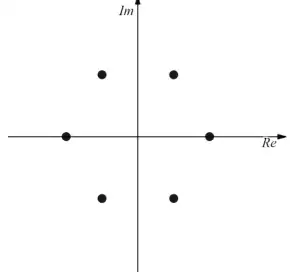 | B1 dB1 | 2.2a 1.1b |
| (2) |
Notes
B1: Plots 6 points that form a hexagon, with a point on the positive real axis and a point on the negative real axis, and one point in each quadrant.
Do not be concerned about the position of each point from the centre, however the sketch must convey a hexagon.
dB1: The points form a hexagon, centre the origin (see diagram), axes need not be labelled. Look for the axes acting as lines of symmetry.
(Drawing line/vectors to each point is acceptable but not necessary for either mark)
Examples
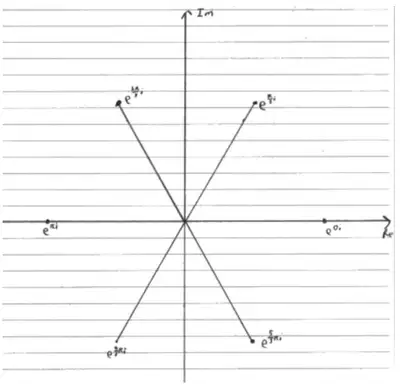
B1dB1
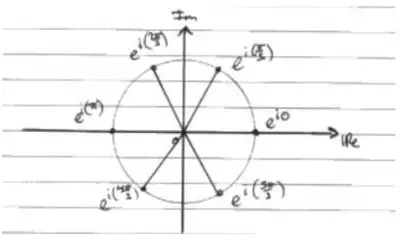
B1dB1
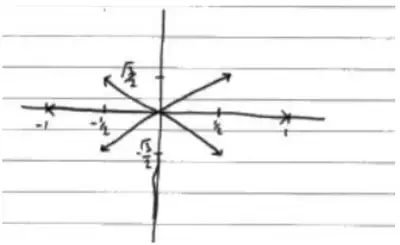
B1dB1
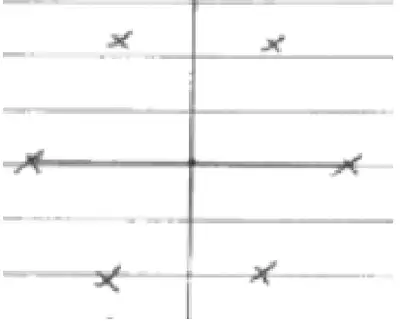
B1dB1
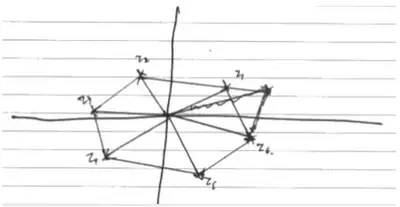
B0dB0
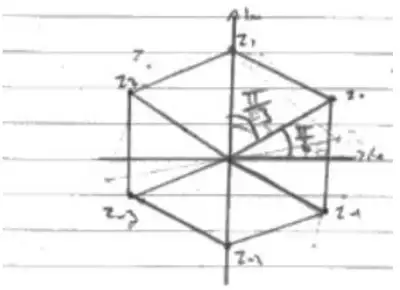
B0dB0
| Scheme | Marks | AO |
|---|---|---|
| e.g. \(\left(\sqrt{3} + \mathrm{i}\right)^6 = \left(2\mathrm{e}^{\frac{\pi}{6}\mathrm{i}}\right)^6 = 64\mathrm{e}^{\mathrm{i}\pi} = -64\,*\) or \(\left[2\left(\cos\dfrac{\pi}{6} + \mathrm{i}\sin\dfrac{\pi}{6}\right)\right]^6 = 2^6(\cos\pi + \mathrm{i}\sin\pi) = 64(-1) = -64\,*\) or \(\left(\sqrt{3} + \mathrm{i}\right)^6 = \left(\sqrt{3}\right)^6 + 6\left(\sqrt{3}\right)^5\mathrm{i} - 15\left(\sqrt{3}\right)^4 - 20\left(\sqrt{3}\right)^3\mathrm{i} + 15\left(\sqrt{3}\right)^2 + 6\sqrt{3}\,\mathrm{i} + \mathrm{i}^6\) \(= 27 - 135 + 45 - 1 = -64\,*\) or \(\left(\sqrt{3} + \mathrm{i}\right)^6 = 27 + 54\sqrt{3}\mathrm{i} + 135\mathrm{i}^2 + 60\sqrt{3}\mathrm{i}^3 + 45\mathrm{i}^4 + 6\sqrt{3}\mathrm{i}^5 + \mathrm{i}^6\) \(= 27 + 54\sqrt{3}\mathrm{i} - 135 - 60\sqrt{3}\mathrm{i} + 45 + 6\sqrt{3}\mathrm{i} - 1 = -64\,*\) | M1 A1* | 1.1b 2.1 |
| (2) |
Notes
M1: Converts \(\sqrt{3} + \mathrm{i}\) to polar form to obtain \(r\mathrm{e}^{\mathrm{i}\theta}\) with at least \(r = 2\) or \(\theta = \dfrac{\pi}{6}\) and applies the power of 6 correctly to obtain \(r^6\mathrm{e}^{6\theta\mathrm{i}}\)
A1*: Obtains the given answer with sufficient working shown.
As a minimum need to see \(2^6\mathrm{e}^{\frac{6\pi i}{6}} = -64\) or \(2^6\mathrm{e}^{\pi\mathrm{i}} = -64\)
If \(r = -2\) is seen in their workings withhold this mark.
OR
M1: Converts \(\sqrt{3} + \mathrm{i}\) to modulus-argument form \(r(\cos\theta + \mathrm{i}\sin\theta)\) with at least \(r = 2\) or \(\theta = \dfrac{\pi}{6}\) and applies the power of 6 correctly to obtain \(r^6(\cos 6\theta + \mathrm{i}\sin 6\theta)\)
A1*: Obtains the given answer with sufficient working shown.
OR
M1: Attempts to expand \(\left(\sqrt{3} + \mathrm{i}\right)^6\) fully using an attempt at the binomial expansion. Must have 7 terms for \((a + b)^n\) and correct binomial coefficients with \(a = \sqrt{3}\), \(b = \mathrm{i}\) and \(n = 6\)
A1*: Obtains the given answer with at least one intermediate line.
OR
M1: Attempts the full expansion of \(\left(\sqrt{3} + \mathrm{i}\right)^6 = \left(\sqrt{3} + \mathrm{i}\right)\left(\sqrt{3} + \mathrm{i}\right)\left(\sqrt{3} + \mathrm{i}\right)\ldots\left(\sqrt{3} + \mathrm{i}\right) =\)
There must be no brackets, no irrational numbers and no terms in i in their simplified answer.
A1*: Obtains the given answer with sufficient working shown including correct full expansion, with at least one intermediate line.
| Scheme | Marks | AO |
|---|---|---|
| \(r = 2\) | B1 | 2.2a |
| \(z = 2\mathrm{e}^{\frac{\pi}{6}\mathrm{i}} \times \mathrm{e}^{\frac{k\pi}{3}\mathrm{i}},\ \ k = 0, 1, 2, 3, 4, 5\) | M1 | 3.1a |
| \(z = 2\mathrm{e}^{\left(\frac{\pi}{6} + \frac{k\pi}{3}\right)\mathrm{i}},\ \ k = 0, 1, 2, 3, 4, 5\) | A1 | 1.1b |
| (3) | ||
| (9 marks) |
Notes
B1: Deduces \(r = 2\) (only)
M1: Obtains at least one value of \(z\) in the form \(r\mathrm{e}^{\mathrm{i}\theta}\) with their consistent value of \(r\), and \(\theta\) taking one of \(\left\{\dfrac{\pi}{6}, \dfrac{\pi}{2}, \dfrac{5\pi}{6}, \dfrac{7\pi}{6}, \dfrac{3\pi}{2}, \dfrac{11\pi}{6}\right\}\)
A1: For \(2\mathrm{e}^{\frac{\pi}{6}\mathrm{i}}, 2\mathrm{e}^{\frac{\pi}{2}\mathrm{i}}, 2\mathrm{e}^{\frac{5\pi}{6}\mathrm{i}}, 2\mathrm{e}^{\frac{7\pi}{6}\mathrm{i}}, 2\mathrm{e}^{\frac{3\pi}{2}\mathrm{i}}, 2\mathrm{e}^{\frac{11\pi}{6}\mathrm{i}}\) with no incorrect or extra values. Accept unsimplified arguments such as having a solution of \(2\mathrm{e}^{\frac{9\pi}{6}\mathrm{i}}\). Ensure i and \(\pi\) are present in each term.
Accept \(2\mathrm{e}^{\frac{\pi}{2}\mathrm{i}}\) as \(2\mathrm{i}\) and \(2\mathrm{e}^{\frac{3\pi}{2}\mathrm{i}}\) as \(-2\mathrm{i}\)