
A2 June 2025 Paper 1 Q9
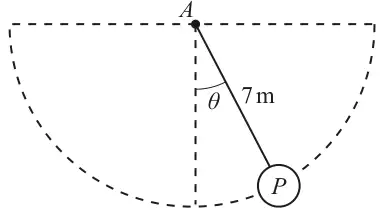
9 A pendulum comprises an object \(P\) of mass \(m\) kg and a string of length 7 m. One end of the string is attached to \(P\) and the other end is attached to a fixed point \(A\).
At time \(t\) seconds, \(t \geqslant 0\), the string forms an angle of \(\theta\) radians, measured anti-clockwise, from the downward vertical through \(A\), as shown in the diagram.
When \(t = 0\), \(\theta = \theta_0 \gt 0\) and \(P\) is released from rest. You may assume that in the subsequent motion \(P\) moves along the arc of a circle, centre \(A\) and radius 7 m, and that \(|\theta| \leqslant \theta_0\) for all \(t \geqslant 0\).
The motion of \(P\) is modelled by the following differential equation.
\(\dfrac{\mathrm{d}^2\theta}{\mathrm{d}t^2} + \dfrac{7}{5}\sin\theta = 0 \; (*)\)
In some situations, it is appropriate to approximate \((*)\) with the following differential equation.
\(\dfrac{\mathrm{d}^2\theta}{\mathrm{d}t^2} + \dfrac{7}{5}\theta = 0 \; ({*}{*})\)
You are now given that \(\theta_0 = \dfrac{1}{15}\pi\).
An additional force now acts on \(P\). It can be shown that it is now appropriate to model the motion of \(P\) with the differential equation \(\dfrac{\mathrm{d}^2\theta}{\mathrm{d}t^2} + \dfrac{k}{m}\dfrac{\mathrm{d}\theta}{\mathrm{d}t} + \dfrac{7}{5}\theta = 0\) where \(k \gt 0\).
| Scheme | Marks | AO |
|---|---|---|
| \(\sin\theta \approx \theta\) is only valid for small angles | B1 | 3.5b |
| [1] |
Notes
B1: States \(\sin\theta \approx \theta\) (or in words), and this is only valid for small angles (oe e.g. ‘close to zero’)
| Scheme | Marks | AO |
|---|---|---|
| \(\theta = A\cos\left(\dfrac{\sqrt{35}}{5}t\right) + B\sin\left(\dfrac{\sqrt{35}}{5}t\right)\) or \(\theta = R\cos\left(\dfrac{\sqrt{35}}{5}t + \varepsilon\right)\) | B1 | 3.4 |
| When \(t = 0, \theta = \dfrac{1}{15}\pi \Rightarrow A = \dfrac{1}{15}\pi\) and \(\dot{\theta} = -\dfrac{\sqrt{35}}{5}A\sin\left(\dfrac{\sqrt{35}}{5}t\right) + \dfrac{\sqrt{35}}{5}B\cos\left(\dfrac{\sqrt{35}}{5}t\right)\) and when \(t = 0, \dot{\theta} = 0 \Rightarrow B = 0\) | M1* | 3.4 |
| \(\theta = \dfrac{1}{15}\pi\cos\left(\dfrac{\sqrt{35}}{5}t\right)\) | A1 | 1.1 |
| \(T = \dfrac{2\pi}{\sqrt{1.4}} = 5.310\ldots\) \(\Rightarrow \theta = \dfrac{1}{15}\pi\cos\left(\sqrt{1.4} \times (6 - 5.310\ldots)\right)\) or for \(\theta = \dfrac{1}{15}\pi\cos\left(\dfrac{\sqrt{35}}{5} \times 6\right)\) | M1* | 3.1b |
| Distance \(= 7\left(\dfrac{4}{15}\pi + \dfrac{1}{15}\pi - \theta\right)\) | M1dep* | 3.4 |
| 6.33 (m) | A1 | 2.1 |
| [6] |
Notes
B1: Correct general solution. Allow exact equivalents e.g. \(\theta = A\cos\left(\sqrt{1.4}t\right) + B\sin\left(\sqrt{1.4}t\right)\), \(\theta = A\cos\left(\sqrt{1.4}t\right)\).
Allow 1.18 or better (1.183215…) for \(\sqrt{1.4}\)
M1*: Use correct initial conditions \(\theta = \frac{1}{15}\pi, \dot{\theta} = 0\) when \(t = 0\) to find constant(s) from a GS of the correct form. Allow \(\theta_0\) for \(\frac{1}{15}\pi\), and allow stating \(B = 0\) without corresponding working. If differentiation seen, then must see \(\sin \to \pm\cos\) and \(\cos \to \pm\sin\) together with a change in coefficients.
A1: cao www – allow \(\theta = \theta_0\cos\left(\frac{\sqrt{35}}{5}t\right)\) provided \(\theta_0 = \frac{1}{15}\pi\) stated explicitly in their working. The correct particular solution (with no incorrect working seen) scores the first three marks. Allow \(\theta = 0.209\cos(1.18t)\) or better.
M1*: Correct method to find \(\theta\) after one complete oscillation or for \(\theta\) when \(t = 6\). Follow through their PS which must be of the form \(\theta = \frac{1}{15}\pi\cos(pt)\) where \(p \gt 0\) and \(p \neq 1\). For reference if correct then \(\theta = 0.1434\ldots\)
M1dep*: For their numerical \(7\left(\frac{4}{15}\pi + \frac{1}{15}\pi - \theta\right)\) or \(7\left(\frac{4}{15}\pi + \theta\right)\) only
A1: awrt 6.33 (6.32603…)
| Scheme | Marks | AO |
|---|---|---|
| \(\left(\dfrac{k}{m}\right)^2 - 4\left(\dfrac{7}{5}\right) \; (\gt 0)\) | M1 | 3.1b |
| \(0 \lt m \lt \dfrac{\sqrt{35}}{14}k\) | A1 | 1.1 |
| [2] |
Notes
M1: For consideration of correct discriminant (allow any inequality or equals)
A1: cao – oe but must be exact