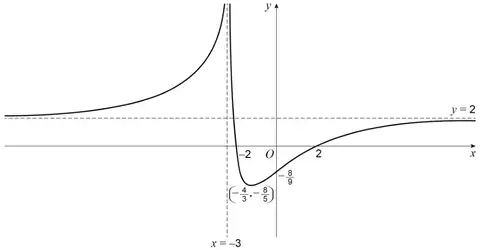
(a) Write down the equations of the asymptotes to the graph of \(y = \mathrm{f}(x)\) [2 marks]
(b) Without using calculus, show that the range of \(\mathrm{f}\) is \(\left\{k : k \geqslant -\dfrac{8}{5}\right\}\) [4 marks]
(c) The graph of \(y = \mathrm{f}(x)\) has one stationary point.
Without using calculus, find the coordinates of this stationary point. [3 marks]
(d) Sketch the graph of \(y = \mathrm{f}(x)\) on the axes below. [4 marks]
Mark scheme (a)
Scheme
Marks
AO
Obtains \(x = -3\) or \(y = 2\)
M1
1.1a
Obtains \(x = -3\) and \(y = 2\) and no other asymptotes.
A1
1.1b
(2)
Typical solution
\[x = -3\]\[y = 2\]
Mark scheme (b)
Scheme
Marks
AO
Forms a quadratic equation in \(x\) involving \(k\) or equivalent.
M1
3.1a
Obtains a quadratic equation with \(k\) in a coefficient and sets the discriminant to zero, either in an equation or inequality.
M1
1.1a
Solves their equation or inequality in \(k\)
M1
1.1a
Completes a reasoned argument, without using calculus, to state that the range is \(\left\{k : k \geqslant -\dfrac{8}{5}\right\}\) AG Allow letters other than \(k\) used.
Draws approximately correct shape of the right-hand branch
B1
1.1b
Draws both branches of the graph approaching the correct asymptotes.
B1
1.1b
Shows at least two correctly labelled axis intercepts.
B1
1.1b
Draws completely correct graph including correctly labelled asymptotes, a stationary point in the third quadrant, and all three correctly labelled axis intercepts. Condone no labelling of stationary point.