
AS June 2019 Q4
4.
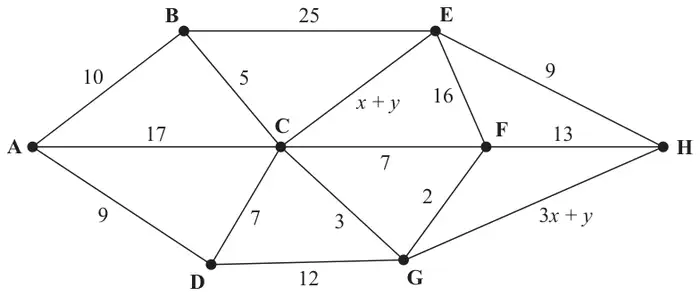
[The total weight of the network is \(135 + 4x + 2y\)]
The weights on the arcs in Figure 1 represent distances. The weights on the arcs CE and GH are given in terms of \(x\) and \(y\), where \(x\) and \(y\) are positive constants and \(7 < x + y < 20\)
There are three paths from A to H that have the same minimum length.
An inspection route starting at A and finishing at H is found. The route traverses each arc at least once and is of minimum length.
| Scheme | Marks | AO |
|---|---|---|
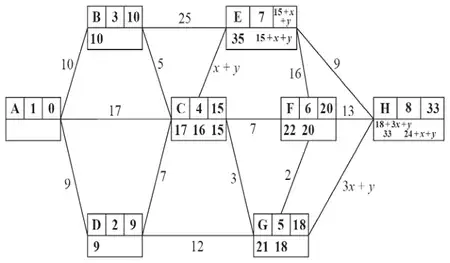 | M1 A1 A1ft A1 | 1.1b 1.1b 1.1b 1.1b |
| Attempt to form a pair of simultaneous equations using their three working values from H e.g. \(3x + y = 15\) or \(x + y = 9\) \(x = 3,\ y = 6\) | M1dep A1 A1 | 3.1a 2.1 2.2a |
| (7) |
Notes
M1: For a larger number replaced by a smaller one in the working value boxes at C, F or G
A1: For all values correct (and in correct order) at A, D, B and C (condone order of labelling starting at A with 0)
A1ft: For all values correct (and in correct order) at G and F following through from A, D, B and C
A1: For all working values correct at E and H (order of working values must be correct at E but condone any order of working values at H) however, at H if only one working value is seen e.g. 18 + 3\(x\) + \(y\) then both 33 and 24 + \(x\) + \(y\) must be seen (or clearly implied) in later working for this mark to be awarded (e.g. 3\(x\) + \(y\) = 15 and \(x\) + \(y\) = 9 would imply this). Similarly, if only two working values seen (e.g. 18 + 3\(x\) + \(y\) and 33) at H then the third (24 + \(x\) + \(y\)) must be implied by later working. Any incorrect working values seen at H though will score A0
M1dep: Forming two equations from the candidate’s three working values at H (so two of their \(18 + 3x + y = 24 + x + y\), \(18 + 3x + y = 33\) and \(24 + x + y = 33\)) – allow all three working values stated anywhere in their solution – dependent on previous M mark. Must be a complete method – so for those finding \(x\) from \(18 + 3x + y = 24 + x + y\) they must also either state or use one of the other two equations (so candidates must be interacting with all three paths from A to H)
A1: Two correct equations formed (dependent on correct working values either seen at H or in their subsequent working) – can be unsimplified but must come from correct working
A1: CAO for \(x\) and \(y\) (\(x = 3\) and \(y = 6\)) – must come from correct working
If all three correct working values at H are seen (either at H or subsequent working) together with both correct answers (with no other working) then award M1A1A1.
| Scheme | Marks | AO |
|---|---|---|
| Arcs BC and CD need to be traversed twice | B1 | 1.1b |
| (1) |
Notes
B1: CAO (arcs BC and CD)
| Scheme | Marks | AO |
|---|---|---|
| Vertex C would appear 4 times | B1 | 2.2a |
| (1) |
Notes
B1: CAO (4 times)
| Scheme | Marks | AO |
|---|---|---|
| 135 + 4(3) + 2(6) + 12 = 171 | B1ft | 1.1b |
| (1) | ||
| (10 marks) |
Notes
B1ft: Follow through only for \(135 + 12 + 4x + 2y\) (for their \(x\) and \(y\) values provided \(7 < x + y < 20\) and \(x\) and \(y\) are positive constants)