
AS June 2022 Paper 1 Q14
14 The function f is defined by
\[\mathrm{f}(x) = \frac{x^2 - 3}{x^2 + px + 7} \qquad x \in \mathbb{R}\]where \(p\) is a constant.
The graph of \(y = \mathrm{f}(x)\) has only one asymptote.
(a) Write down the equation of the asymptote. [1 mark]
(b) Find the set of possible values of \(p\) [4 marks]
(c) Find the coordinates of the points at which the graph of \(y = \mathrm{f}(x)\) intersects the axes. [3 marks]
(d) A curve \(C\) has equation\[y = \frac{x^2 - 3}{x^2 - 3x + 7}\]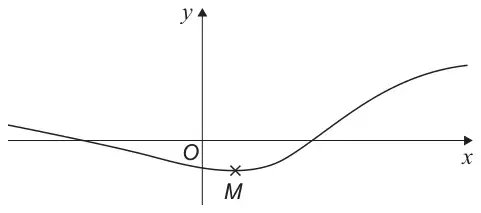
The curve \(C\) has a local minimum at the point \(M\) as shown in the diagram.
The line \(y = k\) intersects curve \(C\)
(i) Show that\[19k^2 - 16k - 12 \leqslant 0\] [5 marks]
(ii) Hence, find the \(y\)-coordinate of point \(M\) [2 marks]
| Scheme | Marks | AO |
|---|---|---|
| Writes the correct equation. | B1 | 1.1b |
| (1) |
Typical solution
\[y = 1\]| Scheme | Marks | AO |
|---|---|---|
| Indicates that the denominator cannot be equal to zero. PI by use of the discriminant of the denominator. | M1 | 3.1a |
| Obtains a relevant inequality for \(p\) eg use of the discriminant of the denominator. | M1 | 1.1a |
| Obtains a correct inequality for \(p\) | A1 | 1.1b |
| Obtains the correct set of values for \(p\) Accept \(-\sqrt{28} \lt p \lt \sqrt{28}\) Condone \(-5.29 \lt p \lt 5.29\) or better. | A1 | 3.2a |
| (4) |
Typical solution
\[x^2 + px + 7 \neq 0\]\[\therefore \ p^2 - 4 \times 1 \times 7 \lt 0\]\[p^2 \lt 28\]\[-2\sqrt{7} \lt p \lt 2\sqrt{7}\]| Scheme | Marks | AO |
|---|---|---|
| Obtains the correct \(y\)-intercept. | B1 | 1.1b |
| Solves \(x^2 - 3 = 0\) | M1 | 1.1a |
| Obtains the correct coordinates for all three intercepts. Must be written as coordinates. | A1 | 1.1b |
| (3) |
Typical solution
\[x = 0 \ \Rightarrow \ y = \frac{0 - 3}{0 + 0 + 7} = -\frac{3}{7}\]\[y = 0 \ \Rightarrow \ x^2 - 3 = 0\]\[\Rightarrow x = \pm\sqrt{3}\]\[\left(0, -\frac{3}{7}\right), \left(\sqrt{3}, 0\right), \left(-\sqrt{3}, 0\right)\]| Scheme | Marks | AO |
|---|---|---|
| (i) Multiplies by the denominator and forms a quadratic equation in \(x\) | M1 | 1.1a |
| Obtains a correct quadratic equation in \(x\) in the form \(ax^2 + bx + c = 0\) PI by a correct discriminant. | A1 | 1.1b |
| Selects a method to demonstrate the required inequality. Substitutes \(k\) for \(y\) and uses the discriminant to form an inequality in \(k\) | M1 | 3.1a |
| Obtains a correct quadratic inequality in \(k\) | A1 | 1.1b |
| Completes a rigorous proof to show that \(19k^2 - 16k - 12 \leqslant 0\) | R1 | 2.1 |
| (5) | ||
| (ii) Selects a method to find the \(y\)-coordinate of the minimum point. Obtains at least one correct root of the given quadratic. PI by \(-0.48\) or \(1.32\) or better | M1 | 3.1a |
| Obtains the correct \(y\)-coordinate. | A1 | 1.1b |
| (2) | ||
| (15 marks) |
Typical solution
(i)
\[k = \frac{x^2 - 3}{x^2 - 3x + 7}\]\[k(x^2 - 3x + 7) = x^2 - 3\]\[(k - 1)x^2 - 3kx + 7k + 3 = 0\]At least one solution, so \(b^2 - 4ac \geqslant 0\)
\[(-3k)^2 - 4(k - 1)(7k + 3) \geqslant 0\]\[9k^2 - 4(7k^2 - 4k - 3) \geqslant 0\]\[-19k^2 + 16k + 12 \geqslant 0\]\[19k^2 - 16k - 12 \leqslant 0\](ii)
\[k = \frac{8 \pm 2\sqrt{73}}{19}\]\[y = \frac{8 - 2\sqrt{73}}{19}\]