
A2 June 2025 Paper 1 Q10
10.
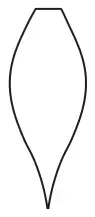
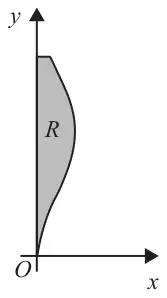
Figure 1 shows the central vertical cross-section of a solid wooden ornament.
Figure 2 shows the curve with equation
\[x = \sin^2\left(\frac{1}{2}y\right) \qquad\qquad 0 \leqslant y \leqslant \frac{8\pi}{5}\]The region \(R\), shown shaded in Figure 2, is bounded by the curve, the line with equation \(y = \dfrac{8\pi}{5}\) and the \(y\)-axis.
The ornament is modelled by the solid of revolution formed when \(R\) is rotated \(360^\circ\) about the \(y\)-axis. The units are centimetres.
[Solutions based entirely on calculator technology are not acceptable.] (5)
Given that
- the density of the wood is 0.85 g/cm\(^3\)
- the mass of the ornament is 6 grams
| Scheme | Marks | AO |
|---|---|---|
| \(\left(z - \dfrac{1}{z}\right)^4 = (2\mathrm{i}\sin\theta)^4 = 16\sin^4\theta\) | B1 | 1.1b |
| \(\left(z - \dfrac{1}{z}\right)^4 = z^4 + 4\left(z^3\right)\left(-\dfrac{1}{z}\right) + 6\left(z^2\right)\left(-\dfrac{1}{z}\right)^2 + 4(z)\left(-\dfrac{1}{z}\right)^3 + \left(-\dfrac{1}{z}\right)^4\) | M1 | 2.1 |
| \(= \left[z^4 + \dfrac{1}{z^4}\right] - 4\left[z^2 + \dfrac{1}{z^2}\right] + 6\) | A1 | 1.1b |
| Uses \(z^n + \dfrac{1}{z^n} = 2\cos n\theta\) \(\left\{16\sin^4\theta\right\} \equiv 2\cos 4\theta - 8\cos 2\theta + 6\) | M1 | 2.1 |
| \(8\sin^4\theta \equiv \cos 4\theta - 4\cos 2\theta + 3\) * cso | A1 * | 1.1b |
| (5) |
Notes
B1: See scheme. This can appear anywhere in the proof.
Accept \(2^4\sin^4\theta\) for \(16\sin^4\theta\), but not \((2\sin\theta)^4\)
Alternatively, they may instead substitute \(\sin\theta = \dfrac{1}{2\mathrm{i}}\left(z - \dfrac{1}{z}\right)\) into the expression \(8\sin^4\theta\). This can be implied but must come from correct work. This can appear anywhere in their proof.
e.g. \(8\sin^4\theta = 8\left[\dfrac{1}{2\mathrm{i}}\left(z - \dfrac{1}{z}\right)\right]^4\) or \(8\sin^4\theta = 8\left[\left(z - \dfrac{1}{z}\right)\right]^4\dfrac{1}{2^4}\)
and allow \(8\sin^4\theta = \dfrac{1}{2}\left[\left(z - \dfrac{1}{z}\right)\right]^4\)
M1: Finds the expansion of \(\left(z - \dfrac{1}{z}\right)^4\) which may be unsimplified. All five terms must be present.
Condone sign slips only
A1: Correct expansion, with terms grouped.
M1: Uses \(z^n + \dfrac{1}{z^n} = 2\cos n\theta\) to write in terms of \(\cos 4\theta\) and \(\cos 2\theta\)
A1*: Achieves the printed answer with no errors or omissions. Cso Follows A0.
| Scheme | Marks | AO |
|---|---|---|
| \(\text{vol} = \pi\displaystyle\int \left(\sin^2\left(\dfrac{1}{2}y\right)\right)^2\,\mathrm{d}y\) | B1 | 3.4 |
| \(\text{vol} = \{\pi\}\displaystyle\int \sin^4\left(\dfrac{1}{2}y\right)\ (\mathrm{d}y)\) \(= \{\pi\}\displaystyle\int \dfrac{1}{8}\big(\cos(2y) - 4\cos(y) + 3\big)\ (\mathrm{d}y) = \ldots\) | M1 | 1.1b |
| \(= \{\pi\}\left[\dfrac{1}{8}\left(\dfrac{1}{2}\sin(2y) - 4\sin(y) + 3y\right)\right]\) | A1 | 1.1b |
| \(= \pi\left[\dfrac{1}{8}\left(\dfrac{1}{2}\sin\left(2 \times \dfrac{8\pi}{5}\right) - 4\sin\left(\dfrac{8\pi}{5}\right) + \left(3 \times \dfrac{8\pi}{5}\right)\right) - 0\right]\) \(= \ldots\) | dM1 | 3.4 |
| awrt 7.3 (cm\(^3\)) | A1 | 1.1b |
| (5) |
Notes
B1: Correct formula \(\pi\displaystyle\int \left(\sin^2\left(\dfrac{1}{2}y\right)\right)^2\,\mathrm{d}y\) (but not \(\text{vol} = \pi\displaystyle\int x^2\,\mathrm{d}y\)) used to find a volume, stated or implied, ignore limits. If there is a missing \(\pi\) or d\(y\) in their integral, then withhold this mark only. However, this mark may be awarded if \(\pi\) and d\(y\) are seen together later in their integral.
Do not award the following marks if algebraic integration is not used. For example finding an answer of 7.3 without algebraic integration will obtain M0A0dM0A0
M1: Uses the result in part (a) to express the volume in an integrable form and attempts to integrate.
Award for an integral of the form \(\displaystyle\int \dfrac{1}{8}\big(A\cos(2y) + B\cos(y) + C\big)\ (\mathrm{d}y)\) with at least one term integrated correctly. Do not be concerned if they use a different variable such as \(\theta\) for \(y\).
Special Case:
If they have not used part (a) and instead use the double angle formulae:
\(\sin^2\alpha = \dfrac{1}{2} - \dfrac{1}{2}\cos 2\alpha\) and \(\sin^4\alpha = \left(\dfrac{1}{2} - \dfrac{1}{2}\cos 2\alpha\right)^2\) with \(\alpha = \dfrac{1}{2}y\)
In this case they must obtain an exact integral equivalent to \(\displaystyle\int \dfrac{1}{8}\big(\cos(2y) - 4\cos(y) + 3\big)\ (\mathrm{d}y)\) and proceed to integrate at least one term correctly.
A1: Correct integration. May be in terms of another variable such as \(\theta\). Ignore \(\pi\)
dM1: Dependent on previous method mark. Finds the required volume using \(\pi\displaystyle\int_0^{\frac{8\pi}{5}} x^2\,\mathrm{d}y\) and applies their limits to their integral and subtracts the correct way round.
If there are no limits seen substituted, then a correct final answer implies the correct use of limits and the inclusion of \(\pi\). This is provided they have already achieved an integrated expression of \(\dfrac{1}{8}\left(\dfrac{1}{2}\sin(2y) - 4\sin(y) + 3y\right)\) oe with correct limits seen, possibly on their integral.
If their integration is incorrect, then there must be evidence of substituting both limits in each of their terms and subtracting. Allow the omission of subtracting zero provided their integration would produce zero for the lower limit.
A1: awrt 7.3
| Scheme | Marks | AO |
|---|---|---|
| Mass \(= \text{``}7.3\text{''} \times 0.85\) \(= \ldots\) | M1 | 2.2b |
| Mass \(= 6.2\) (grams) therefore a good model | A1ft | 3.5a |
| (2) | ||
| (12 marks) |
Notes
M1: Finds the mass of the ornament by multiplying their volume by 0.85
A1ft: Draws an appropriate conclusion about the suitability of the model, comparing their two masses.
If the masses differ by 10% then they must conclude it is a good model.
If the masses differ between 10% and 20% then they may conclude it is either a good model or poor model.
If the masses differ by greater than 20% then they must conclude it is a poor model.
Alternative 1
| Scheme | Marks | AO |
|---|---|---|
| Volume \(= 6 \div 0.85 = \ldots\) | M1 | 2.2b |
| Volume \(= 7.1\) (cm\(^3\)) therefore a good model | A1ft | 3.5a |
| (2) |
M1: Finds the volume of the ornament by dividing the mass of 6 grams by 0.85 g/cm\(^3\)
A1ft: Draws an appropriate conclusion about the suitability of the model, comparing their two volumes.
If the volumes differ by 10% then they must conclude it is a good model.
If the volumes differ between 10% and 20% then they may conclude it is either a good model or poor model.
If the volumes differ by greater than 20% then they must conclude it is a poor model.
Alternative 2
| Scheme | Marks | AO |
|---|---|---|
| Density \(= 6 \div \text{``}7.3\text{''}\) | M1 | 2.2b |
| Density \(= 0.82\) (g/cm\(^3\)) therefore a good model | A1ft | 3.5a |
| (2) |
M1: Finds the density of the ornament by dividing the mass of 6 grams by 7.3 cm\(^3\) (corrected from the printed mark scheme: printed as 7.3 g/cm\(^3\))
A1ft: Draws an appropriate conclusion about the suitability of the model, comparing their two densities.
If the densities differ by 10% then they must conclude it is a good model.
If the densities differ between 10% and 20% then they may conclude it is either a good model or poor model.
If the densities differ by greater than 20% then they must conclude it is a poor model.