
June 2019 Paper 1 Q13
13. The curve \(C\) with equation
\[y = \frac{p - 3x}{(2x - q)(x + 3)} \qquad x \in \mathbb{R}, x \neq -3, x \neq 2\]where \(p\) and \(q\) are constants, passes through the point \(\left(3,\ \dfrac{1}{2}\right)\) and has two vertical asymptotes with equations \(x = 2\) and \(x = -3\)
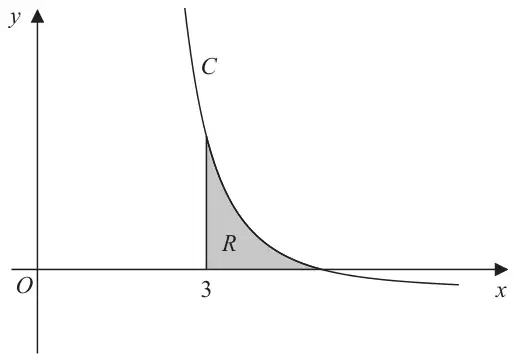
Figure 4 shows a sketch of part of the curve \(C\). The region \(R\), shown shaded in Figure 4, is bounded by the curve \(C\), the \(x\)-axis and the line with equation \(x = 3\)
| Scheme | Marks | AO |
|---|---|---|
| (i) Explains \(2x - q = 0\) when \(x = 2\) oe Hence \(q = 4\ *\) | B1* | 2.4 |
| (ii) Substitutes \(\left(3,\ \dfrac{1}{2}\right)\) into \(y = \dfrac{p - 3x}{(2x-4)(x+3)}\) and solves | M1 | 1.1b |
| \(\dfrac{1}{2} = \dfrac{p - 9}{(2) \times (6)} \Rightarrow p - 9 = 6 \Rightarrow p = 15\,*\) | A1* | 2.1 |
| (3) |
Notes
B1*: Is able to link \(2x - q = 0\) and \(x = 2\) to explain why \(q = 4\)
Eg "The asymptote \(x = 2\) is where \(2x - q = 0\) so \(4 - q = 0 \Rightarrow q = 4\) "
"The curve is not defined when \(2 \times 2 - q = 0 \Rightarrow q = 4\)"
There must be some words explaining why \(q = 4\) and in most cases, you should see a reference to either "the asymptote \(x = 2\)", "the curve is not defined at \(x = 2\)" , ’the denominator is 0 at \(x = 2\)"
M1: Substitutes \(\left(3,\ \dfrac{1}{2}\right)\) into \(y = \dfrac{p - 3x}{(2x-4)(x+3)}\) and solves
Alternatively substitutes \(\left(3,\ \dfrac{1}{2}\right)\) into \(y = \dfrac{15 - 3x}{(2x-4)(x+3)}\) and shows \(\dfrac{1}{2} = \dfrac{6}{(2) \times (6)}\) oe
A1*: Full proof showing all necessary steps \(\dfrac{1}{2} = \dfrac{p - 9}{(2) \times (6)} \Rightarrow p - 9 = 6 \Rightarrow p = 15\)
In the alternative there would have to be some recognition that these are equal eg ✓ hence \(p = 15\)
| Scheme | Marks | AO |
|---|---|---|
| Attempts to write \(\dfrac{15 - 3x}{(2x-4)(x+3)}\) in PF’s and integrates using lns between 3 and another value of \(x\). | M1 | 3.1a |
| \(\dfrac{15 - 3x}{(2x-4)(x+3)} = \dfrac{A}{(2x-4)} + \dfrac{B}{(x+3)}\) leading to \(A\) and \(B\) | M1 | 1.1b |
| \(\dfrac{15 - 3x}{(2x-4)(x+3)} = \dfrac{1.8}{(2x-4)} - \dfrac{2.4}{(x+3)}\) or \(\dfrac{0.9}{(x-2)} - \dfrac{2.4}{(x+3)}\) oe | A1 | 1.1b |
| \(\text{I} = \displaystyle\int \dfrac{15 - 3x}{(2x-4)(x+3)}\,\mathrm{d}x = m\ln(2x-4) + n\ln(x+3) + (c)\) | M1 | 1.1b |
| \(\text{I} = \displaystyle\int \dfrac{15 - 3x}{(2x-4)(x+3)}\,\mathrm{d}x = 0.9\ln(2x-4) - 2.4\ln(x+3)\) oe | A1ft | 1.1b |
| Deduces that Area Either \(\displaystyle\int_3^5 \dfrac{15 - 3x}{(2x-4)(x+3)}\,\mathrm{d}x\) Or \(\left[\ldots\ldots\ldots\right]_3^5\) | B1 | 2.2a |
| Uses correct ln work seen at least once for \(\ln 6 = \ln 2 + \ln 3\) or \(\ln 8 = 3\ln 2\) \([0.9\ln(6) - 2.4\ln(8)] - [0.9\ln(2) - 2.4\ln(6)]\) \(= 3.3\ln 6 - 7.2\ln 2 - 0.9\ln 2\) | dM1 | 2.1 |
| \(= 3.3\ln 3 - 4.8\ln 2\) | A1 | 1.1b |
| (8) | ||
| (11 marks) |
Notes
M1: Scored for an overall attempt at using PF’s and integrating with lns seen with sight of limits 3 and another value of \(x\).
M1: \(\dfrac{15 - 3x}{(2x-4)(x+3)} = \dfrac{A}{(2x-4)} + \dfrac{B}{(x+3)}\) leading to \(A\) and \(B\)
A1: \(\dfrac{15 - 3x}{(2x-4)(x+3)} = \dfrac{1.8}{(2x-4)} - \dfrac{2.4}{(x+3)}\), or for example \(\dfrac{0.9}{(x-2)} - \dfrac{2.4}{(x+3)}\), \(\dfrac{9}{(10x-20)} - \dfrac{12}{(5x+15)}\) oe
Must be written in PF form, not just for correct \(A\) and \(B\)
M1: Area \(R = \displaystyle\int \dfrac{15 - 3x}{(2x-4)(x+3)}\,\mathrm{d}x = m\ln(2x-4) + n\ln(x+3)\)
OR \(\displaystyle\int \dfrac{15 - 3x}{(2x-4)(x+3)}\,\mathrm{d}x = m\ln(x-2) + n\ln(x+3)\)
Note that \(\displaystyle\int \dfrac{l}{(x-2)}\,\mathrm{d}x \to l\ln(kx - 2k)\) and \(\displaystyle\int \dfrac{m}{(x+3)}\,\mathrm{d}x \to m\ln(nx + 3n)\)
A1ft: \(= \displaystyle\int \dfrac{15 - 3x}{(2x-4)(x+3)}\,\mathrm{d}x = 0.9\ln(2x-4) - 2.4\ln(x+3)\) oe. FT on their \(A\) and \(B\)
B1: Deduces that the limits for the integral are 3 and 5. It cannot just be awarded from 5 being marked on Figure 4. So award for sight of \(\displaystyle\int_3^5 \dfrac{15 - 3x}{(2x-4)(x+3)}\,(\mathrm{d}x)\) or \(\left[\ldots\ldots\ldots\right]_3^5\) having performed an integral which may be incorrect
dM1: Uses correct ln work seen at least once eg \(\ln 6 = \ln 2 + \ln 3\), \(\ln 8 = 3\ln 2\) or \(m\ln 6k - m\ln 2k = m\ln 3\)
This is an attempt to get either of the above ln’s in terms of ln2 and/or ln3
It is dependent upon the correct limits and having achieved \(m\ln(2x-4) + n\ln(x+3)\) oe
A1: \(= 3.3\ln 3 - 4.8\ln 2\) oe