
June 2019 Paper 3 Q6
6 The three sides of a right-angled triangle have lengths \(a\), \(b\) and \(c\), where \(a, b, c \in \mathbb{Z}\)
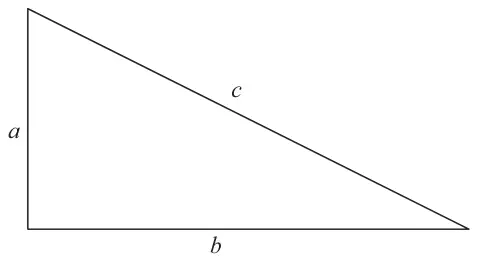
(a) State an example where \(a\), \(b\) and \(c\) are all even. [1 mark]
(b) Prove that it is not possible for all of \(a\), \(b\) and \(c\) to be odd. [3 marks]
| Scheme | Marks | AO |
|---|---|---|
| States an appropriate even Pythagorean triple | B1 | 2.2a |
Typical solution
\[a = 6,\ b = 8,\ c = 10\]| Scheme | Marks | AO |
|---|---|---|
| Begins an appropriate method of proof assuming at least two sides are odd eg states ‘assume \(a\), \(b\) odd’ or defines \(a\), \(b\) (or \(c\)) algebraically with different unknowns | B1 | 3.1a |
| Uses Pythagoras’ theorem with at least two odd sides either in words or algebraically | M1 | 1.1a |
| Completes rigorous argument to prove the required result CSO | R1 | 2.1 |
| (4 marks) |
Typical solution
Assume \(a\) and \(b\) are odd so \(a = 2m + 1\) and \(b = 2n + 1\)
\[(2m + 1)^2 + (2n + 1)^2 = 4m^2 + 4m + 1 + 4n^2 + 4n + 1\]\[= 2\left(2m^2 + 2m + 2n^2 + 2n + 1\right)\]which is even, so \(c^2\) is even, so \(c\) is even.
Therefore it is not possible for all three to be odd.