
October 2020 Paper 1 Q5
5
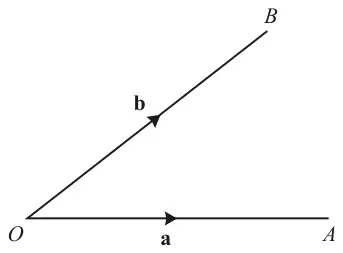
The diagram shows points \(A\) and \(B\), which have position vectors \(\mathbf{a}\) and \(\mathbf{b}\) with respect to an origin \(O\). \(P\) is the point on \(OB\) such that \(OP : PB = 3:1\) and \(Q\) is the midpoint of \(AB\).
The line \(OA\) is extended to a point \(R\), so that \(PQR\) is a straight line.
| Scheme | Marks | AO |
|---|---|---|
| \(\overrightarrow{BQ} = \tfrac{1}{2}(\mathbf{a} - \mathbf{b})\) | B1 | 1.1a |
| \(\overrightarrow{PQ} = \tfrac{1}{4}\mathbf{b} + \tfrac{1}{2}(\mathbf{a} - \mathbf{b}) = \tfrac{1}{2}\mathbf{a} - \tfrac{1}{4}\mathbf{b}\) | B1 | 1.1 |
| [2] |
Notes
B1: Correct \(\overrightarrow{BQ}\) or \(\overrightarrow{QB}\)
Or any correct vector involving \(Q\), but must be clear which vector it is
B1: Correct \(\overrightarrow{PQ}\)
Must be simplified to two terms
SC Allow B1 if correct unsimplified \(PQ\) is seen but individual vectors not explicit
| Scheme | Marks | AO |
|---|---|---|
| \(\overrightarrow{PR}\) has the same direction as \(\overrightarrow{PQ}\), so vector must be a multiple of \(\overrightarrow{PQ}\) | B1 | 2.4 |
| So \(\overrightarrow{PR} = \lambda\left(\tfrac{1}{2}\mathbf{a} - \tfrac{1}{4}\mathbf{b}\right) = \tfrac{1}{4}\lambda\,(2\mathbf{a} - \mathbf{b})\) \(= k\,(2\mathbf{a} - \mathbf{b})\) A.G. | B1 | 2.1 |
| [2] |
Notes
B1: Explain parallel (or collinear) vectors have direction vectors that are multiples of each other
Allow ‘gradient’ for ‘direction’, or ‘they are on the same straight line’, but must state or use ‘multiple’
B1: Show given answer convincingly
Clear detail of scaling factor
| Scheme | Marks | AO |
|---|---|---|
| \(\overrightarrow{AR} = -\mathbf{a} + \tfrac{3}{4}\mathbf{b} + k\,(2\mathbf{a} - \mathbf{b})\) | B1 | 1.1 |
| \(\overrightarrow{AR}\) multiple of \(\mathbf{a}\) only, \(\tfrac{3}{4}\mathbf{b} - k\,\mathbf{b} = 0\) | M1 | 3.1a |
| Obtain \(k = \tfrac{3}{4}\) | A1 | 1.1 |
| ratio \(OA : AR = 2:1\) | A1 | 1.1 |
| [4] |
Notes
B1: Correct expression for \(\overrightarrow{AR}\) (or \(\overrightarrow{OR}\)), in terms of \(k\)
Could use \(A\) to \(Q\) to \(R\) (condone if \(k\) still used)
M1: Use coefficient of \(\mathbf{b} = 0\)
Must be used in \(\overrightarrow{AR}\) or \(\overrightarrow{OR}\)
A1: Obtain correct value for \(k\)
May get different value for their \(k\)
A1: Correct ratio (allow \(1 : \tfrac{1}{2}\)) oe
Answer only is 0, as question says ‘determine’