
October 2021 Paper 2 Q9
9 Points \(A\), \(B\) and \(C\) have position vectors \(\mathbf{a}\), \(\mathbf{b}\) and \(\mathbf{c}\) relative to an origin \(O\) in 3-dimensional space. Rectangles \(OADC\) and \(BEFG\) are the base and top surface of a cuboid.
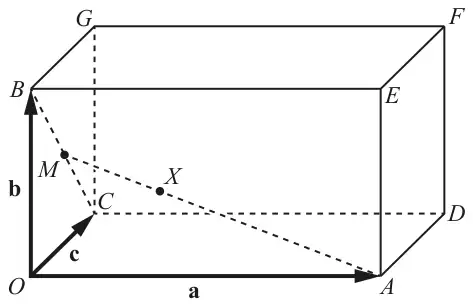
- The point \(M\) is the midpoint of \(BC\).
- The point \(X\) lies on \(AM\) such that \(AX = 2XM\).
| Scheme | Marks |
|---|---|
| Summary method: \(\overrightarrow{OM} = \frac{1}{2}(\mathbf{b} + \mathbf{c})\) or \(\mathbf{b} + \frac{1}{2}(-\mathbf{b} + \mathbf{c})\) oe | B1 |
| \(\overrightarrow{AM}\) or \(\overrightarrow{MA}\) attempted in terms of \(\mathbf{a}\), \(\mathbf{b}\) and \(\mathbf{c}\) \(\left(= \pm\left(\frac{1}{2}(\mathbf{b} + \mathbf{c}) - \mathbf{a}\right)\ \text{oe}\right)\) | M1 |
| \(\overrightarrow{OX} = \mathbf{a} + \frac{2}{3}\overrightarrow{AM}\) or \(\overrightarrow{OM} + \frac{1}{3}\overrightarrow{MA}\) oe attempted in terms of \(\mathbf{a}\), \(\mathbf{b}\) and \(\mathbf{c}\) | M1 |
| \(\overrightarrow{OX} = \frac{1}{3}(\mathbf{a} + \mathbf{b} + \mathbf{c})\) | A1 |
| [4] |
Notes
B1: Can be implied
M1: May be included in working, eg \(\overrightarrow{AX} = \frac{2}{3}\left(\frac{1}{2}(\mathbf{b} + \mathbf{c}) - \mathbf{a}\right)\)
Not necessarily correct
M1: Not necessarily correct
A1: or equivalent simplified form
Examples of methods using the above Other correct methods may be seen Allow inadequate notation
| Scheme | Marks |
|---|---|
| \(\overrightarrow{OM} = \frac{1}{2}(\mathbf{b} + \mathbf{c})\) | B1 |
| \(\overrightarrow{AX} = \frac{2}{3}\overrightarrow{AM} = \frac{2}{3}\left(\frac{1}{2}(\mathbf{b} + \mathbf{c}) - \mathbf{a}\right)\) | M1 |
| \(\overrightarrow{OX} = \mathbf{a} + \frac{2}{3}\overrightarrow{AM} = \mathbf{a} + \frac{2}{3}\left(\frac{1}{2}(\mathbf{b} + \mathbf{c}) - \mathbf{a}\right)\) | M1 |
| \(= \frac{1}{3}(\mathbf{a} + \mathbf{b} + \mathbf{c})\) | A1 |
M1: for \(\overrightarrow{AM} = \left(\frac{1}{2}(\mathbf{b} + \mathbf{c}) - \mathbf{a}\right)\) implied
| Scheme | Marks |
|---|---|
| \(\overrightarrow{BM} = \frac{1}{2}(-\mathbf{b} + \mathbf{c})\) \(\overrightarrow{AM} = \overrightarrow{AO} + \overrightarrow{OB} + \overrightarrow{BM}\) \(= -\mathbf{a} + \frac{1}{2}\mathbf{b} + \frac{1}{2}\mathbf{c}\) | B1 M1 |
| \(\overrightarrow{OX} = \mathbf{a} + \frac{2}{3}\left(-\mathbf{a} + \frac{1}{2}\mathbf{b} + \frac{1}{2}\mathbf{c}\right)\) | M1 |
| \(= \frac{1}{3}(\mathbf{a} + \mathbf{b} + \mathbf{c})\) | A1 |
B1: Implied
| Scheme | Marks |
|---|---|
| \(\overrightarrow{OM} = \frac{1}{2}(\mathbf{b} + \mathbf{c})\) | B1 |
| \(\overrightarrow{XM} = \frac{1}{3}\overrightarrow{AM}\) \(= \frac{1}{3}\left(\frac{1}{2}(\mathbf{b} + \mathbf{c}) - \mathbf{a}\right)\) | M1 |
| \(\overrightarrow{OX} = \overrightarrow{OM} - \frac{1}{3}\overrightarrow{AM}\) \(= \frac{1}{2}(\mathbf{b} + \mathbf{c}) - \frac{1}{3}\left(\frac{1}{2}(\mathbf{b} + \mathbf{c}) - \mathbf{a}\right)\) | M1 |
| \(= \frac{1}{3}(\mathbf{a} + \mathbf{b} + \mathbf{c})\) | A1 |
M1: for \(\overrightarrow{AM} = \left(\frac{1}{2}(\mathbf{b} + \mathbf{c}) - \mathbf{a}\right)\) implied
\(\overrightarrow{OX} = \overrightarrow{OM} - \frac{1}{3}\overrightarrow{AM}\) is equivalent to \(\overrightarrow{OM} + \frac{1}{3}\overrightarrow{MA}\)
| Scheme | Marks |
|---|---|
| \(\overrightarrow{OF} = \mathbf{a} + \mathbf{b} + \mathbf{c}\) | B1* |
| Hence \(X\) lies on \(OF\), so \(AM\) and \(OF\) intersect | B1dep |
| [2] |
Notes
B1dep: Both statements needed. NB dep on B1