
October 2020 Paper 3 Q4
4 Fig. 4 shows the regular octagon ABCDEFGH.
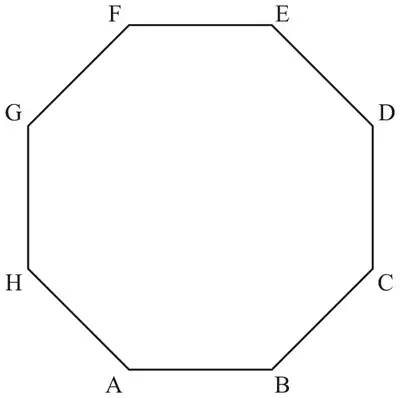
\(\overrightarrow{\mathrm{AB}} = \mathbf{i}\), \(\overrightarrow{\mathrm{CD}} = \mathbf{j}\), where \(\mathbf{i}\) is a unit vector parallel to the \(x\)-axis and \(\mathbf{j}\) is a unit vector parallel to the \(y\)-axis.
Find an exact expression for \(\overrightarrow{\mathrm{BC}}\) in terms of \(\mathbf{i}\) and \(\mathbf{j}\). [3]
| Scheme | Marks | AO |
|---|---|---|
| BC is parallel to \(\mathbf{i} + \mathbf{j}\) OR 1 unit at 45° | M1 | 3.1a |
| \(|\mathbf{i} + \mathbf{j}| = \sqrt{2}\) | M1 | 1.1 |
| \(\overrightarrow{\mathrm{BC}} = \dfrac{1}{\sqrt{2}}(\mathbf{i} + \mathbf{j})\) oe | A1 | 2.2a |
| [3] |
Notes
M1: Eg \(k\mathbf{i} + k\mathbf{j}\)
M1: Could be on diagram
A1: Must be exact eg \(\cos 45\,\mathbf{i} + \sin 45\,\mathbf{j}\)