
October 2020 Paper 1 Q12
12 A function is defined by \(\mathrm{f}(x) = x^3 - x\).
| Scheme | Marks | AO |
|---|---|---|
| \(\dfrac{\mathrm{f}(x+h) - \mathrm{f}(x)}{h} = \dfrac{(x+h)^3 - (x+h) - \left(x^3 - x\right)}{h}\) | M1 | 2.1 |
| \(= \dfrac{x^3 + 3hx^2 + 3h^2x + h^3 - x - h - \left(x^3 - x\right)}{h}\) | A1 | 2.1 |
| \(= \dfrac{3x^2h + 3xh^2 + h^3 - h}{h} = 3x^2 + 3xh + h^2 - 1\) | M1 | 2.1 |
| \(\mathrm{f}^{\prime}(x) = \lim\limits_{h \to 0} \dfrac{\mathrm{f}(x+h) - \mathrm{f}(x)}{h}\) \(= \lim\limits_{h \to 0}\left(3x^2 - 1 + 3xh + h^2\right) = 3x^2 - 1\) | E1 | 2.1 |
| [4] |
Notes
M1: Substituting into \(\dfrac{\mathrm{f}(x+h) - \mathrm{f}(x)}{h}\) and attempt to expand \((x+h)^3\)
A1: Correct expansion of \((x+h)^3\)
Allow correct 6 terms not simplified
M1: Simplifying the fraction to eliminate a denominator
E1: Must include the idea of limit as \(h\) tends to zero AG
| Scheme | Marks | AO |
|---|---|---|
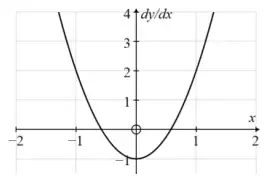 | B1 B1 (dep) | 1.1a 1.1 |
| [2] |
Notes
B1: Correct shape with vertex on the negative \(y\)-axis
B1: (0, -1) labelled and an indication the graph crosses the \(x\)-axis at \(\left(\pm\dfrac{1}{\sqrt{3}}, 0\right)\)
Allow without \(\pm\dfrac{1}{\sqrt{3}}\) if clear that the points are between \((-1, 0)\) and \((1, 0)\)
| Scheme | Marks | AO |
|---|---|---|
| Point of inflection when \(\mathrm{f}^{\prime\prime}(x) = 0\) | M1 | 2.1 |
| \(\mathrm{f}^{\prime\prime}(x) = 6x = 0\) has only one root \(x = 0\) | A1 | 2.1 |
| When \(x = 0,\quad \mathrm{f}^{\prime}(x) = -1 \ne 0\) so the point of inflection is not a stationary point. | E1 | 2.1 |
| [3] |
Notes
M1: Equating their second derivative to zero
A1: Must explain that this is the only point of inflection
E1: Must prove that the point is not stationary from correct value for \(\mathrm{f}^{\prime}(0)\)
Also allow if shown that the stationary points are at \(\left(\pm\dfrac{1}{\sqrt{3}}, 0\right)\)